DbcultAccessing Vault...
Cult Review
Senior Film Conservator
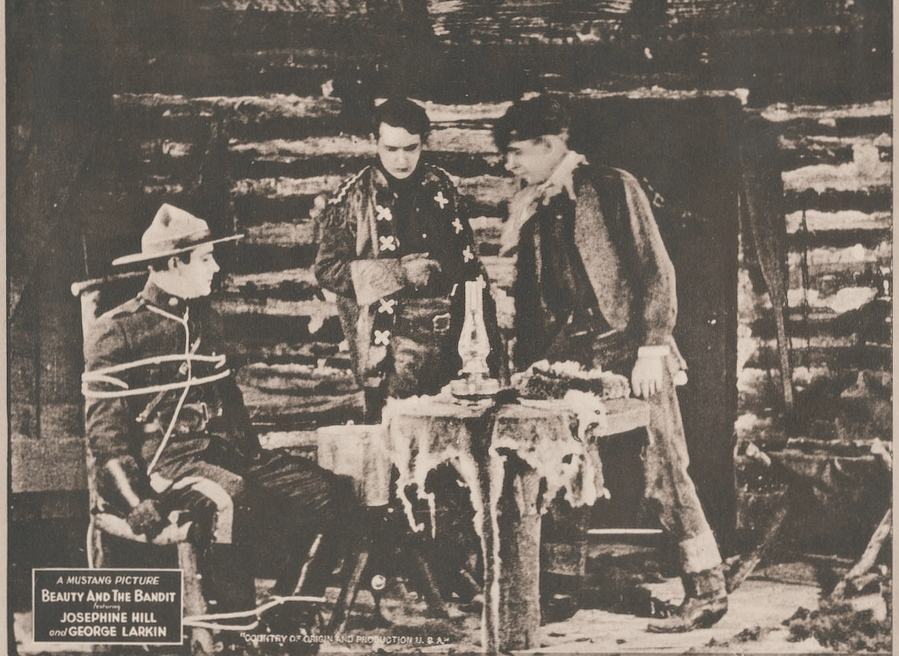
The silent era of cinema often functioned as a crucible for the American psyche, melting down the rugged individualism of the frontier into the desperate, often tragic, narratives of familial disintegration. In Beauty and the Bandit, directed with a keen eye for the visceral tension between the wild and the domestic, we are presented with a story that transcends its genre trappings. It is not merely a Western; it is a liturgical examination of the corrosive power of sudden wealth. The screenplay, penned by the formidable duo of Harry McArthur and George H. Plympton, eschews the simplistic morality of contemporary serials, opting instead for a murky, psychologically dense atmosphere where the 'bandit' is not an abstract villain, but a literal fracture in the family tree.
The film opens with a sequence that emphasizes the tactile nature of the geologist father's work. Unlike the opportunistic 'forty-niners' who flooded the canyons with dreams of easy pickings, our protagonist represents the scientific pursuit—a man who understands the earth's lithic layers. When he strikes gold, it feels less like luck and more like a hard-won victory over nature itself. However, the moment the gold is brought to the surface, the film shifts its visual language. The wide, expansive shots of the landscape begin to feel claustrophobic, as if the very mountains are closing in. This sense of impending doom is a hallmark of the era's better dramas, reminiscent of the thematic weight found in Daughter of Destiny, where the weight of one's lineage becomes an inescapable burden.
The arrival of the bandits is staged with a rhythmic intensity that belies the technical limitations of 1924. There is a kinetic energy to the choreography, a frantic desperation that mirrors the internal state of the characters. When the mask falls and the daughter recognizes her brother among the thieves, the film pivots from an external conflict to an internal apocalypse. This is the 'Beauty' of the title—not merely a reference to Josephine Hill’s aesthetic presence, but to the purity of her loyalty, which is now subjected to a trial by fire. Much like the moral quandaries presented in The Co-respondent, the protagonist is forced into a social and emotional corner where there are no righteous exits.
George Larkin, an actor often celebrated for his physical prowess and stunt work, delivers a performance here that is surprisingly nuanced. While he handles the action sequences with his trademark agility, it is in the moments of stillness—the realization of his brother’s betrayal—that he truly shines. His face becomes a map of conflicting loyalties. Contrast this with the work of Josephine Hill, whose 'Beauty' is far from a passive damsel. Hill imbues her character with a steely resolve that reminds one of the agency found in The Devil's Daughter. She is the moral anchor of the film, the one who must navigate the wreckage of her father's dreams and her brother's soul.
"In the silence of the screen, the loudest sound is the shattering of a family's trust. 'Beauty and the Bandit' captures this dissonance with a haunting clarity that few modern films can replicate."
The chemistry between the leads is palpable, anchored by a shared sense of tragedy. The brother, played with a twitchy, nervous energy, represents the 'prodigal son' trope gone horribly wrong. In many ways, his character arc is a precursor to the noir sensibilities that would dominate cinema decades later. He is a man destroyed by his own proximity to wealth, a theme that resonates deeply when compared to the societal critiques embedded in films like Sex, which examined the transactional nature of human relationships in a different, but equally cynical, context.
One cannot discuss Beauty and the Bandit without acknowledging the contribution of George H. Plympton. His ability to weave complex familial dynamics into the fabric of a genre piece is evident here. The pacing is deliberate, allowing the dread to accumulate like silt in a riverbed. He avoids the melodramatic pitfalls that plagued many of his contemporaries, opting instead for a narrative structure that feels almost Sophoclean. The geologist’s discovery of gold is the 'inciting incident' that leads to his downfall, a classic hubris that we see echoed in works like Journey into the Night.
Plympton’s writing ensures that the 'bandit' element isn't just a plot device; it's a thematic mirror. The bandits are the shadow side of the geologist's ambition. Where the father seeks to extract value from the earth through labor and science, the bandits (and by extension, the son) seek to extract it through violence and theft. This dichotomy is the engine that drives the film toward its inevitable, heart-wrenching conclusion. The film's refusal to offer an easy redemption for the brother is perhaps its most daring choice, setting it apart from the more sentimental fare of the era, such as Anne of Green Gables, which, while excellent, operates in a much more optimistic register.
Visually, the film utilizes the stark contrasts of the Western landscape to great effect. The cinematography captures the dust and the heat, making the gold appear not as a shimmering prize, but as a heavy, burdensome object. The use of shadows during the bandit attack is particularly effective, creating a sense of anonymity that makes the eventual reveal of the brother’s face all the more shocking. This use of light and dark to signify moral ambiguity is a technique that was being refined across the globe, from the Italian grit of Il fornaretto di Venezia to the French stylings of L'hallali.
The editing in the final act is masterfully tight. As the 'Beauty' confronts her brother, the cross-cutting between their faces and the approaching posse creates a ticking-clock scenario that is genuinely suspenseful. It is a masterclass in silent storytelling, where every gesture and every glance carries the weight of a thousand words. The film understands that in the absence of dialogue, the 'final close-up' is the ultimate tool of the director, a concept explored with meta-cinematic flair in The Final Close-Up.
When we place Beauty and the Bandit alongside its peers, its unique flavor becomes even more apparent. While Betsy Ross dealt with the birth of a nation's symbols, this film deals with the death of a family's innocence. It shares a certain grim realism with The Devil's Foot, where the pursuit of truth leads to dark and uncomfortable places. Even compared to the more whimsical Come Robinet sposò Robinette, there is a sense that Beauty and the Bandit is trying to say something more profound about the human condition.
The film also touches upon themes of national identity and duty, though more subtly than Wife or Country. Here, the 'country' is the lawless frontier, and the 'wife' (or in this case, the daughter) is the guardian of the home. The conflict between the law of the land and the law of the blood is a perennial American theme, one that would be revisited in countless Westerns to follow. The 'Message of the Spear' in Moora Neya might be more literal, but the 'message' of the gold in this film is just as lethal.
In the grand tapestry of silent cinema, Beauty and the Bandit is a thread that has unfortunately faded for some, yet it retains a vibrant, almost electric resonance for those who seek it out. It is a film that refuses to be 'High and Dry' (like the characters in High and Dry), instead immersing itself in the muddy, complex realities of life. It reminds us that the most dangerous bandits are not those who hide in the hills, but those who sit at our dinner tables.
For the modern viewer, the film offers more than just historical curiosity. It offers a reflection on our own relationship with wealth and family. In an era where 'gold' has been replaced by digital currencies and 'bandits' by corporate raiders, the core conflict of the film remains strikingly relevant. Josephine Hill’s performance stands as a testament to the enduring power of the female lead in Westerns, a precursor to the complicated heroines of the 21st century. Beauty and the Bandit is a poignant, beautifully crafted tragedy that deserves a seat at the table of great American silent films. It is a stark reminder that while we may dig for gold, we often find only the bones of our own mistakes.
IMDb 6.9
1934
Community
Log in to comment.