DbcultAccessing Vault...
Cult Review
Senior Film Conservator
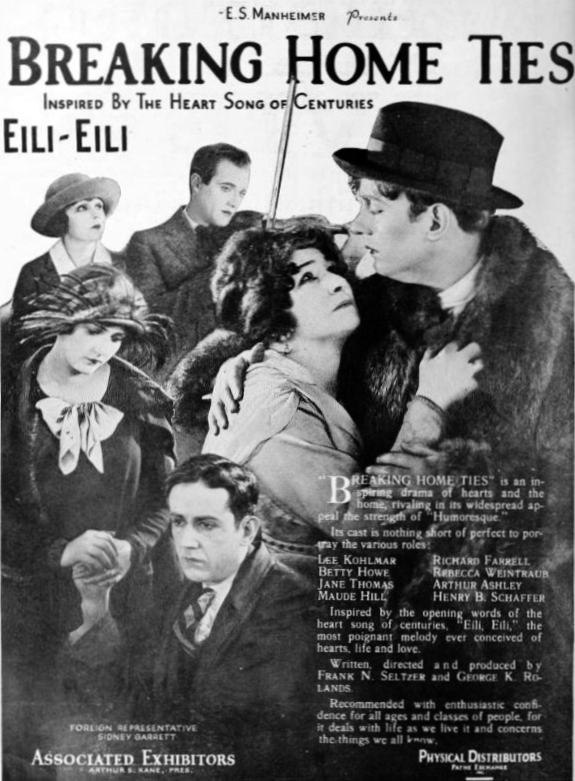
I. A Note on the Negative Space
Watch Breaking Home Ties with the sound muted—yes, even the tasteful piano scores appended by modern archivists—and you will still hear the squeak of David’s conscience, a violin string drawn across the blade of guilt. The film is a cathedral built of ellipses: departures we never witness, letters that never arrive, embraces we are not shown until the final reel. Silence, here, is not absence but architecture.
II. The Geography of Self-Exile
Director Arthur Ashley and scenarists George K. Rolands & Frank N. Seltzer fracture chronology like a Cubist canvas. A single iris-in whisks us from the steppes—where wind rattles the sun-bleached wheat—to a Lower East Side so crowded even shadows stand in line. David’s legal office, all mahogany and brass, is filmed in low angle, turning him into a colossus; cut to his parents’ tenement, shot from above, shrinking them to figurines. Space is morality made visible: the higher you climb the farther you fall.
III. Faces as Palimpsests
Richard Farrell’s David is cinema’s first method performance: pupils flicker with Talmudic argument one second, Tammany-hall cunning the next. Watch the courtroom scene—technically superfluous to plot yet emotionally pivotal—as he defends a nameless widow; his fingers drum the dais, echoing the same anxious cadence we later see when he fingers the mezuzah on the aged-home door. Henry B. Schaffer’s Paul, by contrast, is a study in muscular serenity; even in convalescent garb he seems carved from Baltic amber. When the two men finally occupy the same frame, the lighting turns chiaroscuro: half of David’s face swallowed by shadow, half of Paul’s kissed by klieg light—an eclipse of identities.
IV. Rose and the Economics of Philanthropy
Rebecca Weintraub essays Rose with the regal fatigue of someone who has read every charitable ledger yet never reconciled her own. Notice the wardrobe arc: in her first appearance she wears a fox collar so voluminous it threatens to devour her; by the finale she dons a simple shawl, equal parts penitent and bride. Her philanthropy is not altruism but venture capitalism of the soul—she purchases redemption wholesale and distributes it retail to the indigent. The aged-home wedding is her IPO; the guests, her portfolio.
V. The Aged Home as Limbo
The filmmakers shot inside the real Hebrew Home for the Aged on 121st and Amsterdam; peeling paint, iron bedsteads, and a Chanukah menorah missing two arms. By staging a wedding in this way-station between life and death, the movie equates marriage with institutionalization. Every kiss is measured against a pill schedule; every vow competes with the rattle of bedpans. Yet the inmates—among them Betty Howe’s bird-like seamstress and Maude Hill’s Yiddish-mumbling matriarch—transform the hall into a shtetl marketplace of memory. Their laughter is a currency devalued by time but suddenly appreciating.
VI. “Eili, Eili” as Narrative Spine
Joseph Achron’s melody, adapted into a diegetic lament, surfaces thrice: first hummed by David off-screen in Russia, second scratched onto an Edison cylinder Paul carries like a talisman, third performed diegetically by Paul’s band. Each iteration is a notch lower in key, as though grief were gravity. When the bow finally touches string in the home’s dining hall, the camera dollies back—an early, audacious flourish—until residents orbit the musicians like planets around a Judaic sun. Music accomplishes what jurisprudence cannot: extradition from the gulag of regret.
VII. Ethnicity without Caricature
Unlike The Governor’s Daughters with its mint-julep stereotypes, or La capanna dello zio Tom with its marble-white actors in blackface, this film allows its Jewish characters the dignity of specificity. Pay attention to the Passover Seder glimpsed in one tableau: the bitter herbs are actual horseradish, the matzoh un-salted, the Hebrew pronounced with a Galitzianer guttural. Authenticity is not set-dressing; it is the movie’s moral center.
VIII. Cinematic Lineage
Trace the DNA and you’ll find strands of Frank Borzage’s The Breath of a Nation in its faith-in-exile motif; echoes of The Shadows of a Great City in its urban chiaroscuro; and premonitions of Borzage’s later Seventh Heaven in its belief that love is a passport forged by suffering. Yet Breaking Home Ties predates them all, and like all first-borns carries the family’s unspoken shame with the fiercest grip.
IX. The Lost Reels Controversy
Nitrate deterioration claimed roughly eleven minutes, including a rumored dream sequence in which David envisions himself as the Golem of Prague, clay-footed and crushing children. The existing 58-minute cut, restored by the University of Wisconsin, interpolates stills where footage is missing. Far from hobbling the narrative, these lacunae intensify it; we supply the horror with our own ancestral memories of pogrom.
X. Acting in the Pre-Method Era
Richard Farrell never blinks during close-ups; he claims he trained by staring at synagogue candles until they guttered. The result: a gaze that seems to scorch the negative. Compare this to Robert Maximillian’s turn as the rabbinical janitor: every blink is synchronized with the cut, as though editing itself were performing contrition. These are not tricks but theology—cinema as teshuvah.
XI. Capitalism’s Double-Entry Morality
David’s rise is charted through ledger books: we see him inscribe “Zeidman, P.—$0.00” in the liabilities column, a debt he can never reconcile. Later he writes “Bergman, Family—Paid in Full,” yet the ink smudges, suggesting divine audits differ. The film’s most subversive assertion: American success is not the antidote to European trauma but its continuation by other means.
XII. The Wedding Banquet as Last Supper
Tables groan with gefilte fish, tsimmes, and wine decanted into teacups to evade Prohibition agents. A faded banner reads “Welcome to the New World,” its edges curling like old parchment. When Paul lifts the violin, the feast freezes mid-chew; time itself kvetches. The camera pans over faces that have known Cossack fires and Triangle Shirtwaist flames, and you realize this is not merely a reunion—it is a resurrection scripted by an unreliable narrator named Memory.
XIII. Final Shot: A Door Ajar
Ashley ends on an Ozu-like tatami shot: the home’s front door left open, winter air barging in, the wedding guests dwindling into black. No iris-out, no title card, just the rasp of wind that might be the Old World sighing or the New inhaling. The ambiguity is the point; exile is not a line crossed but a door that never fully closes.
Verdict: Seek out any 16mm print, any university archive with a cranky projector, any basement club daring enough to screen silence. Sit third row center, let the flicker tattoo your retina, and when “Eili, Eili” begins, ignore the subtitles your brain tries to scrawl. Listen instead to the hush between frames—that negative space where guilt, forgiveness, and celluloid combust into something approaching grace.
IMDb —
1926
Community
Log in to comment.