DbcultAccessing Vault...
6.7/10
Senior Film Conservator
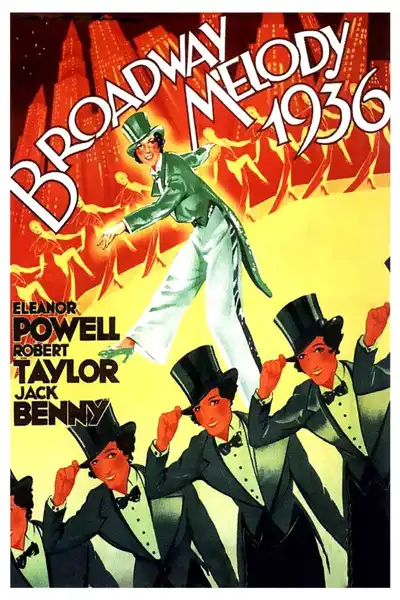
A definitive 6.7/10 rating for a film that redefined the boundaries of cult cinema. Broadway Melody of 1936 remains a cornerstone of transgressive art.
You should definitely watch this if you appreciate the kind of athletic, machine-gun tap dancing that nobody really does anymore. It is a total blast for anyone who likes old-school MGM energy, but if you can't stand thin plots where a wig and a fake accent fool everyone, you’re going to be rolling your eyes pretty hard.
Honestly, the story is just a delivery system for the numbers. It’s about a producer named Bob Gordon—played by a very young, very stiff Robert Taylor—who won't hire his high school sweetheart, Irene. She’s played by Eleanor Powell, and the movie spends a lot of time trying to convince us she’s just an ordinary girl next door before she starts dancing and puts everyone else to shame.
The whole thing kicks off with a gossip columnist played by Jack Benny. He’s great. He has this feud with the producer that feels way more interesting than the actual romance. It reminds me a bit of the lighthearted bickering in The Radio Murder Mystery, though Benny has a way of looking disappointed at the camera that no one else can match.
There is this one scene early on in a rehearsal hall where Powell just starts practicing. She’s wearing these simple shorts and a top, and she just goes to town. It’s probably the best part of the movie because it feels less like a "production" and more like a person showing off a superpower. Her feet move so fast it almost looks like the film is sped up, but it isn't. It’s just her.
Then we get into the "La Belle Arlette" nonsense. To get the part, Irene pretends to be a famous French star that doesn't actually exist. She puts on a dark wig and a thick accent. Robert Taylor’s character falls for it instantly. It’s one of those movie tropes that makes you wonder if people in 1935 were just really easy to trick.
I have to mention the sneezing guy. Robert Wildhack shows up just to give a demonstration on different types of sneezes. It is such a weird, long tangent. He just stands there and goes through the "hushed" sneeze and the "explosive" sneeze. It feels like it belongs in a different movie, maybe something like Would You Believe It!, but it’s so strangely specific that I actually laughed.
The Ebsen siblings—Buddy and Vilma—are in this too. Most people know Buddy Ebsen as the old guy from the Beverly Hillbillies, but here he is this lanky, rubber-limbed kid. He and his sister have a dance together that feels very casual and sweet, like they just finished a sandwich and decided to do a routine in the park. It’s a nice break from the massive, over-the-top stage numbers.
Speaking of stage numbers, the finale is huge. It’s called "Broadway Rhythm." There are neon signs everywhere and people popping out of the floor. It’s impressive, sure, but I liked the smaller moments better. Sometimes these big MGM finales feel a bit like they are trying to bury you under glitter and noise.
The chemistry between Taylor and Powell is... fine. Taylor is mostly there to look handsome and act stressed out about his show's budget. He doesn't have much to do other than be the guy who gets tricked. If you've seen Hit the Deck, you know how these sailor/producer/performer romances usually go. They are predictable but comfortable.
One thing that bugged me was the lighting in some of the office scenes. It’s weirdly dark. Like they forgot to turn on half the lamps on the set. It makes the mood feel a bit heavy for what is supposed to be a light comedy. Or maybe the print I saw was just old. Either way, it stood out.
Jack Benny’s sidekick is played by Sid Silvers, who also helped write the movie. He’s okay, but he yells a lot. He’s the kind of sidekick that was popular back then but feels a bit like a caffeine overdose today. He keeps the energy up, I guess, but I found myself waiting for Benny to come back and save the scene with a dry one-liner.
There’s a song called "You Are My Lucky Star" that everyone knows. Hearing it in its original context is cool. It’s used as this recurring theme that’s supposed to be emotional. It works, mostly because Powell has a very sincere face even when the plot is being ridiculous.
The movie is definitely a product of its time. Some of the jokes about the gossip industry feel like they could have come out of A Neighbor's Keyhole, focusing on that 1930s obsession with what people are doing behind closed doors. It’s all very harmless here, though.
If you look at the supporting cast, you see names like Una Merkel. She’s always great as the wisecracking secretary. She has this way of saying lines that makes you think she knows the movie is silly and she’s just having a good time with it. Every 1930s movie needed an Una Merkel.
I noticed a small mistake in the background of one of the street scenes. There’s a poster for a show that shouldn't be there yet, or maybe I’m just being too much of a nerd about it. It doesn't matter. The movie isn't about historical accuracy. It’s about tap shoes and feathers.
It’s not a perfect film. It drags a bit in the middle when they stop dancing to talk about the fake French lady again. You can almost feel the movie trying to stretch a ten-minute idea into a two-hour feature. But then Eleanor Powell starts spinning and you forget you were bored.
Is it better than the first Broadway Melody? Probably. The tech had caught up by 1935, so it doesn't have that clunky, early-sound feeling of something like Scrambled Weddings. It’s smooth and glossy and very MGM.
Final thought: Just watch it for the dancing. Seriously. Fast-forward through the boring parts if you have to, but don't miss Powell. She was a once-in-a-century talent and this is her at her peak. The plot is just the wrapping paper.
IMDb 7.3
1919
Community
Log in to comment.