DbcultAccessing Vault...
Cult Review
Senior Film Conservator
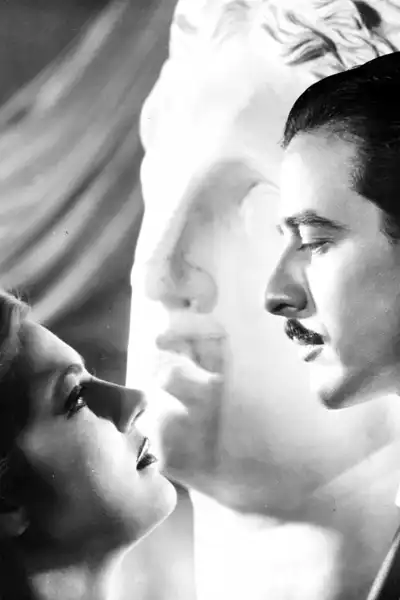
So, 'Crimen a las tres.' Is it worth digging up today? Well, if you’re into those older, dramatic stories where people do wild things for love, then yeah, maybe. It's not for everyone, though. Folks who need fast plots or clear-cut heroes might find it a bit slow, even a little confusing in its choices.
This is one of those films that really leans into the idea of a grand, sweeping gesture. Our main guy, a famous singer, falls head-over-heels for a woman. Like, really head-over-heels. And then, surprise, she’s involved in some kind of crime. What does he do? He just… takes the fall. Just like that. For her. You gotta respect the commitment, even if it feels a little much sometimes.
The film opens with this kind of shadowy, almost noir-ish feel, which I thought was a nice touch. Lots of dramatic lighting, especially around the singer, who always seems to be in a spotlight even when he's just, you know, sitting in a room. It gives him this sort of mythical presence, I guess.
Élida de Caro, as the woman he loves, has this really expressive face. You can see her trying to process everything, especially after he makes his big confession. She doesn’t quite look grateful, more like stunned and a little bit horrified. Which, fair enough. Someone just basically ruined their life for you.
There's a scene where he's practicing a song, and the lyrics are just so on the nose about undying devotion. It’s almost comical, but then you see the intensity in his eyes, and you realize they’re actually going for it. Full commitment to the melodrama. 🎤
What struck me was how the crime itself is almost a side note. It’s the catalyst, sure, but the movie isn't really about solving it or even understanding it fully. It's all about the singer’s choice, his sacrifice. Like, what even was the crime? The film doesn't spend a ton of time explaining, just enough to get us to the big decision.
Alfonso Sayons plays the singer, and he has this certain weight to him. You believe he’s famous. His suits, the way he carries himself – it all screams 'star.' But then, when he’s making this life-altering decision, there's a kind of desperate vulnerability there. It’s not just a noble act; it feels like he genuinely believes this is his only path.
There's a moment, I think it's in a police station or something similar, where he just stares at her across a room. No words. Just a look. And it goes on for a bit. You can almost feel the movie trying to convince you this moment matters, really trying to sell the depth of his feeling. It almost works. Almost. 🙄
The pacing is interesting. Some scenes just linger. Other times, it jumps ahead pretty quick. Like, one minute he’s famous, the next he’s confessing, and it feels like there’s a whole chunk of emotional lead-up missing. But then you get a long shot of someone just walking down a corridor, and you’re like, 'Okay, what are we doing here?'
I found myself wondering about the supporting characters too. Like, what did his manager think? Or his bandmates? Did they just shrug and say, 'Well, that’s just how The American Beauty is, I guess.' The film doesn't really care to tell us, which is fine, I suppose. It’s his story.
There's a particular scene near the end, where the consequences of his choice are really sinking in. It’s quiet. No big speeches. Just him, alone, and the camera just stays on him. For a long time. It starts to feel awkward, then poignant, then a little boring, then back to poignant again. It’s a roller coaster of emotional connection.
The sets are pretty minimal. Lots of dark rooms, heavy curtains. Very stagey, which isn't a bad thing for this kind of drama. It keeps the focus tight on the faces, on the emotion. Though, I did notice one lamp that just looked a bit wobbly in a crucial scene. Little things like that catch your eye.
Overall, 'Crimen a las tres' feels like a time capsule. It’s not perfect, not by a long shot. Some of the dramatic turns feel a bit forced, and you might roll your eyes once or twice. But there’s a genuine heart to it, a real belief in the power of this kind of epic, all-consuming love. It reminds you of a different era of filmmaking, where big emotions were the main event. It's a curiosity, and sometimes, that's enough. If you like this sort of thing, you might also enjoy the dramatic flair of Victor and Victoria, though that's a whole different vibe.
IMDb 5.2
1923
Community
Log in to comment.