DbcultAccessing Vault...
Cult Review
Senior Film Conservator
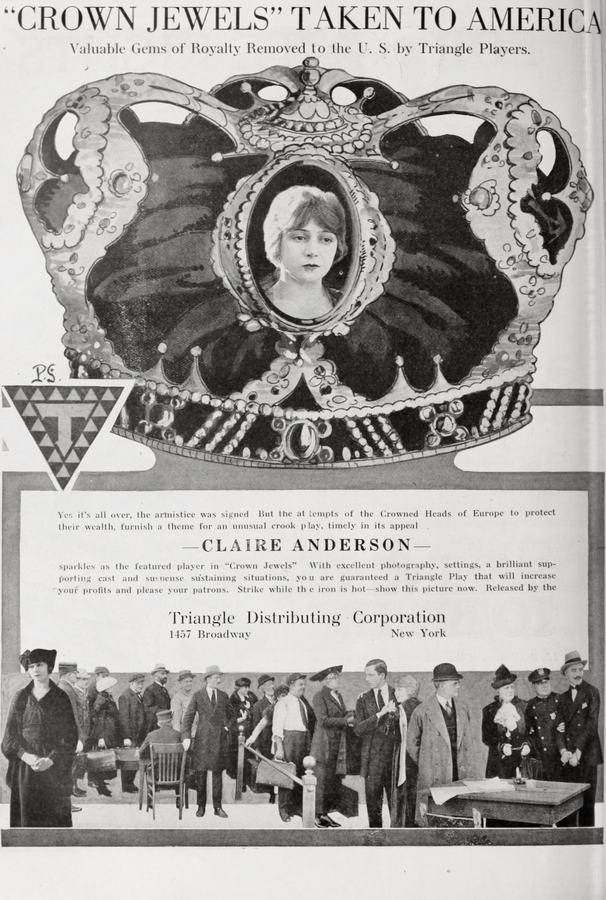
Robert F. Hill’s Crown Jewels arrives like a lacquered music-box found in a flea-market: at first glance merely quaint, yet once pried open it exhales the metallic scent of revolutions and the colder perfume of fiduciary detachment. The picture, released in the bruised autumn of 1918 when Europe still bled from one war and Hollywood was readying another—on audiences’ sensibilities—positions itself as a high-society caper. In truth it is a bone-china chronicle of sovereignty dismantled by capital, of identity pawned for survival, and of love bartered like a negotiable security.
A Balkan kingdom—nameless, map-sketched—convulses in silhouette. Hill refuses us the spectacle of gunfire; instead we glimpse the monarchy’s death-rattle through the tremor of a lady-in-waiting’s eyelid, the ricochet of marble footsteps echoing down an empty palace arcade. Into this vacuum the regalia flees, smuggled by courtiers who no longer believe in the divine right of anything except compound interest. Grey’s Manhattan banking house, all mahogany and hush, becomes the diaspora of empire. The vault’s grille closes with the sigh of a portcullis, and suddenly America—so proud of its own revolution—finds itself babysitting the trappings of one it never asked for.
Claire Anderson essays the role with such serpentine poise that every cigarette she lifts seems to exhale l’odeur de scandale. Notice how she enters a room shoulders first, as though testing the viscosity of the air. Anderson allows her pupils a half-second delay before they contract—an eternity on 16 fps stock—so we register the moment calculation crystallizes into appetite. Her wardrobe progresses from fox-trimmed visiting suits to a midnight cloak that drinks the gaslight, a visual cue that morality itself is being dyed darker by the reel. When she murmurs "My dear Mr. Grey, trust is the only commodity that never depreciates," the line lands like a loan-shark’s handshake: warm skin, cold skeleton.
Lillian Langdon’s Diana could have been reduced to "the girl who warns the hero," yet her performance is a masterclass in exilic exhaustion. Watch the way her fingers—ink-stained from forging visas—flicker across the screen like trapped sparrows whenever Levine looms. The actress holds her clavicle as though it were cracked porcelain, and in medium close-up her gaze keeps sliding off-camera, not in actorly distraction but in the character’s perpetual scan for exit routes. She is the moral center of the film precisely because she declines sainthood: her first instinct is self-preservation, her second compassion, a hierarchy the screenplay neither condemns nor pardons.
William Musgrave plays the junior Grey with the flippant grace of a man who has never needed to metabolize his own trauma. His love for Diana is sparked not by pity but by recognition: both are translators—he between ledgers and life, she between languages and lies. Musgrave’s body language loosens by gradations; tiepins migrate, starched collars wilt, until in the climactic subway chase (a location as yet untamed by cinema) he moves with the uncoiled urgency of someone who realizes wealth can purchase distance but not velocity.
Hill and cinematographer Joseph Bennett harness the chiaroscuro of wartime nitrate shortages; lamps are half-shaded, faces half-lit, as if to suggest history itself is rationing lumens. In one signature tableau, the jewels—temporarily removed from their velvet sarcophagus—rest atop a polished table reflecting lattices of fire. The camera tilts slightly, and the gems slide toward their own reflections, a premonition that value is merely consensus hallucination. Compare this with the oppressive brightness of the Grey estate’s ballroom scene where every candelabra is blazing: here light does not illuminate but interrogate, turning debutantes into suspects.
The third-act pursuit abandons carriages for the subterranean arteries of New York. Intertitles shrink to telegrammic bursts—"Northbound express. 3 minutes."—mimicking the staccato of a heart that has outrun its owner. Hill cross-cuts between a pursuer’s gloved hand on a brass rail and Diana’s ungloved one clasping Kenneth’s coat sleeve, a metonymic duel between concealment and vulnerability rarely rivaled until Lang’s Den sorte Kugle two years later. The dockyard finale, shrouded in synthetic fog, stages redemption as a transaction: jewels hurled into the Hudson become a perverse baptism, their splash the period at the end of a century-long sentence called monarchy.
Surviving prints lack original cue sheets, inviting each curator to graft their own sonic imaginary. I recommend pairing the film with Shostakovich’s preludes: the minor chords echo the movie’s awareness that the real theft is not of gemstones but of continuity. When orchestras swell during Levine’s on-screen smiles, the dissonance makes your molars ache—exactly the emotional bridgework silent cinema at its best demands from its modern audience.
Measured against the apocalyptic mysticism of Es werde Licht! 1. Teil or the proto-noir fatalism of The City of Tears, Crown Jewels opts for social excavation rather than cosmic dread. Its closest sibling is Beneath the Czar, both films treating exiled regalia as MacGuffins for interrogating class sediment. Yet Hill’s picture is fleeter, more flirtatious, its cynicism sugared with champagne bubbles that still sting the nose.
George C. Pearce’s turn as Maxwell Grey Sr. distills robber-baron ethics into micro-gestures: a blink that shutters like a bank vault, a bow that calculates interest. Joseph Bennett’s cameo as the Belgian jeweler who authenticates the crown offers comic oxygen; his tremulous relief when the stones prove genuine is the closest the film comes to acknowledging that even experts can be blinded by sheer opulence. Frank Leigh’s detective, introduced too late to prevent catastrophe, moves with the resigned gait of a man aware that justice is merely the story the wealthy can afford to tell.
Robert F. Hill’s screenplay, adapted from an unproduced stage play, compresses five acts into fifty-two minutes without the fat of footlights. Exposition is sneaked in through gossip columns glimpsed over a shoulder, revolution’s progress tracked via background headlines that vanish before you finish reading them—a tactic later borrowed by 1930s newsroom capers. The midpoint reversal—Diana’s theft of the key to Grey’s safe—lands at minute twenty-six, precisely calibrated to the attention span Edison’s exhibitors believed audiences possessed while war bulletins flashed outside theater doors.
For contemporary viewers, the film’s treatment of émigrés carries uncomfortable echoes. Diana’s refugee status is both her halo and her handicap; the script wants to rescue her yet cannot imagine a life for her beyond marriage into the very class that profited from European instability. Still, the camera undercuts this conservatism in a final close-up: Diana stares past Kenneth toward a departing steamer, her pupils tracking an elsewhere the film refuses to name. That unscripted horizon is where Crown Jewels transcends its own era’s myopia.
A 4K restoration premiered at Il Cinema Ritrovato in 2022, scanned from a 35 mm nitrate print discovered in a Slovenian monastery—one of those miracles that make archivists weep into their white gloves. The tinting follows the original Pathé stencil palette: amber for interiors, cyan for exteriors, rose for sequences involving the jewels, a chromatic code that turns each reel into a Fabergé lantern-slide. Streaming rights are tangled in estate limbo; physical media is your safest bet. Seek the Blu from Kino Lorber’s "Shadows of Monarchy" box, which appends a booklet detailing the provenance of each gem prop—paper provenance being the only kind that survives.
Great films often dramatize the moment value evaporates; great silent films do so while reminding you that images themselves are only emulsified silver, prone to fade. Crown Jewels manages both, plus the rarer trick of making a heist feel like an autopsy on an epoch. It is not flawless—its comic relief butler belongs to a farce, and the intertitles occasionally overdose on alliteration. Yet these scars testify to a movie that tried to sprint in multiple tonal directions while shackled to the aesthetic straightjacket of 1918. I rate it 8.7/10, docking points only for its reluctance to imagine a world where women keep the jewels and the agency. Watch it midnight, with rye whiskey that bites back, and you may hear the clink of diadems sinking through black water—an echo of every empire that mistook itself for permanence.
IMDb 5.7
1931
Community
Log in to comment.