DbcultAccessing Vault...
Cult Review
Senior Film Conservator
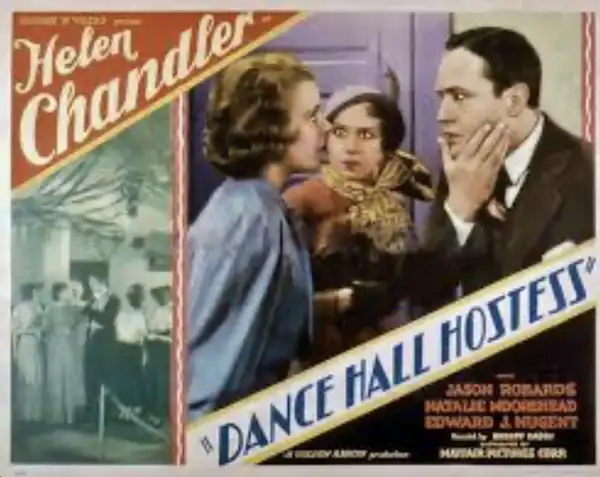
If you have seventy minutes to kill and a soft spot for dusty, pre-code B-movies where everyone talks like they have a mouth full of marbles, then yes, Dance Hall Hostess is absolutely worth your time. 🍿
People who love scrappy 1930s melodramas where the microphone feels like it was hidden inside a potted plant will have a blast. But if you cannot stand crackly audio or plots that turn on a dime for no logical reason, you should probably steer clear.
The whole thing is about Myra, played by Helen Chandler. You might know her as Mina from Dracula, looking all pale and dreamy.
Here she is working in a sweaty, low-rent dance hall where men pay a dime to spin her around. It is a tough gig, and Chandler looks perpetually tired, which actually works perfectly for the character.
Then enters this incredibly obnoxious, filthy rich drunk guy.
He decides Myra is his next prize, because of course he does. This immediately pisses off her boyfriend, who has the emotional maturity of a wet paper towel.
The boyfriend is played by Edward J. Nugent, and he spends most of his screen time looking like he wants to punch a wall. I kept thinking about how different this is from other silent-era transitions like The Single Code, which had a bit more dignity.
This film does not care about dignity. It just wants to get to the next confrontation.
There is this one scene in the club where a background extra in a tuxedo is just staring directly at the camera for like five seconds.
Nobody noticed it during editing, I guess. Or maybe they just did not have the budget to shoot another take.
It is these little mistakes that make these old talkies so fun to watch. Here are a few other odd details I caught:
The rich guy, played by Jason Robards Sr. (yes, the father of that Jason Robards), is hilarious. He slurs his words so much I had to rewind twice to understand his proposal.
He is trying to be charming, but he just comes off as a guy who needs a very long nap and some black coffee. Myra’s reactions to him are priceless.
She has this look of pure, polite dread on her face. It reminds me of the awkward social vibe in Innocent Husbands, where everyone is just pretending everything is fine when it clearly is not.
The writing by Carl Krusada and Betty Burbridge is incredibly choppy. Characters just show up in rooms with no explanation of how they got there.
At one point, Myra's boyfriend is suddenly furious about a letter we never actually saw him receive. Maybe a scene was cut? Or maybe they just forgot to film it.
It is like watching a soap opera that has been put through a paper shredder and taped back together. But honestly, that is the charm.
If you wanted a neat, polished story, you would be watching something from Metro-Goldwyn-Mayer. This is Poverty Row filmmaking at its most frantic.
I loved the weirdly dark lighting in the apartment scenes. It felt less like artistic choices and more like they only had two working light bulbs on set that day.
The movie gets much better once the boyfriend starts making terrible decisions. He gets so jealous he basically drives Myra right into the rich guy's arms.
It is like watching a slow-motion car crash, if the cars were made of cardboard and moving at five miles an hour. If you liked the dramatic tension in Whispers, you might find this a bit too silly.
But for me, the silliness is the whole point. It is a quick, messy slice of 1933 history.
Don't expect some grand message about the human condition. Just grab some popcorn, ignore the hiss in the audio track, and enjoy the chaos.
IMDb —
1916
Community
Log in to comment.