DbcultAccessing Vault...
Cult Review
Senior Film Conservator
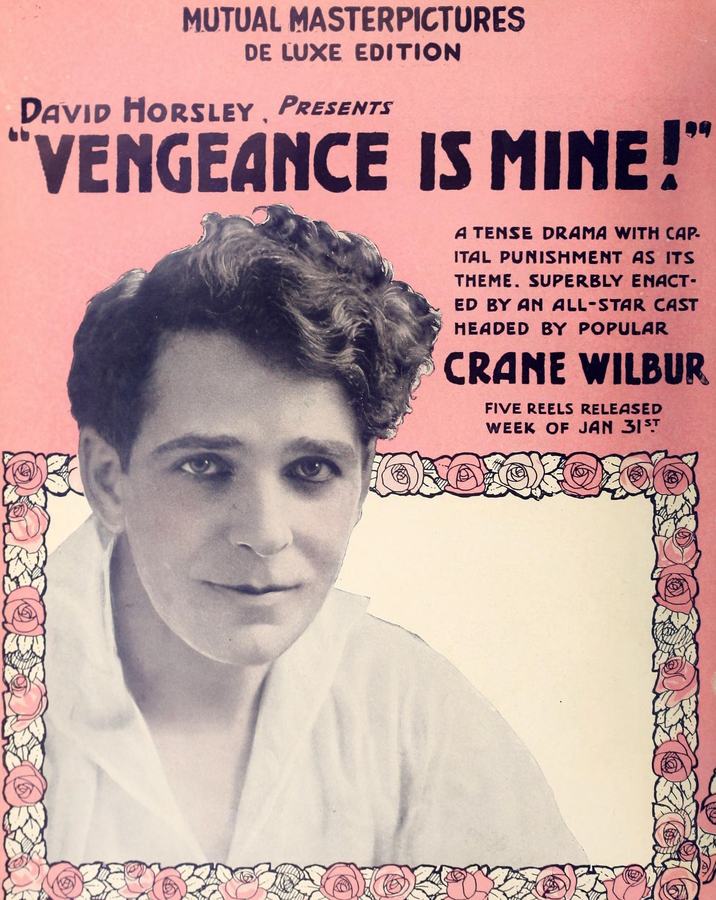
The flickering nitrate of Vengeance Is Mine! arrives like a telegram from the id: urgent, sulphurous, impossible to ignore. Shot in the ghost year of 1915—when Europe bled and Hollywood was still a citrus orchard—this eleven-reel moral earthquake feels shockingly post-modern in its disdain for innocence. From the first iris-in on Stanley Clark’s predatory grin, director Crane Wilbur weaponizes shadow the way later noir filmmakers would weaponize cigarette smoke: every pool of darkness is a confession booth that accepts no absolution.

Consider the hotel-room prologue: a single oil-lamp brands the scene with ochre guilt. Marion, white dress virginal yet clinging like wet tissue, is posed against a wallpaper pattern of cyclamen blooms that resemble spilled arterial spray. Wilbur’s camera—mobile for its day—glides past the brass bedstead as Clark’s fingers, pianist-slender, coax both page and virtue free. The tear of paper is soundtracked by nothing save the projector’s mechanical purr, yet audiences in 1915 reportedly gasped as if a pistol had fired. That rip is the film’s primal wound; everything afterward is scar tissue.
Wilbur brazenly fractures chronology, anticipating Friday the 13th’s flashback fever by six decades. The jump from Marion’s deflowered dusk to her gilded governorship is bridged by a fade-to-black so complete it feels like burial. We re-emerge amid marble columns, ticker-tape, and a husband whose smile is indistinguishable from a campaign poster. E. Hunt plays Marion with the haunted opacity of a woman who has stapled her personality shut; every close-up reveals eyes flicking sideways as if checking the lock on a vault.
Meanwhile Clark—C.W. Mills in a performance that oozes velvet malice—has aged into a human invoice, dunning Marion with the ferocity of a tax collector. The blackmail letters, typed on paper thin as onion skin, are slipped inside official envelopes bearing the state seal: corruption nesting inside legitimacy. Note Wilbur’s sly visual rhyme: the torn register page reappears as a paper mask Clark holds over his face while leering, turning bureaucratic residue into Harlequin menace.
Richard Loring—James Gunn, eyes like bruised pewter—embodies the last honorable man in a universe that has auctioned integrity for political capital. His decision to tail Marion is staged as a chiaroscuro pursuit through rain-slick streets that prefigure the urban nightmares of Lost in Darkness. Inside Clark’s boarding-house room, wallpaper peels like scorched skin; the fisticuffs are clumsy, ferocious, human. When the revolver drops—an unplanned participant—it lands with a thud that Wilbur undercranks for a heartbeat, amplifying kinetic dread.
Marion’s accidental shot is filmed from the weapon’s POV: for a surreal second we become the bullet, racing toward Clark’s gasping, incredulous eyes. The iris closes on his corpse like a coin slid over a dead man’s gaze. From that instant, the film’s moral ledger tilts: Richard’s chivalric impulse to shield Marion mutates into state-sanctioned execution, while her silence calcifies into tacit complicity.
Governor John Loring—R.M. Iliff, ramrod-straight voice never rising above a sorrowful baritone—faces a Sophoclean fork: save his brother by confessing the truth, or spare his wife and children civic annihilation. Wilbur stages the crisis in the governor’s mansion parlor, a mausoleum of ancestral portraits whose eyes seem to track every ethical twitch. The mise-en-scène is a masterclass in negative space: John stands isolated in doorway-shaped shadow while Marion, child on hip, hovers beneath a chandelier dripping prismatic tears. His decision to abdicate office is conveyed without dialogue cards—just a slow unpinning of the state seal from his lapel, placed on the desk like a communion wafer of defeat.
Compare this to the similar moral implosion in God, Man and the Devil; yet where that film leans on metaphysical abstraction, Vengeance Is Mine! roots its tragedy in the banal machinery of paperwork, hotel registers, and cancelled checks. Wilbur’s thesis: evil is not Mephistophelian but bureaucratic—it proliferates in ledgers, carbon copies, and silence.
Cinematographer William Jackson employs low-key lighting that anticipates 1940s noir by a quarter-century. Faces slip into half-shadow so that characters literally speak from darkness. Marion’s confession scene—filmed in medium close-up—bisects her visage: the illuminated side pleads, the obfuscated side lies. Meanwhile, Clark’s lodgings are a labyrinth of diagonal shadows cast by Venetian blinds, a visual template later Xeroxed by every hard-boiled crime thriller.
Color tinting deepens the emotional palette: amber for nostalgic flashbacks, viridian for courtroom claustrophobia, crimson for the fateful gunshot. The sole use of cerulean tint arrives when the Loring family boards the westbound train—an ironic baptism in sky-blue possibility that cannot rinse the blood from their hands.
E. Hunt’s Marion is a revelation in restraint: watch her pupils dilate when she hears Clark’s voice off-screen—a full five seconds before her body recoils. The performance is silent yet symphonic; micro-gestures replace pages of dialogue. James Gunn’s Richard carries the resigned nobility of a man who has read his own autopsy report; walking to the death house, he stumbles on a child’s toy in the corridor—Wilbur lingers on the moment until pathos metastasizes into existential ache.
C.W. Mills essays Clark as a human ledger—every smirk is an entry, every bowtie adjustment a debit against his soul. Note how he folds the blackmail page into a paper airplane and sails it across the room toward Marion: childhood play weaponized into adult terrorism.
Crane Wilbur, better known later for his macabre thrillers, here unveils an ethical calculus worthy of Dostoevsky. The script refuses catharsis: Richard’s sacrificial death sentence is commuted off-screen to life imprisonment, not through deus-ex-machina but via John’s deliberate political seppuku. The family’s exile is framed in a chilling long shot: train steam swallowing their silhouettes until figures become gray ghosts against an industrial dawn. No title card announces redemption—because none exists. The final image is a bookend to the first: a hotel register, now empty save for the indent of torn paper, a negative space of identity.
Cinephiles will trace DNA strands to Jane Eyre’s madwoman-in-the-attic secrecy, or to The House Built Upon Sand for its motif of sexual guilt calcifying into domestic ruin. Yet Vengeance Is Mine! predates Hitchcock’s preference for the wrong man trope and Lang’s Mabuse cycle of conspiratorial paperwork. It even whispers forward to the 1980s erotic thrillers where evidence becomes eroticized weaponry, though Wilbur’s treatment is colder, more agnostic.
A 2023 4K restoration by the Library of Congress reveals textures smothered for a century: the glint of Clark’s stick-pin, the watermark on the extortion letter, the hand-painted crimson of the fatal gunshot frame. Accompanied by a new score—piano, brushed snare, and bowed vibraphone—the film now breathes like a freshly excavated relic that refuses museum dust.
Modern audiences, marinated in true-crime podcasts, will recognize the narrative’s core: how the powerful weaponize silence, how institutional corridors amplify personal guilt into national scandal. In an era when a single screenshot can upend dynasties, Clark’s torn ledger page feels almost quaint—yet its lesson is evergreen: information is only as moral as the hand that holds it.
To watch Vengeance Is Mine! is to stare into a mirror where the glass has been replaced by indictment. Wilbur offers no heroes, only survivors who barter integrity like casino chips. The film’s final gift is a dare: once the last reel flaps against the projector gate, try to locate an innocent character. You will fail. And in that failure lies the picture’s bruised, implacable brilliance.
Stream it, archive it, teach it—just don’t dare to forget it. Because somewhere, in some ledger still unwritten, your name may already appear on a page waiting to be torn.
IMDb —
1917
Community
Log in to comment.