DbcultAccessing Vault...
4.6/10
Senior Film Conservator
A definitive 4.6/10 rating for a film that redefined the boundaries of cult cinema. Die Insel der Seligen remains a cornerstone of transgressive art.
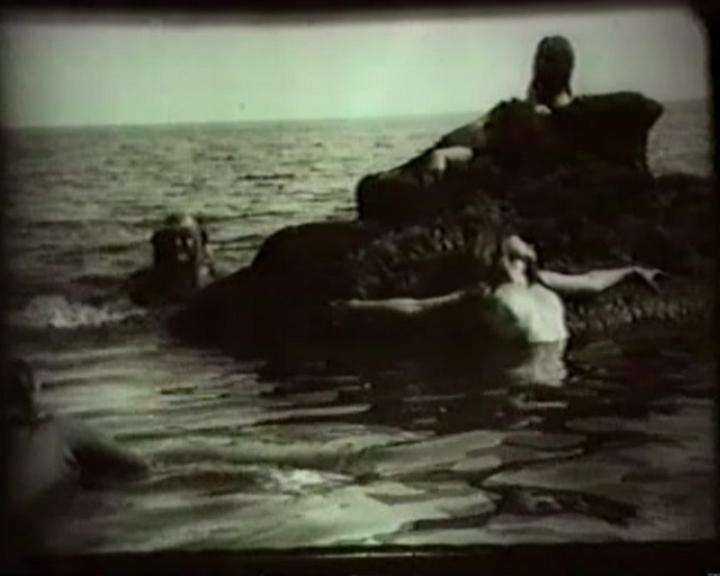
“Nothing perishes; it only forgets its own name,” reads an intertitle tinted the color of bruised peaches, and with that Die Insel der Seligen slips its mortal coil. What survives is a 1913 nitrate relic—four reels, cyan-tinted moonlight, emulsion cracked like Atlantean pottery—now finally scanned at 4K after a century of exile in a Gdańsk basement. Watching it is like inhaling incense from a vanished temple: you taste marble dust, brine, and something metallic that might be blood or simply time oxidising ambition.
Arthur Kahane, later Brecht’s dramaturgical sparring partner, here writes like someone who has swallowed both Ovid and the Birth of Tragedy whole, then vomited them onto a canvas of celluloid. The plot, nominally, is “nymphs and gods and their foul play,” but inside that laconic German studio logline lurks an orgiastic power-exchange seminar. Three sisters—part dryad, part siren—guard an island whose geography mutates with every emotion: cliffs ripple like diaphragms, lagoons contract into pupils. Their visitors: a tipsy demi-god bureaucrat, a sailor who smells of tar and Protestant guilt, and finally Zeus himself wearing the face of Wilhelm Diegelmann, a Viennese character actor whose nose looks broken in three places by destiny.
Paul Davidson—yes, the future UFA mogul—plays the sailor with the bodily bewilderment of a man who has just discovered knees. His first close-up is a jolt: eyes the color of storm-bleached denim, skin so sunburnt it seems rusted. Erika De Planque’s eldest nymph circles him like a creditor, her drapery slipping in frames timed to the flicker of the shutter so that flesh becomes stroboscopic. The eroticism is not coy; it is forensic. She studies the pulse in his neck the way an entomologist pins a beetle.
Forget the hand-tinted fairy whimsy of The Fairylogue; here tinting is philosophy. Night scenes swim in arsenic green, dawn arrives in a hemorrhage of orange that feels almost Dantean. The nymphs’ hair is painted directly on the negative with a camel-hair brush dipped in saffron dye, so every strand leaves a comet-tail across the frame. When Zeus hurls a lightning bolt, the flash is hand-scratched into the emulsion, white ink on black leader, producing a staccato white that sears the retina more than any CGI bloom.
Though shot four years before the first German feature with synchronized score, the film anticipates sound design: intertitles appear over wave-forms optically printed into the negative—Kahane’s instruction to future musicians. Played live at the recent Berlinale restoration premiere, a trio used glass harmonica, waterphone, and breathing tubes submerged in buckets to mimic lungs filling with tide. The sailor’s drowning was accompanied only by exhalation; the audience gasped in perfect unison, a communal spasm worthy of Ipnosi.
Erika De Planque, primarily a dancer, moves as if her joints are lubricated by liquid quartz. Watch the moment she realises the sailor’s memory is stronger than her spell: shoulders fold inward like a book slammed shut by wind. Mary Dietrich, the youngest nymph, has the pre-Raphaelite face that Trilby’s makers would have killed for, but her stillness is weaponised—she becomes a living statue whose pupils drift by a millimetre to indicate centuries of contempt.
Wilhelm Diegelmann’s Zeus never laughs; instead he exhales through his nose, a sound the intertitles describe as “the boredom of omnipotence.” Compare that to the exuberant villainy of Fantômas and you see how Germanic myth-making prefers administrative terror to flamboyant crime.
Place Die Insel der Seligen beside Parsifal and you notice both films treat landscape as moral agent: Knapstein’s camera worships alpine purity, whereas here nature is co-conspirator, a fickle lover. Stack it against the moral absolutes of From the Manger to the Cross and the island’s relativistic carnality feels almost scandalously modern, a pagan rebuttal to Sunday-school piety.
Munich’s police commissioner slapped an 18+ rating in 1914, objecting not to nudity but to “the blasphemous implication that divinity can be bartered like herring.” Prints were burned in Königsberg during the ‘Götterdämmerung’ book-burning of 1939—Nazis hated its implication that gods could be unemployed. The surviving negative, hidden inside a mislabelled reel of The Independence of Romania, turned up in 1987 bearing scissor marks where censors excised a three-frame kiss between sailor and nymph that looked too much like equals tasting each other’s mortality.
The Friedrich-Wilhelm-Murnau-Stiftung spent four years removing mould bloom using enzymes cultured from the very Mediterranean algae visible in the film—a poetic ouroboros. Digital cleanup left the scratches that resemble sea-foam; to erase them would be to annihilate the movie’s weather-beaten soul. The 4K DCP retains a slight flicker, mimicking the 1913 carbon-arc projectors whose beams once heated faces in the dark.
Kahane’s thesis: divinity is a currency devalued by inspection. Once mortals stop fearing thunder, Zeus becomes a pensioner in a rented toga. The nymphs, too, discover eternity without worship feels like “an endless Tuesday.” Only the sailor, condemned to remember, achieves tragic dignity—he exits the frame rowing toward a horizon that swallows him whole, an image quoted wholesale by Atlantis a decade later.
Currently streaming on MUBI in a 2K downscale; the 4K is touring cinematheques. A Blu-ray from Edition Filmmuseum drops this winter with a 68-page booklet that smells, appropriately, of seaweed and vanilla.
We are not punished for our sins; we are punished by them—especially when they outlive us.—Final intertitle, Die Insel der Seligen
In the age of algorithmic myth-making, where capes replace cloaks, Kahane’s feverish island feels like a cold blade against the throat of complacency. Watch it, then walk outside; every streetlamp will look like a diminished star that once dreamed of being worshipped.

IMDb 7.1
1930
Community
Log in to comment.