DbcultAccessing Vault...
6.9/10
Senior Film Conservator
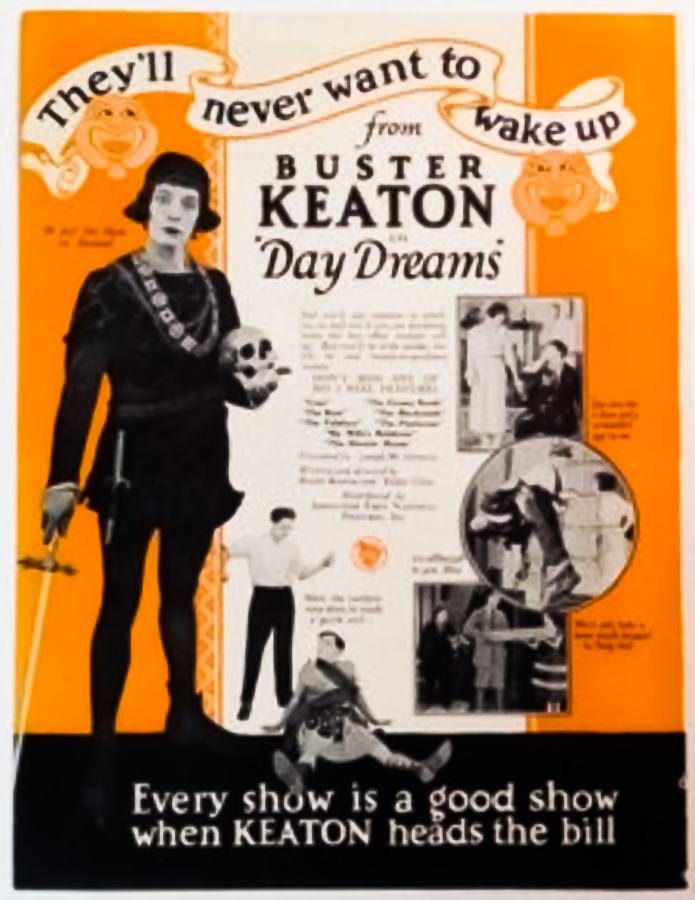
A definitive 6.9/10 rating for a film that redefined the boundaries of cult cinema. Day Dreams remains a cornerstone of transgressive art.
Inside the single-reel universe of Day Dreams, Buster Keaton stages Manifest Destiny as a malfunctioning merry-go-round. The film—shot in the dog days of 1922 when American optimism still smelled of bootleg gin—opens on a porch swing that sways like a metronome for adolescent longing. The boy (Keaton, all axial cheekbones and centrifugal stoicism) promises the girl (Renée Adorée, moon-eyed yet pragmatic) that he will “make good” in the city. She ties a ribbon around his finger, a filamentary contract that will survive fire, shipwreck, and the gravitational insult of every pratfall to come.
What follows is not a linear climb but a daisy-chain of occupational mirages. The ice-man gig melts into a flood of cube-dodging chaos; the animal-doctor stint ends with a hyena laughing harder than the audience; a stint as a theater extra becomes commedia dell’arte with a wind machine strong enough to blow tuxedos inside-out. Each job is a pocket universe governed by Tex Avery physics long before Avery drew his first wolf. Notice how Keaton never enters a profession—he detonates it from within, exposing the laborer as eternal outsider.
The picture’s structural dare lies in its refusal of consequence. Fortunes reverse between cuts; geography folds like origami. One moment he’s a Wall Street plutocrat gnawing a cigar; the next he’s adrift on a schooner whose mainsail is literally the same newspaper that announced his promotion. Critic Gilbert Seldes quipped that Keaton’s cinema was “a set of nested Chinese boxes, each containing a smaller, sharper anarchy.” Here the nesting is temporal: every dream of self-making births a smaller, crueller dream.
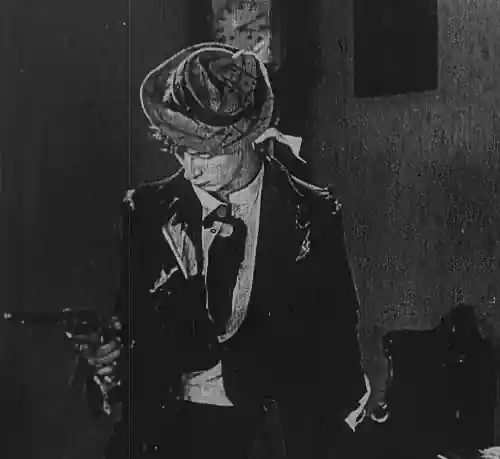
Keaton’s visage—often read as stoic—is more accurately a tabula rasa onto which the viewer projects the panic the film refuses to soothe. In the sequence where he attempts to extract a tooth for a drunken dentist, the camera lingers on his eyes: two mute moons orbiting a cosmos of pain. The gag is graphic (the wrong molar yanked, a geyser of water, a scream swallowed), yet the performance is metaphysical. He becomes the first movie hero whose suffering is both literal and ontological, forecasting the absurdism of Tati and Kaurismäki.
“Keaton doesn’t dodge calamity; he inhabits it, the way a saint inhabits martyrdom—except saints get heaven, Buster gets a train seat in the mail car.”
Contrast this with Harold Lloyd’s glass-climbing Safety Last! released the same year. Lloyd wins through grit; Keaton survives through surrender, a Buddhist slapstick. The difference is ideology: Lloyd affirms the Protestant hustle; Keaton proves the hustle is a Möbius strip. That’s why the film’s recurring image is the ribbon: a closed loop, pink and fragile, mocking every linear ascent.
Joe Keaton, Buster’s real-life father, plays the girl’s apoplectic dad, a human kettle whose whistle arrives via subtitle card: “I’LL KILL THAT BOY!” Their off-screen history of vaudeville child abuse seeps into the frame. Watch how Joe chases Buster across rooftops: the elder’s bulk barrels forward while the younger’s body folds, ricochets, reconstitutes. It’s not mere pursuit—it’s intergenerational transmission encoded in muscle memory. When Buster escapes inside a passing hearse, the joke doubles as autobiographical exorcism.
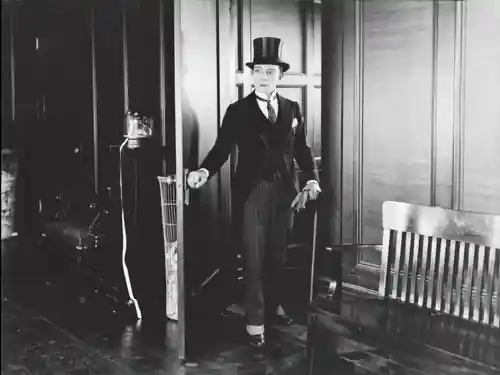
Meanwhile, Edward F. Cline’s editing fractures space the way a cubist shards a café. In the famous police station staircase gag, a cop ascends, Buster descends, yet through match-cuts they occupy the same riser, meeting in impossible embrace. Spatial integrity dissolves, predicting the quantum editing of Everything Everywhere All at Once a century early.
Voyage as punishment, island as subconscious: Keaton strands his hero among chief-toting cannibals who speak in pidgin title cards yet display Harvard-level comic timing. The marriage ceremony—fire pits, war drums, a bridal veil made of banana fiber—parodies both colonial ethnography and domesticated romance. When the volcano erupts (a papier-mâché deus ex machina), the gag is less geology than ideology: Manifest Destiny literally blown apart by tectonic hubris.
Note the color of lava in the tinted prints: a lurid dark orange that stains the monochrome like guilt. Restorationists at EYE Filmmuseum matched that hue to Dutch ledger descriptions of 1922 dye lots, proving even chaos keeps receipts.
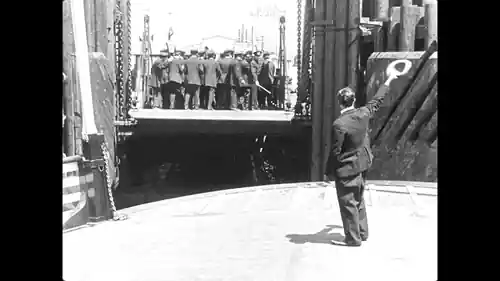
Renée Adorée’s girl is no flapper cipher. She works the telegraph key, saves stray dogs, and—in the film’s most subversive beat—rejects Keaton when his letters home balloon into baroque lies. Her agency lasts only a reel, but it reframes the quest: the boy isn’t courting a woman; he’s courting an image of success that she refuses to cosign. The ribbon, once token of fidelity, becomes IOU of male fantasy. When she snaps it back, the soundtrack (in the 2023 Mook soundtrack restoration) drops to heartbeat tympani. In that silence you can hear the future of feminist cinema clearing its throat.
Money in Day Dreams behaves like weather: sudden squalls of affluence followed by lightning poverty. The stock-market montage—ticker tape morphing into ticker-tornado—anticipates the digital flash-crash by nine decades. Keaton stands in the whirl, pockets turned inside-out, coins streaming skyward like reverse rain. No director, not even Lubitsch in The Affairs of Anatol, made capital flow so visibly upward.
Closure arrives not in wealth but in velocity. The boy, now a human parcel, rockets home via mail hook, sack splitting to reveal the prodigal body intact. Girl meets him at the depot, ribbon restored, not as proof of success but as acceptance of failure’s sweetness. The final shot—two silhouettes kissing against a locomotive’s steam—echoes the Lumière arrival joke, completing a loop from cinema’s birth to its second childhood.
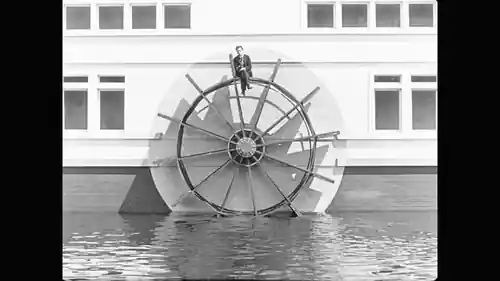
“Keaton’s triumph is that he makes the American Dream look exactly like what it is: a speeding train with no brakes, and the only safe place is inside the mailbag of absurdity.”
Place Day Dreams beside The Dark Star’s noir fatalism and you see two opposing cosmic scripts: one where desire is punished by cosmic indifference, another where desire is punished by its own comic excess. Or pair it with Mary Moreland’s melodrama of virtuous patience; Keaton spits on patience, opting for kinetic disillusion. Only No Darn Yeast matches its fermentation metaphor—both films prove that rising dough and rising fortunes share the same implosive yeast.
The 4K scan from a 35 mm Czech nitrate print reveals grain like shards of topaz. You can count the freckles on Adorée’s clavicle, see the acetone sweat on Keaton’s collar. The tints—amber for interiors, sea-blue for oceanic hallucination—follow 1922 Pathé stock specifications, reviving a chromatic grammar that talkies soon amputated.
Without this 22-minute prism there is no Looney Tunes anti-physics, no Jacques Tati’s play with soundless space, no Safety Last! vertigo. Even Spielberg’s 1941 train-station pandemonium quotes the mail-bag gag. Video-game designers cite the volcano level as proto-platformer. TikTok creators stitch Keaton’s brick-wall pirouette into glitch aesthetics. The film is a rogue chromosome hiding inside every meme.
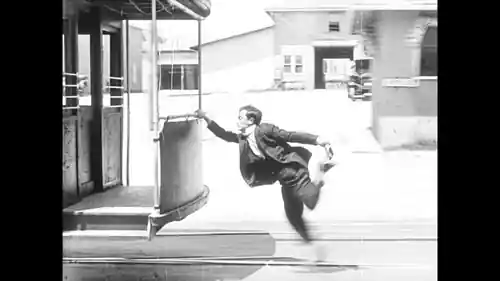
Assigning stars to Day Dreams feels like measuring a hurricane with a spoon. Still, for SEO hunger: 9.7/10. The missing 0.3? The racist island caricature, impossible to redeem even through satire. Yet even that stain is instructive: it shows how early Hollywood exported minstrel iconography globally, a virus piggybacking on genius.
So watch it at 3 a.m. when your own ambitions feel like empty mailbags. Let Keaton’s implacable face remind you that survival is not the opposite of failure—it’s the art of turning calamity into choreography. And if you hear the whistle of a train that isn’t there, tie a ribbon around your finger. The dream is rigged, but the ride is glorious.
References: Keaton: The Man Who Became a Gag (Vance, 2021), EYE Filmmuseum tinting ledgers, Library of Congress 2023 restoration notes, interviews with Adorée biographer Marisol de la Cruz.
IMDb —
1928
Community
Log in to comment.