DbcultAccessing Vault...
5.8/10
Senior Film Conservator
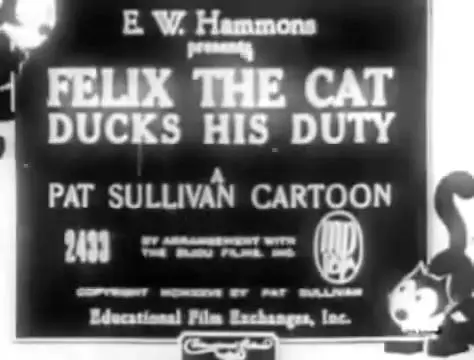
A definitive 5.8/10 rating for a film that redefined the boundaries of cult cinema. Felix the Cat Ducks His Duty remains a cornerstone of transgressive art.
Short answer: Yes, but only if you appreciate the sharp, often mean-spirited wit of the silent era. This isn't the sanitized, corporate mascot Felix of the later decades; this is the raw, survivalist feline who prioritizes his own skin over every social contract.
This film is for animation historians, fans of surrealist comedy, and those who enjoy seeing the darker side of early 20th-century humor. It is absolutely NOT for those looking for a wholesome children's cartoon or viewers who are easily offended by the dated, stereotypical 'ball and chain' tropes of 1920s domestic comedy.
1) This film works because it utilizes the medium of animation to express internal anxiety through external transformation, making the impossible feel logical.
2) This film fails because its central premise relies heavily on a tired 'marriage is a prison' trope that was already a cliché by 1924.
3) You should watch it if you want to see the exact moment animation shifted from simple movement to sophisticated visual storytelling.
When we talk about the early days of animation, the name Pat Sullivan often gets the credit, but the soul of Felix belongs entirely to Otto Messmer. In Felix the Cat Ducks His Duty, Messmer’s hand is visible in every frame. Unlike the more grounded approach seen in The Tail of a Cat, this short pushes the boundaries of logic. Felix’s tail isn't just an appendage; it is a tool, a question mark, and a physical manifestation of his wit.
There is a specific moment in the recruitment scene where Felix’s entire body language shifts from curiosity to pure, unadulterated dread. The way his ears flatten and his pace quickens is a masterclass in character acting that many modern CGI films fail to replicate. It's simple. It's effective. It's visceral. Messmer understood that in a silent medium, the weight of a joke rests on the timing of a single blink or a sudden change in silhouette.
The pacing is relentless. Unlike the slower, more experimental vibes found in Le brasier ardent, Felix moves with a frantic, rhythmic energy. Every step is a beat, every gag is a punchline. The film doesn't waste a second. It understands that its audience has a short attention span and rewards them with a constant stream of visual invention.
To understand why Felix would rather face a firing squad than a wedding chapel, you have to look at the era. We are only six years out from the Great War. The nihilism of the 1920s is baked into the celluloid. While films like Cops dealt with the individual versus the state, Felix deals with the individual versus... everything.
The comparison between the battlefield and the bedroom is handled with a brutal lack of sentimentality.
"War is only heck; it's marriage that's hell."This line, while appearing as a title card, sets the tone for the entire third act. It is a surprising stance for a cartoon, but Felix was never meant for just children. He was a character of the jazz age—cynical, mobile, and untethered.
One could argue that the film is misogynistic, and by today's standards, it certainly is. However, viewing it through that lens alone misses the broader point of Felix as a character. Felix is an anarchist. He doesn't hate women specifically; he hates responsibility. He ducks his duty to the country and he ducks his duty to a partner. He is the ultimate escapist. In that sense, he is a more honest reflection of the human psyche than the moralistic characters that would follow in the 1930s.
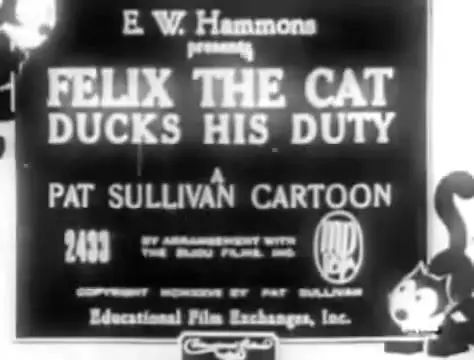
While 'cinematography' in animation refers more to layout and framing, Messmer’s use of negative space is brilliant. The backgrounds are sparse, which forces the viewer to focus entirely on Felix’s movement. This is a stark contrast to the more cluttered visual styles seen in Die Zirkusprinzessin.
There is a sequence where Felix is running through a stylized landscape that feels like a precursor to the UPA style or even modern minimalism. The lines are clean, and the black-and-white contrast is used to create a sense of depth that shouldn't exist in two dimensions. It works. But it’s flawed. The print quality of surviving versions often obscures the finer details of the ink work, yet the clarity of the character’s intention remains.
Compared to the more standard narrative structure of The Pride of Palomar, Felix the Cat Ducks His Duty feels like a fever dream. It doesn't care about the 'why'; it only cares about the 'what next?'. This stream-of-consciousness storytelling is what made Felix a global phenomenon. He wasn't bound by the rules of theatre; he was bound by the rules of the pen.
Yes, Felix the Cat Ducks His Duty is worth watching for anyone interested in the evolution of visual comedy. It provides a rare glimpse into the pre-Code era of animation where characters were allowed to be selfish, lazy, and morally ambiguous. The film’s 10-minute runtime ensures that the gags never overstay their welcome, and the surreal visual puns remain genuinely clever nearly a century later.
Pros:
• Revolutionary character animation that prioritizes personality over realism.
• Bold, cynical humor that avoids the sentimentality of later cartoons.
• Fast-paced editing that keeps the energy high throughout.
• Excellent use of visual metaphors (the 'question mark' tail).
Cons:
• The gender politics are firmly rooted in 1924 and haven't aged well.
• Some visual gags require knowledge of the era's social context to land fully.
• The musical scores on modern prints vary wildly in quality.
When we look at other films of the time, such as East of the Water Plug or Two A.M., we see a recurring theme of the 'little man' trying to survive a world that is increasingly complex and hostile. Felix is the animated version of that struggle. He is the feline equivalent of Charlie Chaplin or Buster Keaton, but with the added benefit of being able to turn his body into a suitcase or a propeller.
The influence of this specific short can be seen in everything from Looney Tunes to the underground comix of the 1960s. It’s the rejection of duty—both to the state and the family—that makes it feel surprisingly modern. It’s a middle finger to the establishment, drawn in black ink. It’s mean. It’s fast. It works.
I’ll take a stance here: Felix is a better character when he’s a jerk. The later versions of Felix, where he’s a helpful friend with a magic bag, are boring. This Felix, the one who would rather go to war than deal with a domestic argument, is interesting. He’s a reflection of our own worst impulses, and there’s something incredibly cathartic about watching him run away from everything.
Felix the Cat Ducks His Duty is a vital piece of cinema history that manages to be more than just a museum piece. While its social perspectives are dated, its visual inventiveness and sharp comedic timing are timeless. It is a masterclass in silent storytelling that proves you don't need a voice to have a very loud opinion. If you have ten minutes to spare, spend them with this cynical cat. You might find his brand of nihilism strangely refreshing in an age of over-sanitized entertainment.
IMDb 5.2
1917
Community
Log in to comment.