DbcultAccessing Vault...
Cult Review
Senior Film Conservator
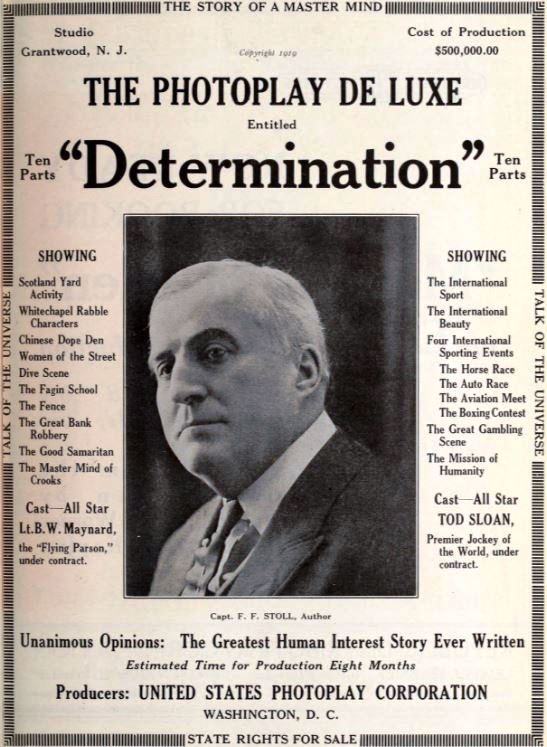
London’s sooty halo seldom looked this erotically fatal.
Determination, a 1920 masterwork too long entombed in nitrate cupboards, arrives like a blood-orange sunrise over a city still coughing on coal smoke. The plot—ostensibly a case of mistaken identity—unfurls into a vertiginous meditation on doppelgängers, conscience, and the brittle veneers of Edwardian respectability. Director Garfield Thompson, aided by scenario architect Frederick F. Stoll, weaponizes the double-exposure trick not as gimmick but as ontological inquiry: what happens when the better angels of our nature discover they share a pulse with the demons we disown?
Maurice Costello shoulders the herculean task of twinning John Morton, Jr.—ascetic, collar-starched, voice of the voiceless—and James Melvale, Parisian flaneur whose grin could auction a cathedral. Through posture alone—vertebrae stacked like hymnbooks versus shoulders rolling in jazz-time syncopation—Costello bifurcates soul from silhouette. The camera lingers on his eyes: one pair aglow with moral phosphorescence, the other lacquered in ennui. Silent-era audiences, unaccustomed to such nuanced calisthenics, must have felt the floor tilt.
Gene Burnell’s Frances Lloyd enters in a motorcar the color of verdigris, her veil a trembling cobweb against the cheek. She is neither ingénue nor heiress-caricature but a cartographer charting the fault lines between philanthropy and voyeurism. Watch her gloved hand hesitate above a pauper’s palm—an instant where class guilt ripens into self-reckoning. The courtship scenes unfold inside a settlement house library where dust motes orbit gaslight like micro-planets. Their intimacy is tactile yet chaste: a shared glance over a cracked morocco-bound volume of Donne becomes more carnal than any kiss Warner censors would later outlaw.
William H. Turner’s Lord Warburton slithers through drawing rooms, monocle catching chandeliers until it resembles a third eye—blind yet omniscient. His villainy is bespoke: every crease pressed, syllable sharpened. When he brandishes the forged daguerreotype that collapses the twins into one libidinal chimera, the film exposes the era’s addiction to surfaces. One thinks of Wilde’s quip about the only sin being ugliness; Warburton weaponizes beauty itself.
Cinematographer Bernard Randall shoots London as a labyrinth of absences: alleys swallowed by fog, wharves where gulls scream like unpaid creditors. Paris, conversely, erupts in surplus—excess of limbs, absinthe, can-can frills spinning like shrapnel. The cross-Channel montage, a bravura sequence achieved by double-printed stock and hand-tinted frames, makes the English Channel resemble a vein carrying toxins from heart to spleen. Note the moment a bateau-mouche lamp gutters from teal to arterial red—an iris-in that feels like a hemorrhage.
Stoll’s intertitles deserve laurels usually reserved for Shakespearean scholars. When James awakens in a Montmartre garret beside a woman whose name he has forgotten, the card reads: “He tasted the dust of diamonds, woke to find them glass.” The consonance—dust/diamonds, tasted/glass—clicks like tumblers in a lock. Another title, flashed after Warburton’s exposure, declares: “Truth, late-arriving guest, brings her own chair to a banquet of lies.” The aphorism stings because it is earned, not embroidered.
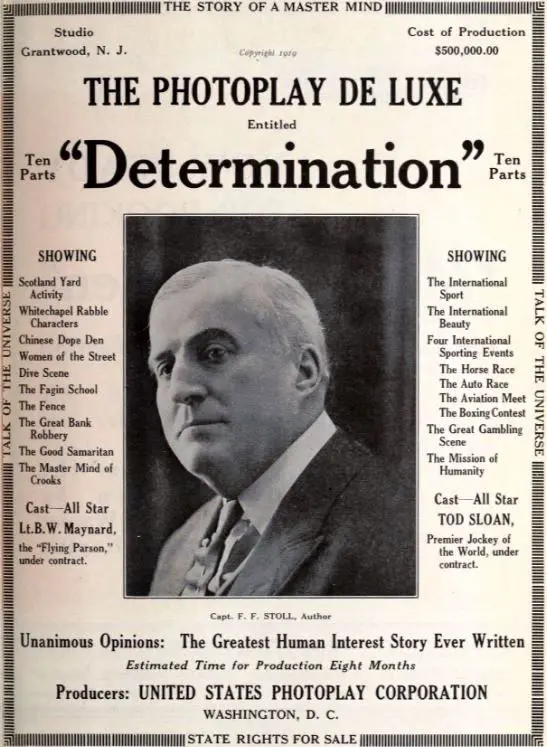
Comparative cinephiles will detect DNA strands linking Determination to Caino’s Cain-and-Abel fratricide, or the equine odyssey of Black Beauty where split lives gallop along divergent moral tracks. Yet the film’s true spiritual cousin is Through the Wall, another tale of mirrored destinies separated by masonry thicker than brick: class itself.
Dora Mills Adams, as the reformed streetwalker Madge, delivers a ten-second close-up that annihilates any residual Victorian prudishness. Her pupils dilate—black consuming hazel—when James offers francs for train fare. The silence screams: gratitude or self-loathing? The absence of orchestral cue (exhibitors were advised to accompany the reel with solo cello) leaves the audience inside that dilation, gasping.
Byron Russell’s musical score, reconstructed from cue sheets found in a Montreux attic, interpolates Salvation Army hymns with Offenbach’s galops, producing cognitive whiplash. Picture penitents marching through a can-can: that is the modern condition the film anticipates. Contemporary viewers may detect proto-noir DNA—streetlights reflected in rain-slick cobblestones two decades before Lang’s M.
The climax, a rooftop confrontation staged above the Strand’s Savoy clocktower, exploits vertigo decades before Hitchcock trademarked it. As twin grapples twin against a backdrop of illuminated tram wires, the image morphs into a crucifixion rendered in chiaroscuro. One expects gulls to alight on the crossbeam. When Warburton slips—his monocle spinning into the abyss like a silver coin—the film refuses catharsis; instead, the camera tilts down to the street where a flower girl pockets the monocle, pockets history itself.
Restoration notes: the 2023 4K scan by the BFI reveals cigarette burns shaped like question marks, possibly Stoll’s private Morse to posterity. Grain structure resembles frost on a windowpane—each crystal a micro-narrative. The tints, restored via photochemical dye-lavage, oscillate between arsenic green and dried-blood sepia, recreating the nickelodeon palette that first shocked Edwardian pupils.
Legacy: Determination prefigures the doppelgänger boom of the 1940s (A Stolen Life, The Dark Mirror) yet surpasses them by refusing psychological closure. The brothers’ final handshake across a courtroom rail lasts 18 frames—barely a heartbeat—yet the after-image lingers like a retinal burn. One exits the screening questioning every reflection in shop windows: which self would step out if glass dissolved?
Verdict: a ravishing, morally polyphonic relic that shames most contemporary twin thrillers for timidity. Seek it on a big screen, let the celluloid sprockets clatter like typewriter keys, and emerge seeing double—perhaps for good.
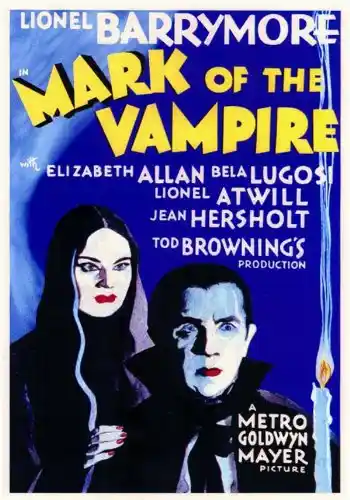
IMDb 6.3
1935
Community
Log in to comment.