DbcultAccessing Vault...
Cult Review
Senior Film Conservator
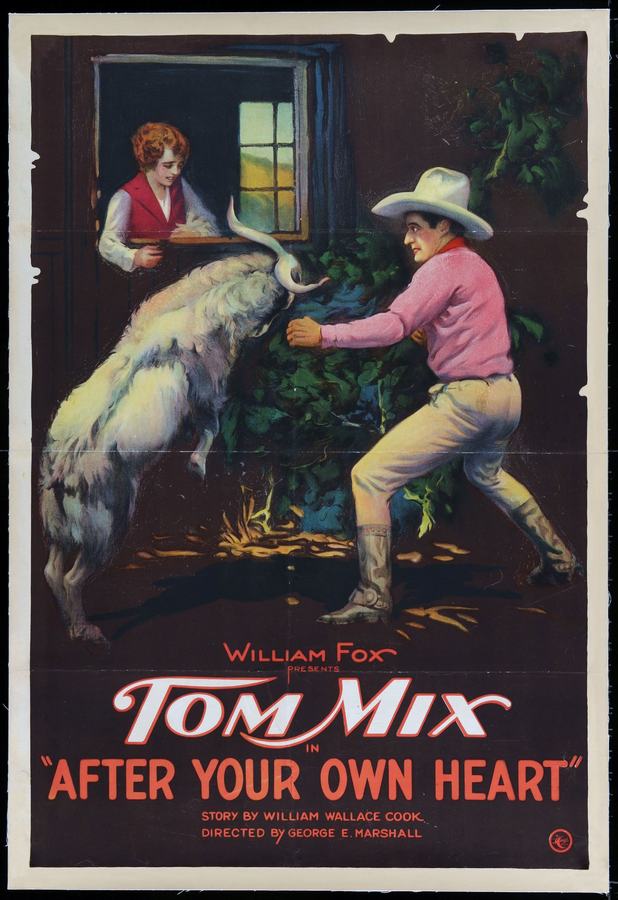
After Your Own Heart (1922) emerges as a peculiar yet compelling artifact of early Western cinema, where the conventions of the genre are both honored and subverted in equal measure. Directed by a trio of writers-turned-filmmakers—William Wallace Cook, John Montague, and Ralph Spence—the film positions itself as a romantic drama with the structural rigidity of a courtroom thriller, all while leaning into the slapstick energy of a silent action-adventure. It’s a curious blend, but one that feels eerily prescient in its treatment of resource conflicts and familial duty, themes that would dominate Hollywood narratives for decades to come.
At the heart of the film lies Herbert Parker (William Buckley), a college athlete transplanted from the East to the sunbaked plains of Arizona. His arrival is framed not as a hero’s journey but as a reluctant inheritance, tasked with managing a ranch that becomes embroiled in a land and water rights dispute with the neighboring Bramley estate. The setup is classic enough, but the script chooses to complicate matters by introducing Loretta Bramley (Ora Carew), the daughter of ranch owner Luke (Tom Mix). Herbert’s love for Loretta creates an immediate narrative friction: how can a man defend his legal rights when his heart has already been claimed by the family of his adversary?
The film’s first act lingers in the dry, almost clinical tension of legal negotiation—maps are unfurled, legal documents are exchanged, and the parched landscape itself seems to breathe with the weight of impending conflict. But the real narrative engine emerges in the form of Tex Marole (Sid Jordan), a foreman whose scheming introduces a heist-like urgency to the plot. Tex’s plan to kidnap Loretta isn’t just a romantic threat; it’s a calculated move to destabilize the Bramleys, leveraging Loretta’s vulnerability as both a symbol of her father’s legacy and a pawn in Tex’s larger scheme. This duality elevates the film beyond a mere Western romance, infusing it with the psychological tension of a hostage drama.
The midpoint of After Your Own Heart is where the film truly diverges from its peers. While many Westerns of the era leaned into the mythic isolation of the frontier, this film embraces the industrial modernity of its time. The climax—a chaotic battle between Luke’s men and Tex’s gang—features automobiles as weapons of war, a visual choice that underscores the collision between old-world ranching traditions and the mechanized future. Even more striking is the use of an airplane to drop dynamite, a sequence that feels less like a product of its time and more like a surrealist interlude. These elements, while jarring to modern sensibilities, highlight the film’s willingness to experiment with scale and spectacle, anticipating the grandeur of later Hollywood blockbusters.
Tom Mix’s performance as Luke Bramley is a masterclass in understated authority. Unlike the flamboyant antiheroes of his later career, Mix here embodies a quiet, almost patriarchal stoicism. His interactions with Herbert are marked by a subtle wariness, as if he’s constantly measuring the young man’s worth against the stakes of his own survival. Ora Carew’s Loretta, meanwhile, is a study in restrained agency; her role as both a romantic prize and a potential victim is never fully resolved, leaving her character in a liminal space between empowerment and vulnerability. This ambiguity, perhaps unintentionally, mirrors the broader ethical gray areas of the film’s central conflict.
Thematically, After Your Own Heart functions as a parable about the commodification of nature. The contested water source—central to both the legal and romantic plotlines—is never named, yet its absence feels like a character in itself. The film’s resolution, in which Herbert marries Loretta and extends an olive branch to her father, avoids the typical Western trope of absolute victory. Instead, it offers a pragmatic truce, one that acknowledges the impossibility of total resolution in a world where personal and economic interests are inextricably linked.
For fans of the genre, the film’s most audacious choice is its treatment of violence as spectacle rather than moral reckoning. The final showdown is less about justice and more about the catharsis of destruction—automobiles crash, dynamite explodes, and the landscape itself becomes a character in the chaos. This approach echoes the aesthetic of later silent films like The Pageant of San Francisco, which similarly weaponized urban destruction for narrative impact. Yet where those films reveled in the spectacle of collapse, After Your Own Heart uses its visuals to underscore the futility of unchecked ambition.
The film’s technical execution is equally noteworthy. The use of wide shots to frame the Arizona desert is both practical and poetic, with the vastness of the land serving as a metaphor for the characters’ isolation. Close-ups on faces during key emotional beats—Herbert’s conflicted gaze, Loretta’s silent pleas—are handled with a sensitivity that suggests an early understanding of the power of intimacy in silent cinema. These moments are juxtaposed with frenetic action sequences, creating a rhythm that alternates between meditative and explosive.
In terms of legacy, After Your Own Heart occupies a strange space in cinematic history. It’s neither a towering classic nor a complete failure, but rather a fascinating case study in how early filmmakers navigated the shift from theatrical storytelling to the possibilities of the screen. Its influence can be faintly traced in later Westerns that grappled with similar themes, such as The Iron Woman (1922), which also wove personal drama into its action sequences. However, its unique blend of romantic tension and industrial-age violence remains largely unmatched, making it a niche but vital piece of the genre’s evolution.
In conclusion, After Your Own Heart is a film that rewards patience and curiosity. Its pleasures are not immediately obvious—there’s a certain clunkiness to its pacing, and the moral ambiguity of its characters may discomfort purists. But for those willing to engage with its contradictions, it offers a rich tapestry of themes and visuals that speak to the complexities of early 20th-century America. It’s a reminder that even in the shadow of more celebrated works, there exist hidden gems that, when examined closely, reveal the breadth of cinema’s early experimentation.
IMDb —
1933
Community
Log in to comment.