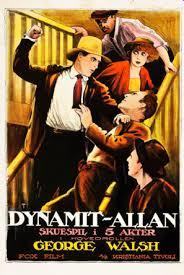
In the annals of classic cinema, few films manage to balance the heft of moral inquiry with the pulse of a taut thriller as deftly as *Dynamite Allen*. Directed with a sure hand by Thomas F. Fallon, this 1920s-era drama is a masterstroke of narrative economy, using its modest runtime to explore the corrosive effects of industrial greed and the redemptive power of clarity—both literal and metaphorical.
At its core lies the plight of Betty Reed, a young girl of extraordinary sensitivity played with haunting nuance by Lettie Ford. Her blindness, both physical and symbolic, becomes the fulcrum of the film’s moral architecture. When she witnesses the murder of mine owner Roger Pitney, her impaired vision leads her to misidentify Sid Allen, a man who has been a paternal figure to her, as the killer. This misstep sets in motion a cascade of consequences that ripple through years of silence, suspicion, and eventual retribution.
The film’s brilliance lies in its refusal to sanitize the chaos of its characters. Brigham Royce, as Sid Allen, embodies the quiet dignity of a man wronged, his performance a study in restrained pathos. His son, portrayed by Edna Murphy with a steely resolve, becomes Betty’s unlikely ally, their dynamic a testament to the film’s nuanced exploration of legacy and justice. The antagonists, particularly the gang leader who seeks to silence Betty, are not mere villains but manifestations of a system that thrives on obfuscation.
Visually, *Dynamite Allen* is a feast of chiaroscuro contrasts. The mining town is rendered in stark, brooding tones, its crumbling facades and smoke-choked skies a metaphor for the moral decay at its heart. The cinematography, though uncredited, deserves accolades for its fluidity and attention to texture. Shots of the mine’s interior, with its claustrophobic corridors and flickering lamplight, evoke a sense of entrapment that mirrors Betty’s psychological journey.
The narrative’s emotional core is Betty’s regained sight, a pivotal motif that transcends the literal. Her return to the town is not merely a physical act but a symbolic reawakening. The film’s second half is a masterclass in tension-building, as Betty and her companion navigate a labyrinth of threats—kidnapping, coercion, and the ever-present specter of false accusations. Each confrontation is a microcosm of the larger themes: the fragility of truth and the resilience of the human spirit.
What elevates *Dynamite Allen* beyond the realm of mere genre exercise is its thematic ambition. It interrogates the idea of justice as a process rather than an endpoint. The resolution, when it arrives, is neither tidy nor entirely satisfying, which is precisely its power. The real killers are exposed, but the scars of their actions linger, a reminder that truth, while essential, is often insufficient to heal the wounds it uncovers.
The supporting cast, including George Walsh and Nellie Parker Spaulding, add layers of complexity to the proceedings. Their characters are not mere plot devices but fully realized presences, each with their own moral calculus. The film’s pacing, though brisk, allows moments of stillness—a quiet scene of Betty poring over old letters, a tense exchange in a shadow-draped alley—to resonate with emotional depth.
Comparisons to other works of the era are inevitable, yet *Dynamite Allen* holds its own against films like The Forbidden City and The Climbers. Unlike the grandiose spectacle of those titles, Fallon’s film is intimate in scope, focusing on the personal rather than the panoramic. Its influence can be glimpsed in later noir classics, though it remains distinct in its emphasis on internal conflict over external action.
Technically, the film is a marvel. The sound design, though rudimentary by today’s standards, is used with precision to heighten tension—a sudden silence in a crowded room, the distant rumble of machinery, all serve to amplify the stakes. The score, a subtle blend of melancholic strings and dissonant motifs, underscores the film’s thematic undercurrents without overpowering the narrative.
Critics at the time noted the film’s "unflinching realism," a testament to its refusal to offer easy answers. In an era when Hollywood often prioritized escapism, *Dynamite Allen* dared to confront the moral ambiguities of its time. It is this willingness to grapple with complexity that ensures its enduring relevance.
For modern audiences, the film may require some acclimation to its pacing and visual language. Yet those who approach it with an open mind will find a story that transcends its era. It is a film about the cost of truth and the courage required to seek it, themes as urgent today as they were a century ago.
In conclusion, *Dynamite Allen* is a triumph of character-driven storytelling. It is a film that demands to be seen not just for its historical context but for its timeless exploration of justice and the human condition. For those who appreciate the interplay of form and substance, it is an essential watch.