DbcultAccessing Vault...
Cult Review
Senior Film Conservator
Spoiler-rich excavation ahead; enter the atelier at your own spectral risk.
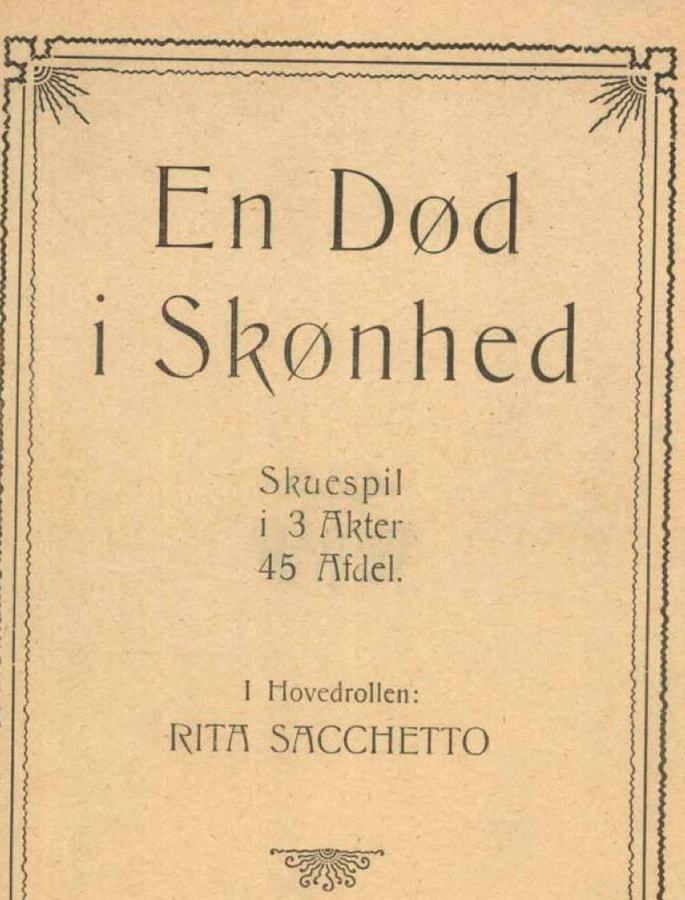
Early Scandinavian cinema seldom flirted with outright supernaturalism; it preferred the chill of social realism to séance. Yet En Død i Skønhed—translatable as “A Death in Beauty”—detonates that restraint, fusing Symbolist painting with the nascent grammar of film. Director-writer Rita Sacchetto, better known as a danseuse, choreographs grief like a fevered ballet: every iris-in feels like a pirouette toward annihilation. The plot’s vertebra is simple—artist loses wife, paints wife, steals life to finish wife—but the execution spirals into a Kierkegaardian meditation on substitution, on how aesthetic obsession cannibalizes the living to appease the dead.
Cinematographer Erik Holberg treats light as a mortician treats flesh: reverently, clinically, with gloved detachment. Interiors are swallowed by tenebrism; exteriors bask in an anemic Nordic sun that never warms skin. Note the repeated motif of windows: each pane functions as both barrier and portal, suggesting that visibility itself is a form of violence. When Maja first steps into the studio, her silhouette eclipses a skylight, and for a heartbeat the entire screen blacks out—an eclipse of empathy.
Leonore Sacchetto (Maja) performs with shoulders before face; every shrug of her clavicles articulates the slow transfer of vitality. Watch her final collapse: knees fold like damp paper, but the eyes remain open, two wet pebbles refusing to grant the audience the mercy of closure. Opposite her, Nicolai Johannsen’s Benno is a study in necromantic narcissism—his fingers twitch with Pentecostal fervor each time the brush kisses canvas. The widower doesn’t want a likeness; he wants a resurrection, and Johannsen lets us taste that theological hunger without softening its egotism.
Danish intertitles typically lean Lutheran—spare, didactic. Here they fracture into poetic fragments: “Beauty is a knife that remembers the wound,” reads one, over a super-imposed dissolve of wife and model. The letters themselves quiver, as though typeset in ice mid-thaw. Sacchetto thereby weaponizes text; the audience cannot simply read exposition—we must survive it.
Contemporary screenings often accompany Nordic silents with Hardanger fiddle or Nyckelharpa. Do resist. The film’s negative space hungers for your own footfall on creaking parquet, for the hush of breath you didn’t know you held when Maja’s pulse flatlines. Supply your own interior soundtrack—preferably something with unresolved suspensions.
Place this alongside Pierrot the Prodigal—both probe art as self-annihilation—yet Pierrot’s harlequinade dissolves into commedia buffoonery, whereas En Død i Skønhed retains a Lutheran severity. Conversely, When It Strikes Home domesticates grief into parlors and pianolas; Sacchetto refuses that coziness, letting grief roam like a famished wolf across soundstage and psyche alike.
Some read the film as vampiric male gaze: artist drains female life to immortalize beauty. But Sacchetto’s authorship complicates that binary. The camera lingers on Maja’s agency—her foot rocking a sewing pedal, her fingers drumming on a thigh—signaling that she trades flesh for something equally spectral: a chance to be seen. The transaction is mutual predation, a Nordic danse macabre where muse and maker swap masks.
A 4K restoration premiered at the 2022 Silent Nordic festival, scanned from a 1916 tinted nitrate held in Copenhagen’s Det Danske Filminstitut. The blues now ripple like fjords; the candlelit oranges smolder. Unfortunately, only five prints circulate internationally, so most viewers will encounter 1080p streams peppered with chemical acne—an ironic patina that underscores the film’s obsession with decay.
Trace its DNA in Bergman’s Hour of the Wolf, in von Trier’s Melancholia, even in Garland’s Annihilation where the alien refracts human form into floral horror. Yet few descendants match Sacchetto’s concision: a 47-minute runtime that feels like suspended animation. When the final slash rips canvas, you may sense your own memories hemorrhaging—proof that the film’s true canvas is not linen but the viewer’s psyche.
Watch at 3 a.m. with all lights extinguished except a single desk lamp pointed at a mirror—let the reflection fracture your peripheral vision. Keep a glass of ice water within reach; sip whenever the film’s tint changes. By the time the credits flicker, the water will have warmed, and you will have acclimated to the same thermal decay that Benno’s palette undergoes. That bodily echo is the closest we come to resurrecting the dead: art not as image, but as shared temperature.
Not a museum piece but a reliquary—one that invites you to shatter the glass. Sacchetto’s achievement lies not in telling us that art devours, but in letting us feel the chew marks on our own marrow. Approach expecting aesthetic comfort and you will exit with frostbitten certainty: beauty never dies; it simply changes host.
IMDb —
1926
Community
Log in to comment.