DbcultAccessing Vault...
Cult Review
Senior Film Conservator
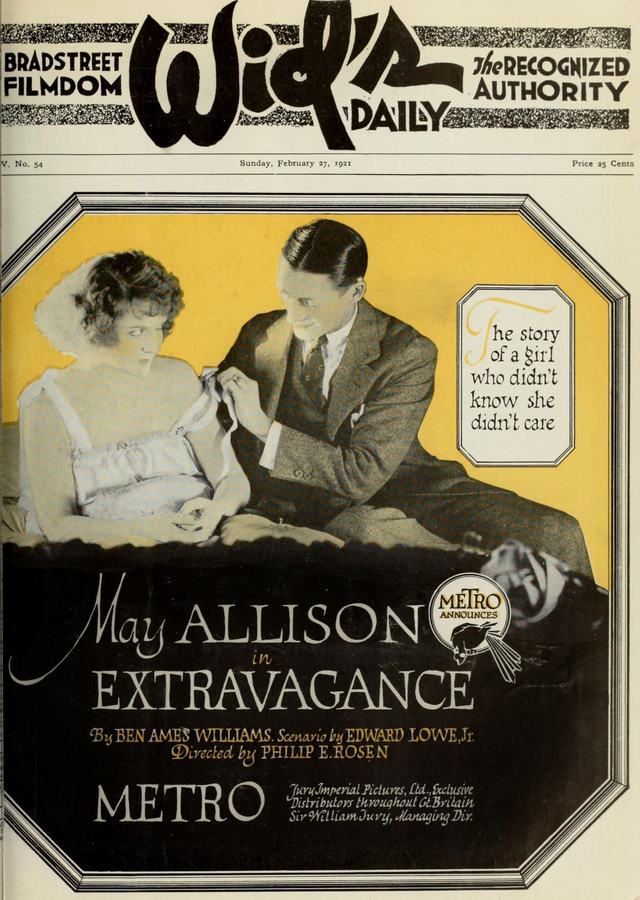
A sable pelt, ink-black and feral, slinks into the hushed Manhattan apartment of Jim and Esther like a caged omen; the moment Esther’s manicured fingers brush its collar, matrimonial oxygen thins.
The celluloid itself seems to goose-bump under Edward T. Lowe Jr.’s scenario, each frame marinated in chiaroscuro so luxuriant you can almost smell the benzene of the tinting bath. Director Phil Rosen doesn’t merely photograph a marriage collapsing—he x-rays it, letting the negative space between spouses yawn wider than any Sea Sirens frame ever dared.
Esther, played by May Allison with the brittle radiance of a champagne flute already cracked, believes the sable will staple her identity to the skyline. Instead it unspools her. Watch the way Allison’s pupils dilate when she first strokes the fur—an orgasmic shudder that the Hays Office, had it existed, would have ordered burned. Contrast that with Theodore von Eltz’s Jim: shoulders rounded like a man forever buttoning the wrong hole, voice (via intertitles) pitched in accountant’s shorthand. Their first shared shot is symmetrical bliss; by reel three, Rosen fractures the composition with a diagonal mirror, splitting husband from wife as cleanly as a ledger torn in half.
Lawrence Grant’s Morrell arrives in a dinner jacket so impeccably wicked it could auction orphans. He is the original lifestyle influencer: a man who sells atmosphere by the cubic foot. Grant plays him with a smile that never fully opens, as though even his molars hold IOUs. His seduction of Esther is less carnal than fiduciary—he teaches her that time itself can be leased, that a midnight cab ride can be expensed to tomorrow’s despair.
When Jim steps in front of the El train, Rosen withholds the impact. We see only the coat—Jim’s modest Chesterfield—billowing onto the tracks like a rejected ledger page. The moment is echoed later when Esther hurls the sable back at the shop clerk: two garments abandoned, two lives liquidated, yet only one death makes the headlines. The censors demanded retribution; the film delivers something more acidic—an existential void wearing a price tag.
Grace Pike’s Alice is introduced sipping a malted through a straw, eyes wide as trolley tokens. She functions as the film’s future tense: every warning Esther ignored, Alice still has the luxury to heed. Their single scene together—a powder-room tête-à-tête lit by a lone bulb that flickers like a moral tachycardia—plays like a relay baton of doom. Pike’s tremulous gratitude when Esther hands over the coat feels obscene, as though innocence itself were accepting stolen goods.
Cinematographer Allen G. Siegler shoots credit like a ghost: lace curtains billow into negative space, streetlights flare into over-exposed halos that resemble unpaid bills. Note the recurring motif of doorways: every threshold is framed like a mouth ready to swallow savings. Even the sable, when hung, casts a shadow shaped suspiciously like a zero.
While Carnival reveled in orchestral bravado, Extravagance trusts the rasp of projector gears—each clack a heartbeat, each flicker a deficit. Contemporary reviewers complained the film lacked “relief”; they missed the point. Relief would be a commercial break, a chance to breathe away from the film’s merciless arithmetic.
Allison’s greatest trick is letting Esther’s desperation peek through the peacock postures. Watch her calculate the tip at a speakeasy: eyes narrowing like a gambler counting cards she’s already played. Von Eltz, meanwhile, carries the physical vocabulary of a man perpetually smelling sour milk—his shoulders rise to his earlobes whenever Esther mentions “little extras.” By the time he purchases the revolver, we realize he’s merely balancing the books the only way his ledger allows.
Where Below the Surface moralizes through aquatic rescue, and The Upper Crust satirizes via dinner-table skirmishes, Extravagance offers no buoy. Its closest cousin in cruel clarity is Il processo Clémenceau, yet even that film grants the dignity of courtroom rhetoric. Here, the verdict is mutely inscribed on a sales slip.
Stream it today and the sable might as well be a Birkin financed by Klarna; Morrell, an Instagram wealth guru promising passive income through forex. Jim’s suicide reads like a Reddit post headed “Can’t make minimum payments—out of options.” The film’s 1921 release date is merely a production detail; its expiration date is never.
The 2022 4K restoration by EYE Filmmuseum harvests details invisible since premiere night: the satin piping on Morrell’s smoking jacket, the micro-beads of sweat on Esther’s philtrum when she signs the installment contract. Tinting reinstates the cobalt of 3 a.m. despair and the arterial red of exit signs. Most chilling is the intertitle formerly lost: “A future paid for yesterday is a past due tomorrow”—a line that should be emblazoned on every credit-card statement.
Extravagance doesn’t ask you to pity Esther; it asks you to audit the ledger you carry in your own marrow. Every viewer leaves the theater wearing an invisible coat—cut to measure by desire, lined with denial. The only question remaining is whether you’ll notice the stitches tightening before the fabric devours you.
IMDb —
1919
Community
Log in to comment.