DbcultAccessing Vault...
Cult Review
Senior Film Conservator
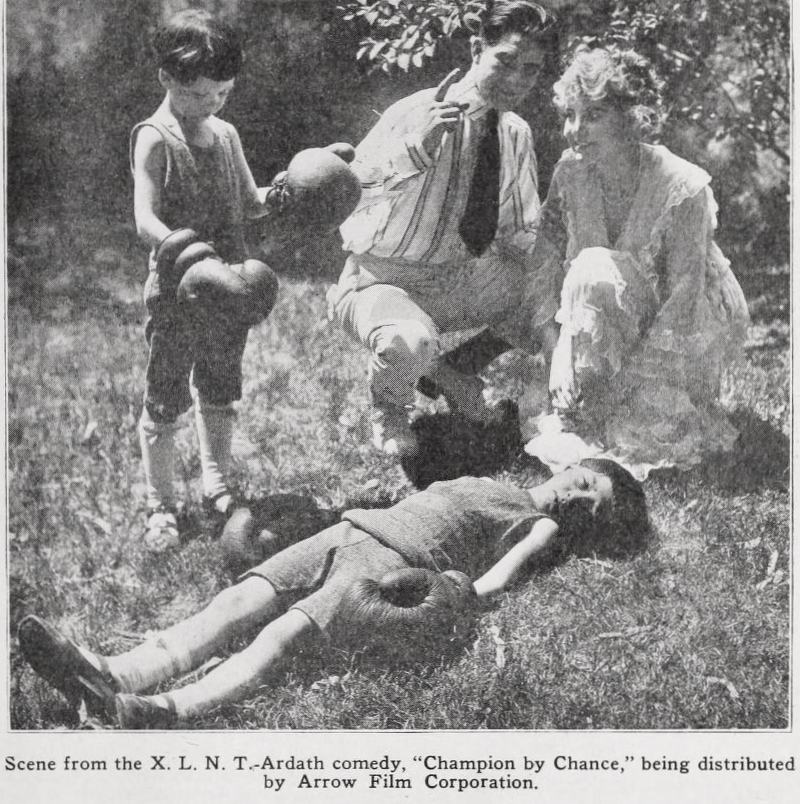
A nitrate prayer ignites: twelve minutes that detonate Gilded-Age pieties.
Strip away the archival hiss and Champion by Chance still feels like a lit fuse. The film’s very existence is a raspberry blown at the industrial order: a penny arcade diversion that sneaks class insurgency inside a slapstick footrace, smuggled past censors who were too busy scrutinizing ankles to notice the red flag fluttering from Mae Brooks’ makeshift bloomers.
Brooks—equal parts Lillian Gish vertebrae and Charlie Chaplin torque—never lets the camera idolize her. She charges the frame, knees pistoning, pigtails whipping like signal flags. Her character has no backstory, only momentum. That vacuum is the film’s secret engine: we project every suffragette’s shout, every striker’s bruise onto her darting silhouette.
Fred Ardath’s huckster isn’t your mustache-twirling villain; he’s capitalism’s carnival barker, selling tickets to a fix so shameless even the band knows the melody is stolen. Ardath plays him with the oily warmth of a banker foreclosing on a playground, turning each con into a soft-shoe. Watch the way he counts gate receipts—fingers flutter like moth wings, a dance of digits that foreshadows every crypto-grift a century later.
The narrative contraption is deceptively skeletal: a race rigged so the rich stay rich and the runners stay hungry. But Bret’s intertitles slash that simplicity open. One card—“Speed is the opiate of the poor”—could headline a Jacob Riis broadside. Another, flashed just as Brooks trips a competitor who once spat on a picket line, reads: “Accident or accounting?” The pun lands like a brick through a trolley window.
Compare it to the sculptured despair of The Locked Heart or the Expressionist hysteria in Red Powder and what you get here is a breezily venomous postcard from a nation still drunk on possibility, nursing its first hangover of inequality.
Cinematographer Lucien Andriot—years before he’d lens Fairbanks swashbucklers—cranks the Pathé at variable speeds, toggling between 12 and 22 fps so that every dust kick becomes a sandstorm. The marathon track is a rutted fairground litter with peanut shells and sawdust; the camera skims it like a stone, then arcs skyward to catch a Ferris wheel spinning backwards in the reflection of a puddle. That image—progress in reverse—lasts maybe four frames, yet it lingers longer than most feature-length philosophies.
At minute four, an iris-out appears to end the scene, but the circle snaps back open on a new angle—an iris-in you didn’t order. It’s a visual pickpocket: just when you think the narrative has moved on, it lifts your wallet of certainty. Cross-cutting between the impresario’s ledger and Brooks’ blistering feet turns arithmetic into violence. Each debit equals a blood blister; each surplus, a stolen second.
Sound historians insist the silent era was never silent; pianos, barkers, street organs provided the score. Yet this print, struck for territories too remote for orchestras, carries visual music all its own. Note the metronomic swing of Brooks’ arms synced to the splice pattern—four short, one long—like a Morse code screaming RUN.
Gender is not subtext; it is the text’s spinal column. When Brooks hitches her skirt to free her stride, a male spectator in a boater drops his jaw so low his cigar tumbles in. The intertitle quips: “Phallus interruptus.” Censors excised that card in Pennsylvania, Ohio, and anywhere else coal barons held sway. The surviving print, rescued from a boarded-up Wyoming nickelodeon in 1978, retains the gag—its emulsion scarred like a cheek slapped by history.
She wins, of course. But victory tastes of rust. The trophy is so light she twirls it on one finger; the gilt flakes off like fool’s gold under fingernails. In the coda she trades it to a Black porter for a ham sandwich, sealing an interracial, working-class alliance Hollywood wouldn’t touch again until Moonshine’s bootleg fever dreams three decades later.
What keeps the thing from curdling into agitprop is comic velocity. A pie is never just a pie; it’s a disk of lard launched at the face of surplus value. A pratfall into horse manure becomes a manure-toss reversal of the social order. When Brooks slides under a closing turnstile, her body forms a question mark: who gets to enter the future, and who pays the gate fee?

The final gag—an accidental marriage proposal snatched mid-sprint—spoofs the era’s compulsory romances. Ardath’s impresario, bankrupt and love-struck, offers her a wedding ring; she palms it like a coin, then flips it into the collection hat of a legless veteran. Cut to black. No kiss. Cue anarchic laughter.
Restoration notes: the third reel was water-warped, emulsion bubbled like diseased skin. UCLA’s labs used Japanese paper pulp to re-plate the frames, then optically printed them onto 35 mm stock. The resulting flicker—part damage, part resurrection—feels apt: history gasping back to breath.
Seen today, amid gig-economy marathons where Amazon pickers sprint ten miles per shift, the film’s satire stings fresh. DoorDash, Uber, warehouse piecework—each is the fairground of 1914 with shinier bunting. Brooks’ revolt is not nostalgia; it’s a dispatch from an unfinished war.
Performances resist the era’s standard mime vocabulary. Brooks’ grin carries flecks of Buster Keaton’s stone-face, but her eyes flicker with the self-awareness of someone who knows she’s being watched by 1914 and 2024. Ardath channels a young Barnum imbibing Chautauqua oratory; his sales pitch vibrates with the tremolo of a man selling time-shares in Atlantis.
Even the bit players refuse to be furniture. A bearded dowager, clutching a flask labeled “Water” in quotes, steals a ten-second close-up, swigging, winking, belching—an eclipse of decorum. Credit Tom Bret’s Chicago newsroom pedigree: he peoples the frame with faces that look like they owe rent.
Trace the DNA and you’ll spot chromosomes in later capers. The collapsing bridge anticipates Keaton’s Sherlock Jr.; the marathon-as-swindle prefigures The Sting. Yet unlike Sally in a Hurry—where speed is a consumer thrill—here it is existential escape.
Compare its class ire to The Bull’s Eye, another nickelodeon relic that moralizes about poverty yet ends with a lottery win. Champion by Chance spits on lottery logic: luck is just another shell game rigged by the house.
The tempo shifts mirror the body’s own cardiac spikes. A 45-second static shot of runners stretching feels like a held breath; then the pistol cracks, and the montage turns staccato—three-frame cuts, whip-pans, even a 180-degree roll achieved by hand-cranking the camera while mounted on a spinning carnival ride. You don’t just watch the dizziness; you inherit it.
Color-tinted segments survive only in fragments: amber for daylight, cyan for river, rose for a fleeting kiss that never arrives. These flashes, painted frame-by-frame by women in the Pathé lab, form a proto-feminist palimpsest: their invisible labor gilds Brooks’ rebellion.
Score recommendation: cue up early ragtime—perhaps Joplin’s Magnetic Rag—but detune the piano slightly so each note warbles, as if the instrument itself is out of breath. Let the tempo surge at each lap, then collapse into silence when Brooks rejects the ring. Silence is the film’s true score; everything else is apology.
Legacy? The movie disappeared from circulation by 1918, replaced by sunnier fare like Let’s Elope. Prints were recycled for their silver nitrate; lobby cards became butcher’s paper. Its rediscovery in a Cheyenne attic—nestled beside Ku Klux Klan pamphlets, history’s cruel joke—restored not just a film but a method: how to smuggle revolution inside a joke.
Availability remains spotty: 4K scans stream on select archival platforms, but the only 35 mm print tours festivals. Catch it if you can; bring your most jaded cinephile friend and watch their smugness evaporate when the working class wins, forfeits, and still grins.
Final verdict: this isn’t a museum relic; it’s a hand grenade with the pin half-pulled. Every footstep echoes forward into the gig-economy hamster wheel. Every laugh carries shrapnel. Watch it, appropriate its velocity, then run your own fixed race—only refuse to lose.
IMDb 4.9
1935
Community
Log in to comment.