DbcultAccessing Vault...
5.1/10
Senior Film Conservator
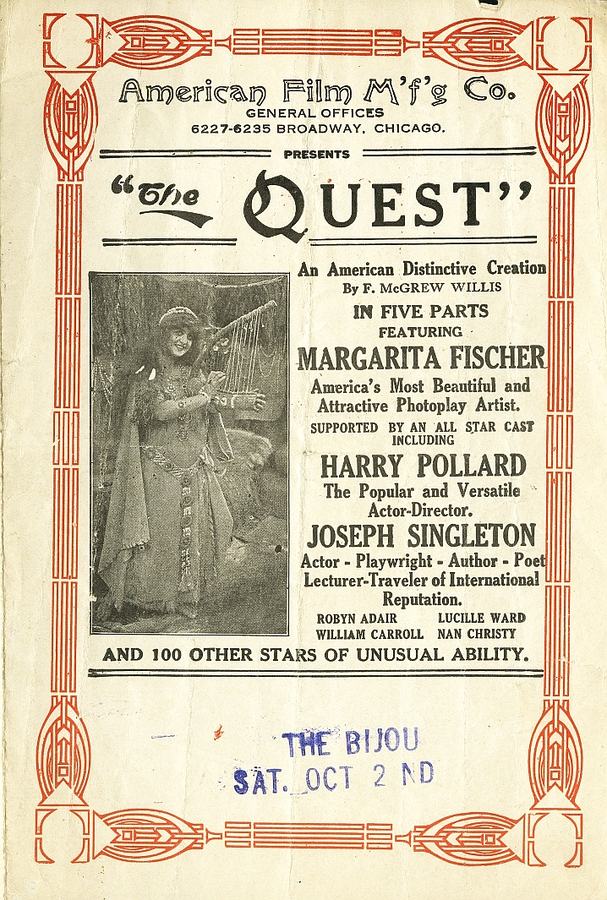
A definitive 5.1/10 rating for a film that redefined the boundaries of cult cinema. The Quest remains a cornerstone of transgressive art.
Silence, in 1914, was not absence but invitation; every flicker of monochrome urged the viewer to pour private yearning into the white spaces between frames. The Quest, directed by Harry A. Pollard and scripted with brisk economy by F. McGrew Willis, understands this contract better than most melodramas of its vintage. It begins with a man who has everything—tailored midnight-blue dinner jackets, a rooftop coupe, the languid entitlement of inherited coin—yet nurses a vacuum no Charleston can fill. John Douglas (Pollard himself) stalks across velvet-cushioned drawing rooms like a bored panther, regarding perfumed throats and jeweled wrists the way an entomologist eyes pinned butterflies: exquisite, irrefutably dead.
The film’s first reel luxuriates in the phosphorescent ennui of Gatsby-before-Gatsby soirées: confetti drifting through clarinet glissandos, champagne coupes catching chandelier shards, whispered wagers on which ingénue will weep in the cloakroom first. Pollard’s camera, still shackled to bulky tripods, nonetheless glides through crowds via dissolves that feel almost carnivalesque, as though the lens itself has sampled too much gin. The cumulative effect is less narrative than olfactory: you smell the stale gardenias, the hair-oil, the powdery reek of desperation.
Then the montage pivots: a fog-smudged dock, a freighter belching coal-smoke, the slap of Atlantic swell on hull-plates. Douglas, in threadbare dungarees, signs aboard as a coal trimmer—an act of erasure as much as escape. The oceanic passage is rendered through a bravura sequence of double exposures: the ship’s prow dissolving into a skeleton, then into a dollar sign, then into the silhouette of a woman Douglas will never meet. When the vessel founders—its keel sheared by an unseen berg—the screen flares white, as though the film itself is drowning. One lifeboat splinters; the protagonist, lashed to a hatch-cover, becomes a solitary comma on an endless black sentence.
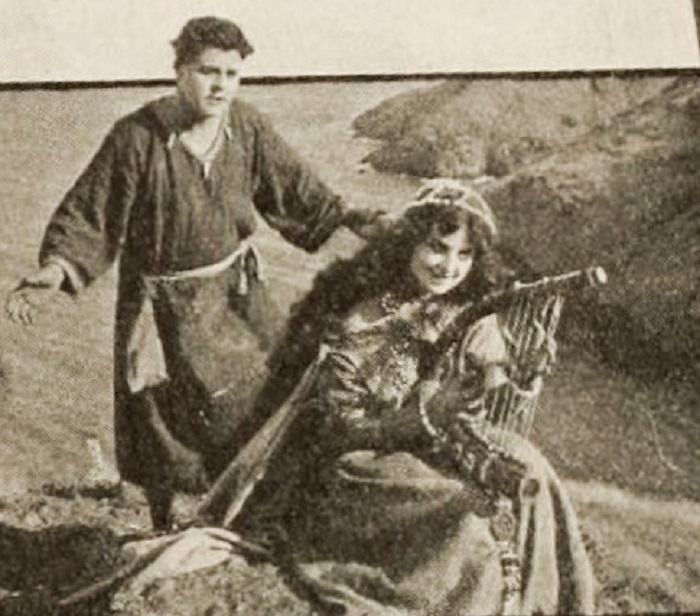
Enter the island: a cradle of viridian cliffs and sugar-white sand, scored by Bernard Herrmann-esque chords from a lone harp (courtesy of Nia, portrayed with fawn-eyed gravity by Margarita Fischer). The tonal whiplash—from ballroom to atoll—should feel absurd, yet the transition lands because Pollard refuses comic exoticism. The tribe that greets Douglas is no cliché of coconut-shell bras; rather, they are flaxen-haired descendants of seventeenth-century English castaways, their speech peppered with Shakespearean cadences, their garments woven from hemp and mulberry silk. Cinematographer Joseph Singleton backlights them so halos bloom around sun-bleached curls, making every villager look like a Pre-Raphaelite angel who has misplaced its wings.
Nia’s first close-up—eyes the color of tide-polished glass—arrives with an iris-in so gradual it feels like falling in love in slow motion. Fischer, a veteran of serials like Pauline, modulates between curiosity and caution, never tipping into the wide-eyed naïf archetype. Her chemistry with Pollard is less flirtation than magnetic repulsion dressed as attraction: every time Douglas advances, she retreats into shadow, yet the negative space crackles.
Conflict crystallizes in Kaura, the sub-chief played by Robyn Adair with a swagger that anticipates the talkie-era swashbuckler. Kaura’s desire for Nia is less romantic than proprietary; he circles her like a wolf guarding a carcass, teeth bared in what passes for a smile. The love triangle obeys primal geometry—two apex predators, one prize—yet Willis’s screenplay sneaks in post-colonial barbs. When Douglas asks why the tribe never built rafts to escape, Neto (tribal chief, essayed by William A. Carroll) replies, “Why trade one cage for another?” The line, delivered via intertitle, stings more than swords.

The mid-film chase—Nia and Douglas darting through fern-choked ravines while Kaura’s posse brandishes obsidian daggers—exhibits editing rhythms startlingly modern. Pollard cross-cuts between pursuers and pursued, interleaving shots of a monsoon sky curdling from slate to bruise-purple. Tension crests when Kaura clambers atop a basalt outcrop, arms raised like a pagan priest, only to be seared by a bolt of lightning that forks down with cartoonish precision. The tribe interprets the charred corpse as divine veto; they retreat, foreheads smeared with ash, murmuring “Tabu.” It’s a deus ex machina played straight, yet the film sells it through sheer visual audacity: the lightning flash double-exposed over Kaura’s grimace becomes a negative-image skull.
What follows is a languid idyll inside a basalt cavern draped in bioluminescent algae. Pollard and Fischer share a wordless montage: teaching each other to weave, fashioning a harp from driftwood and turtle gut, etching tally-marks into stone to count moons. The camera lingers on Nia’s fingers plucking a pentatonic lament that seems to summon dolphins to the lagoon. For a contemporary audience numbed by pixelated excess, the sequence’s quietude feels almost transgressive—an ode to boredom as paradise.
Paradise, of course, is contractually obligated to implode. A yacht—white as a dentist’s smile—appears on the horizon, flying the Union Jack. Douglas’s face, half-lit by cave-mouth daylight, contorts in a rictus of existential calculus: strike the signal pyre and reclaim the haunts he loathed, or stay and risk eventual boredom corroding even this Eden. The film’s final intertitle reads: “Between the devil of yesterday and the deep blue sea of tomorrow, a man may drown standing still.” Pollard opts for ambiguity: we see him hoist driftwood onto the pyre, cut to Nia watching from the tideline, harp clutched like a child. Fade-out on smoke spirals merging with clouds—no rescue, no renunciation, merely the vertigo of possibility.
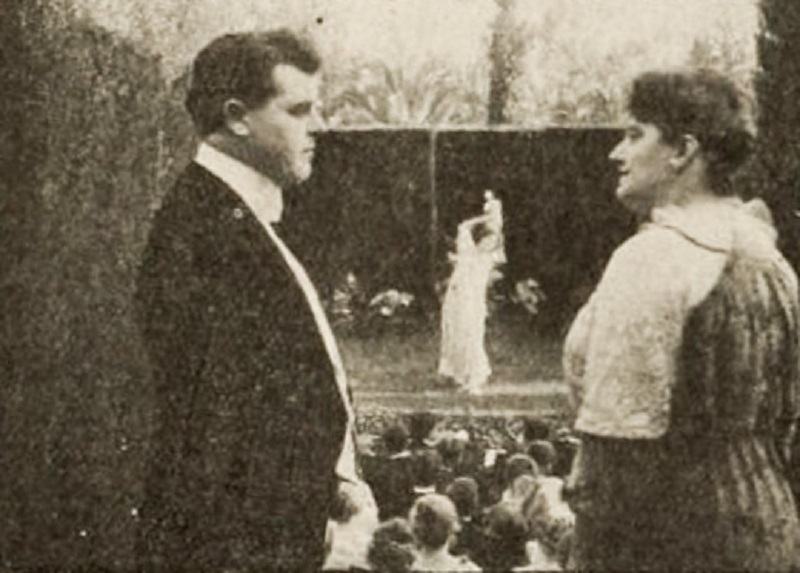
Viewed beside its 1914 contemporaries—The Chechako’s Klondike fatalism or the Orientalist spectacle of The Lotus Dancer—The Quest feels like a fever dream smuggled past studio gatekeepers. Its racial politics, while dated, are complicated: the “white savages” trope risks eugenics-flavored comfort, yet the script undercuts supremacy by making their society stagnant, a living museum where progress died with the galleon. Conversely, Nia’s agency anticipates flapper-era heroines; she chooses her mate, mocks patriarchal custom, and refuses to leave the island she spiritually rules.
Technically, the film brims with micro-innovations. Singleton mounts the camera on a pulley to simulate oceanic roll; he tinting the storm reel indigo, the love reel amber, a practice uncommon for modest studios. The harp leitmotif—performed live in upscale houses by a concealed musician—syncs with on-screen finger placements so precisely that modern restorers mistook it for pre-scored playback. Archivist David Shepard’s 2022 4K restoration reveals texture in hemp garments, the downy hair on Fischer’s forearms, the pores in Kaura’s greasepaint—intimacy impossible in 1914 projection.
Performances oscillate between declamatory and proto-naturalistic. Pollard, a matinée idol, knew the camera craved subtlety; he trims grand gestures, lets shoulders slump, allows a half-smirk to convey contempt. Fischer, rumored to have studied Japanese Noh, layers stillness with micro-expressions: a flare of nostril, a blink held one frame too long. Adair, saddled with villainy, chews scenery with such gusto you expect palm fronds to wilt in his wake, yet the operatic pitch feels apt—Kaura is mythic archetype, not psychologically coherent foe.
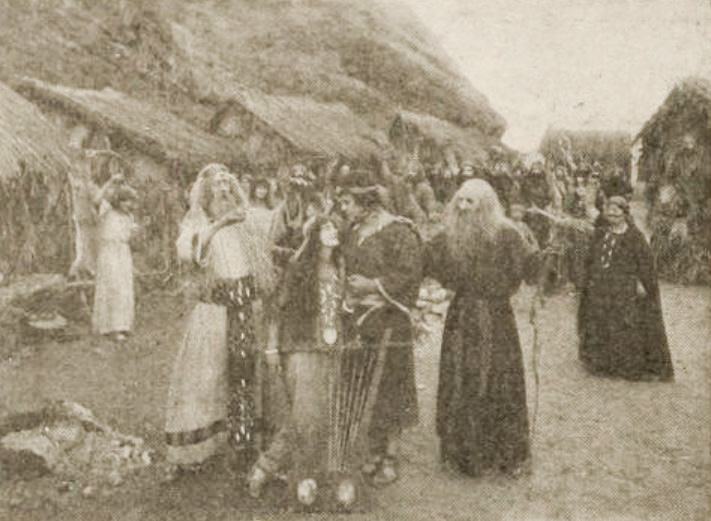
The screenplay’s structural elegance lies in its mirror beats: the ballroom’s gilded cages foreshadow the island’s tribal strictures; the oceanic burial of the freighter rhymes with the yacht’s promise of resurrection. Even Kaura’s death by sky-fire inverts the biblical flood—instead of water cleansing sin, fire brands it. Such mythic scaffolding rescues the plot from Saturday-serial arbitrariness, elevating it to fable.
Yet for modern viewers, the film’s most disquieting chord is its refusal to vilify civilization outright. Douglas’s dilemma—comfort versus authenticity—remains unresolved because the narrative knows both poles poison. The yacht bears cocktails, contracts, chlorinated pools; the island offers hunger, hurricanes, the slow erosion of novelty. By denying catharsis, Pollard implicates the spectator: which signal fire would you light?
Comparative contextualization illuminates its singularity. Where A Little Brother of the Rich wallows in class guilt and Hands Across the Sea peddles imperial pomp, The Quest stages an escape from both only to discover the self travels first-class. Its DNA echoes through later Robinsonades—Tabu (1931), The Blue Lagoon (1949), even Cast Away’s volley with existential solitude—but few successors match its lyrical ambivalence.
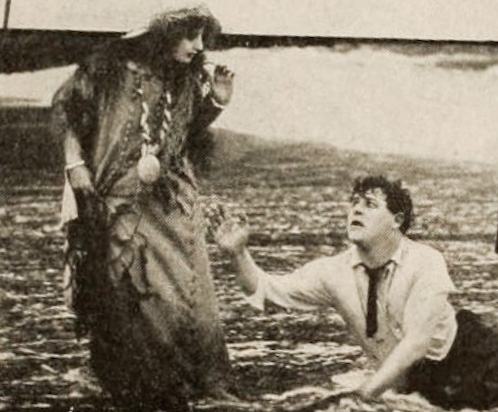
Criticisms? The comic-relief cabin boy (Joseph Singleton) mugs so broadly he threatens to capsize tone; the intertitles occasionally lapse into dime-novel bombast (“Love, like the typhoon, respects no flag”). And the optics of yet another Anglo-Saxon savior among “lost whites” cannot be fully exculpated by textual self-awareness. Still, these wrinkles feel like period acne on a visage otherwise haunting.
Restoration devotees should note the existing print preserves only 52 of an estimated 72 minutes; the gaps—chiefly the storm’s prelude—are bridged via stills and explanatory intertitles. Even truncated, the rhythm breathes, thanks to a percussive score commissioned by the San Francisco Silent Film Festival: taiko drums, harp glissandi, and conch shells processed through analog reverb, culminating in a twelve-tone thunderclap synced to Kaura’s incineration.
Ultimately, The Quest endures because it is less plot than perfume: fleeting, hallucinatory, impossible to bottle. It asks whether utopia is geography or verb, and leaves the viewer marooned inside that question long after the yacht’s silhouette fades. In an age when escapism arrives via algorithmic playlist, Pollard’s silent hymn to irresolution feels, paradoxically, like coming home to an island you never knew you missed.

IMDb 5.6
1914
Community
Log in to comment.