DbcultAccessing Vault...
Cult Review
Senior Film Conservator
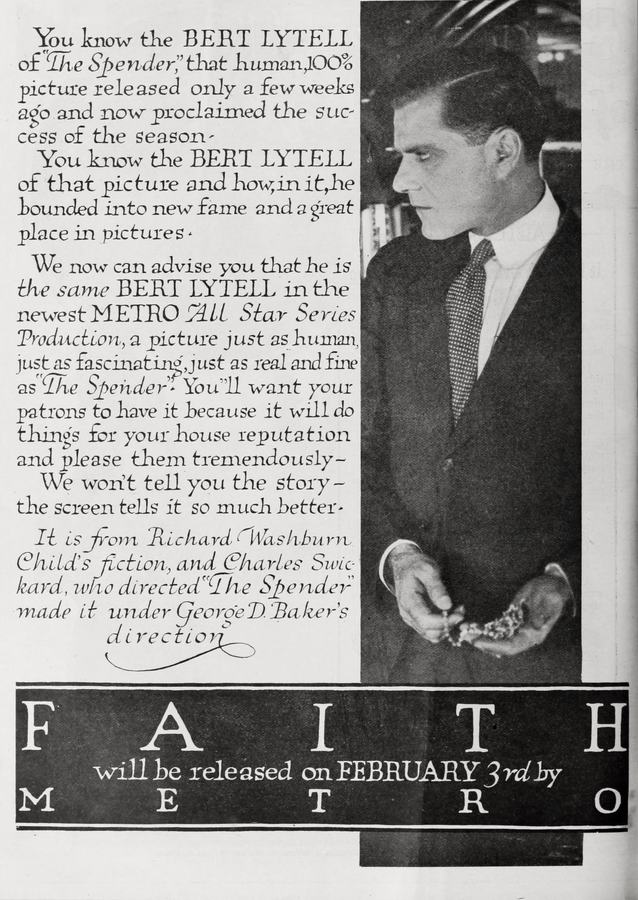
Stepping back into the cinematic landscape of 1919, one encounters a fascinating tapestry of storytelling, often imbued with straightforward moral lessons yet frequently executed with surprising nuance. Amidst this vibrant era of nascent film language, George D. Baker's Faith emerges not just as a narrative, but as a compelling ethical crucible, a quiet yet potent exploration of integrity, temptation, and the unexpected pathways to personal redemption. This silent drama, featuring the earnest Bert Lytell, delves into the very core of human character, posing questions that remain remarkably pertinent even a century later. It's a testament to the enduring power of simple, well-told stories that resonate beyond their immediate historical context.
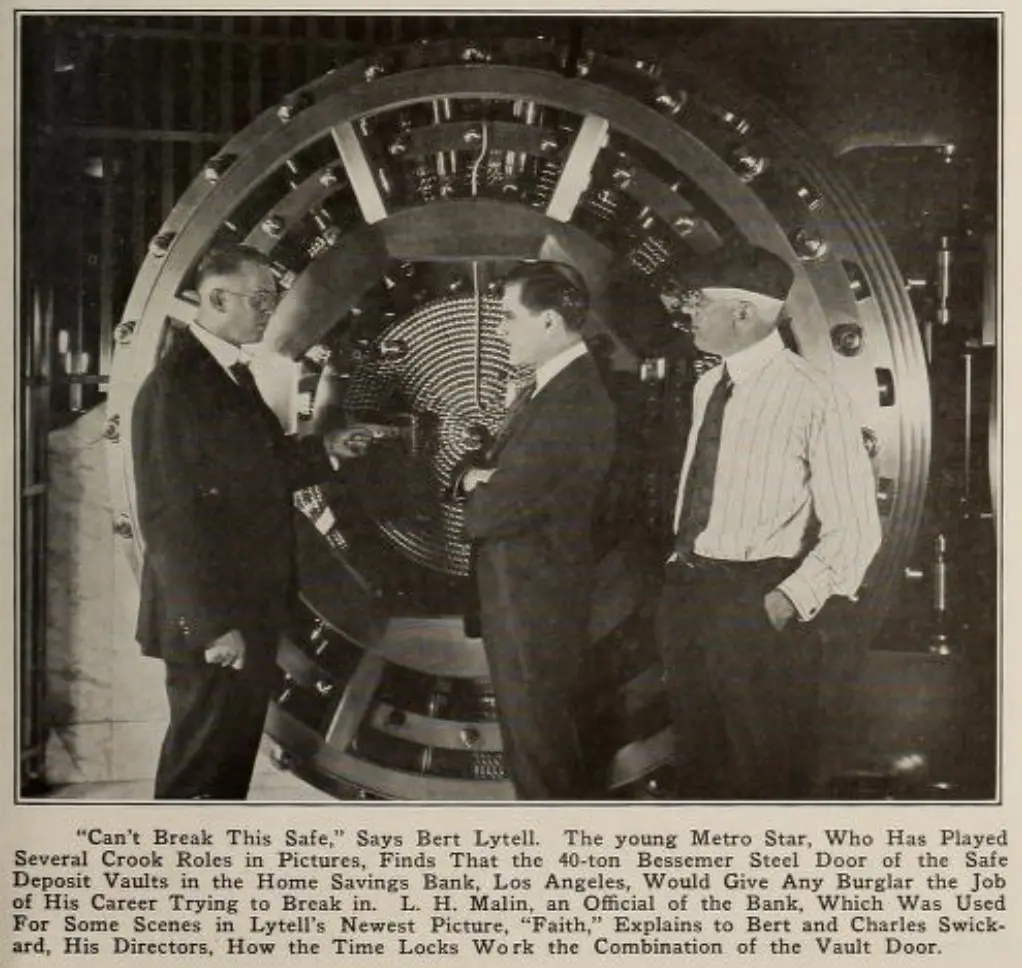
At the heart of Faith lies George Farrelly, portrayed with a subdued intensity by Bert Lytell. George is introduced as a man tethered to the monotonous rhythm of his existence, a custodian overseeing the formidable safe-deposit vaults within a bustling New York bank. His life, one imagines, is a daily exercise in quiet diligence, a guardian of others' fortunes while his own seems to stagnate. This mundane routine is shattered by the arrival of Charity Garvice, his childhood sweetheart, a beacon of warmth and concern played by Rosemary Theby. Charity brings with her an unsettling message from Martha Owen, George's venerable, blind former teacher (Edythe Chapman). Martha, possessing an almost extrasensory perception, harbors a premonition—a deep-seated feeling that George's life is veering toward a crisis, an impending moral challenge. This spiritual intuition sets the stage for the film's central dilemma, transforming a simple bank employee into an unwitting protagonist in a drama of conscience.
To alleviate Martha's palpable anxiety, George weaves a tale, a fabricated confession designed to both satisfy her premonition and perhaps, subconsciously, to explore the very boundaries of his own ethical framework. He describes discovering a diamond necklace, an object of immense value, carelessly left unattended outside a strong box belonging to the formidable bank president Harrington's wife. This moment of discovery morphs into a moment of profound temptation. George recounts how he almost, but not quite, bestowed the glittering bauble upon an unnamed young woman, only to ultimately retain it, rationalizing his decision by claiming it was "too late" to return it. It's a narrative fraught with psychological tension, a hypothetical fall from grace that George presents as a mere story.
Martha, with her profound inner sight, accepts George's "confession" at face value, offering sagely advice: the necklace must be returned. Her counsel, delivered with quiet conviction, brings her a sense of peace, a belief that George has chosen the path of righteousness. Yet, the true drama unfolds when George, burdened by the weight of his secret, confesses to Charity that his elaborate tale was no fiction; it was the unvarnished truth. This revelation plunges Charity into a vortex of fear and moral anguish, highlighting the precariousness of George's position and the potential for his downfall. Her reaction underscores the societal stakes involved, not just for George's soul, but for his standing and future.
The subsequent act of restitution, George's courageous decision to return the necklace, is a turning point. It's a moment pregnant with consequence, as he confronts Harrington, the powerful bank president (Edwin Stevens). Harrington, instead of immediately summoning the authorities, grants George a single, agonizing hour—an hour to put his affairs in order, specifically to see Charity, before the police are called. This gesture, seemingly magnanimous yet chillingly conditional, ratchets up the tension, creating a race against time for George to secure his future with the woman he loves. In a whirlwind of emotion and urgency, George marries Charity, a commitment forged under the shadow of impending legal repercussions.
The climax, however, delivers a masterful twist. Harrington reveals that the entire incident, the "missing" necklace, the temptation, George's confession, and his eventual restitution, was an elaborate, meticulously orchestrated test of character. The necklace was deliberately left out, a bait to gauge George's honesty and integrity. Far from being prosecuted, George's display of moral fortitude is rewarded: Harrington offers him the coveted position of assistant manager. This stunning reversal transforms a tale of potential disgrace into one of profound vindication and upward mobility, all hinging on a solitary moment of truth. It's a narrative arc that speaks volumes about the value placed on ethical conduct, even in the cutthroat world of early 20th-century finance.
Faith, as its title suggests, is fundamentally about trust—trust in oneself, in others, and in a higher moral code. The film masterfully explores the insidious nature of temptation, not as a grand, dramatic lure, but as a quiet, opportunistic whisper. George's initial act of taking the necklace isn't portrayed as a premeditated crime, but rather a moment of weakness, a lapse in judgment born from perhaps boredom, a sense of unfulfillment, or simply the sheer audacity of the opportunity. This makes his struggle all the more relatable and human. It's a classic moral dilemma, reminiscent of works like Temptation, where characters grapple with choices that could redefine their lives.
The role of Martha Owen, the blind teacher, is crucial. She represents an almost spiritual conscience, a moral touchstone for George. Her premonition, devoid of concrete details, taps into a universal human experience: the feeling that something is amiss, a sense of impending consequence. Her blindness paradoxically grants her a deeper insight, allowing her to "see" beyond the superficialities of George's fabricated story to the truth of his inner turmoil. This symbolic representation of wisdom and intuition elevates the film beyond a simple crime-and-punishment narrative, infusing it with a more profound, almost allegorical dimension.
Charity's role, too, is pivotal. Her name itself is symbolic, embodying the selfless love and concern she holds for George. Her anguish upon learning the truth is not judgmental, but deeply empathetic, reflecting the societal pressures and potential ruin that George faces. She acts as his emotional anchor, a tangible reason for him to choose the righteous path. Their hasty marriage under duress highlights the urgency of their bond and George's desperate desire to secure their future, even as his past threatens to unravel it. This intertwining of personal love and moral rectitude provides a powerful emotional core to the story.
The film’s ultimate revelation—that the entire incident was a test—is a stroke of narrative genius, characteristic of the era's fascination with moral instruction and character building. It transforms a story of potential downfall into a celebration of integrity. This kind of "trial by fire" narrative can be seen in other films of the period, albeit with different outcomes, such as The Cheat (1915), where moral compromises have far more devastating and irreversible consequences. Faith, however, chooses a more optimistic, albeit dramatically tense, resolution, affirming the belief that honesty ultimately triumphs. It speaks to a societal desire for clear moral lessons, where virtue is rewarded, and integrity is a path to advancement.
The film also touches upon themes of social mobility and the American dream. George, a mere custodian, is elevated to assistant manager, not through nepotism or cunning, but through the sheer force of his character. This narrative arc reinforces the idea that hard work and, crucially, unwavering honesty, are the true keys to success. It's a message that resonated deeply in post-WWI America, a nation grappling with industrialization, social change, and the persistent ideal of meritocracy. The contrast between George's initial "bored" existence and his ultimate professional triumph underscores the transformative power of a single, correct moral choice.
In the silent era, the burden of conveying complex emotions and intricate plot points fell squarely on the actors' expressive faces, gestures, and the director's visual storytelling. Bert Lytell as George Farrelly delivers a performance that is both understated and profoundly effective. He convincingly portrays the internal conflict of a man caught between a moment of weakness and a deep-seated desire for righteousness. His shifts from mundane resignation to panicked confession, and finally to relieved vindication, are handled with a subtlety that avoids histrionics, a common pitfall of early cinema. Lytell's ability to communicate George's moral struggle without uttering a single word is a testament to his skill and the refined acting techniques emerging in the late 1910s.
Edythe Chapman's portrayal of Martha Owen is particularly noteworthy. As the blind teacher, she exudes an aura of serenity and wisdom that makes her premonitions and counsel entirely believable. Her expressive face conveys deep concern and ultimate relief, anchoring the film's moral center. Rosemary Theby, as Charity Garvice, brings a vital emotional intensity to the screen. Her distress and unwavering loyalty to George are palpable, providing the audience with a tangible connection to the human stakes of George's dilemma. Edwin Stevens, as the formidable President Harrington, masterfully balances authority with an almost paternalistic concern, making his ultimate revelation both surprising and satisfying. His performance is key to the film's clever twist, ensuring that his character isn't merely a villain but a shrewd observer of human nature.
George D. Baker's direction, working with the script by Richard Washburn Child, George D. Baker himself, and A.G. Kenyon, is precise and economical. The film doesn't rely on extravagant set pieces but rather on intimate character interactions and carefully framed shots that emphasize emotional states. The pacing builds effectively, moving from the initial quiet monotony to the escalating tension of George's confession and the subsequent race against time. The use of intertitles is judicious, providing necessary exposition without overwhelming the visual narrative. This thoughtful approach to direction allows the core themes to shine through, demonstrating a growing sophistication in cinematic language. The film avoids the melodramatic excesses sometimes found in contemporary productions like Traffic in Souls, opting instead for a more focused, character-driven drama.
Released in 1919, Faith arrived at a pivotal moment in American history, just as the nation was emerging from the shadow of World War I and grappling with the dawn of the Roaring Twenties. It was a period of immense social and economic change, where traditional values were being questioned, yet the bedrock principles of honesty and integrity remained deeply ingrained in the cultural psyche. Films like Faith served not only as entertainment but also as moral compasses, reinforcing virtues that were seen as essential for a stable society.
The film’s focus on a "test" of character resonates with a long tradition in literature and drama, from biblical parables to classical tragedies. It taps into a fundamental human anxiety: how would one truly act when faced with an irresistible temptation and the apparent absence of immediate accountability? The answer, in Faith, is a hopeful one, asserting that innate goodness, when prompted by conscience and love, can prevail. This contrasts with more cynical portrayals of human nature found in some contemporary works, or even earlier films like The Unchastened Woman, which explored societal hypocrisy and moral ambiguity with a sharper edge.
While perhaps not as widely remembered as some of the blockbusters of its day, Faith offers a valuable glimpse into the storytelling conventions and moral preoccupations of its time. It's a film that quietly champions the virtues of honesty and the power of ethical choice, demonstrating that even a seemingly small act of integrity can lead to profound personal and professional transformation. Its narrative simplicity belies a sophisticated understanding of human psychology, making George's journey from custodian to assistant manager a compelling and ultimately uplifting one.
In an era where the lines between right and wrong often blur, Faith serves as a poignant reminder of the enduring value of integrity. It's a film that, despite its century-old vintage, retains a surprising freshness in its central message. The quiet tension, the heartfelt performances, and the satisfying resolution coalesce into a cinematic experience that, while firmly rooted in its silent film heritage, offers a timeless reflection on what it means to be truly honorable. It stands as a modest but meaningful entry in the annals of early American cinema, a testament to the power of a good story well told, proving that sometimes, the greatest tests of character occur not in grand battles, but in the quiet decisions of everyday life.
IMDb 6.8
1931
Community
Log in to comment.