DbcultAccessing Vault...
Cult Review
Senior Film Conservator
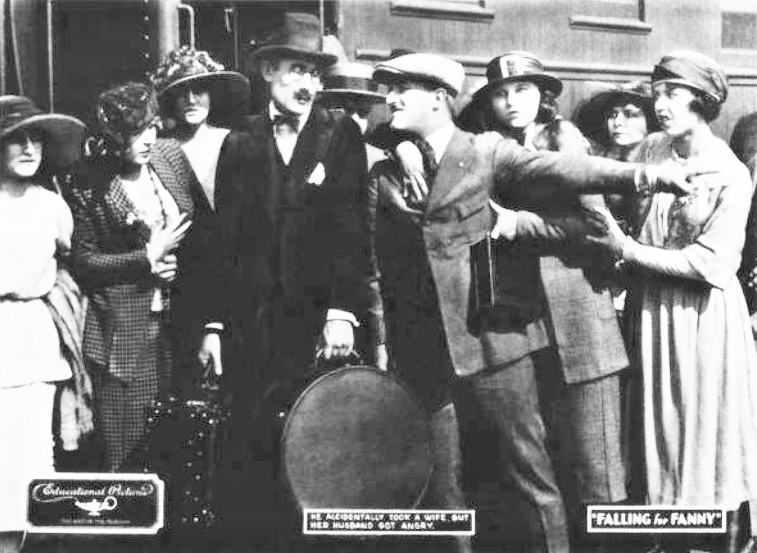
*Falling for Fanny* is a cinematic gem that marries the charm of classic Hollywood with the sharp edge of social satire. At its heart, the film unfolds as a series of escalating misjudgments, each more improbable than the last, yet meticulously crafted to feel authentic. The protagonist’s initial encounter with Fanny—a scene steeped in visual gags and awkward physicality—sets the tone for a narrative that thrives on the tension between sincerity and farce.
What begins as a simple act of following a woman home—a gesture simultaneously innocent and invasive—quickly spirals into a legal farce, with the protagonist’s arrest serving as a catalyst for his transformation. This sequence, rendered with both comedic timing and narrative purpose, underscores the film’s central theme: the futility of attempting to control fate. Director Frank Roland Conklin uses this incident to pivot the story from slapstick to introspection, a shift that is both surprising and thematically resonant.
Helen Darling’s performance is nothing short of electrifying. Fanny is not merely a romantic interest; she is a force of nature, her defiance rooted in a critique of the patriarchal norms that the protagonist embodies. Her arrest of the young man is less an act of cruelty than a declaration of autonomy, a theme that resonates deeply in the context of early 20th-century cinema. Darling’s nuanced portrayal—alternating between vulnerability and steel—elevates the film from a mere comedy to a subtle commentary on gender dynamics.
Eddie Barry’s protagonist is a study in contradictions. His earnestness, while endearing, is also his undoing, as his inability to adapt to Fanny’s world leads to a series of missteps that are as cringe-worthy as they are hilarious. Barry’s physical comedy is particularly effective in the post-arrest sequences, where his determination to prove his honor manifests in increasingly absurd gestures. Yet, beneath the surface, there’s a pathos to his character—a yearning for connection that transcends the film’s comedic framework.
To fully appreciate *Falling for Fanny*, one must situate it within the broader landscape of early Hollywood cinema. The film’s preoccupation with honor and redemption echoes themes found in works like *The Huntress of Men* and *Should Tailors Trifle?*, though it distinguishes itself through its sharper focus on romantic entanglements. Unlike the darker undertones of *The Man Who Laughs*, this film leans into a more lighthearted, almost whimsical tone, making it a standout in Conklin’s oeuvre.
The film’s visual language is deceptively simple. Conklin employs tight framing in dialogue scenes to heighten the tension between characters, while wide shots during the outdoor sequences emphasize the vastness of the world the protagonist must navigate to win Fanny’s trust. The use of shadow and light is particularly effective in the jailhouse scene, where the protagonist’s isolation is mirrored by the stark contrast of his environment.
Decades after its release, *Falling for Fanny* remains a testament to the enduring appeal of romantic farce. Its influence can be traced in later films such as *Princess Romanoff* and *The Ordeal of Rosetta*, though none capture the same balance of humor and heart. For modern audiences, the film offers a refreshing contrast to the overproduced rom-coms of recent years, reminding us that simplicity, when executed with precision, can be just as compelling as spectacle.
*Falling for Fanny* is more than a quaint relic of a bygone era. It is a meticulously crafted narrative that challenges its audience to find depth in the absurd. With its stellar performances, deft direction, and timeless themes, the film is a must-watch for anyone who appreciates the interplay of comedy and romance. For a deeper dive into similar works, explore The Huntress of Men or Should Tailors Trifle?, both of which offer fascinating counterpoints to this enduring classic.
IMDb 6.1
1934
Community
Log in to comment.