DbcultAccessing Vault...
Cult Review
Senior Film Conservator
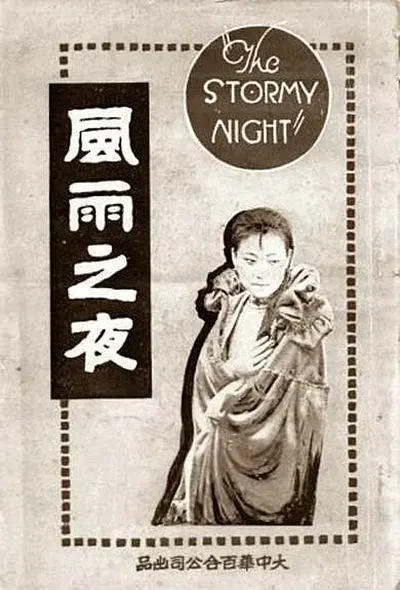
Is Fengyu zhi ye worth your time in an era of high-definition blockbusters? Short answer: yes, but only if you view cinema as a window into the evolution of human emotion rather than just a source of adrenaline.
This film is for the dedicated cinephile who finds beauty in the crackle of old celluloid and the exaggerated gestures of silent-era acting. It is emphatically not for those who require fast-paced editing or a linear, spoon-fed plot. It demands patience. It rewards focus.
1) This film works because it uses atmospheric environmental storytelling to mirror the psychological collapse of its characters before 'noir' was even a defined term.
2) This film fails because the second act suffers from repetitive pacing that can make its relatively short runtime feel significantly longer.
3) You should watch it if you are interested in the roots of Chinese melodrama or want to see how early filmmakers handled complex social themes without the benefit of synchronized sound.
Fengyu zhi ye is a vital piece of cinematic history. While many silent films of the mid-20s, like A Friendly Husband, leaned into lighthearted domesticity, Shouju Zhu takes a darker, more analytical path. The film is worth watching for the sheer technical ambition displayed in its lighting. In an era where flat lighting was the standard for efficiency, Zhu experiments with shadows that feel heavy and oppressive.
The performances, particularly by Yingzhi Wang, are surprisingly nuanced. Unlike the broad, pantomime style often seen in Western imports of the time like The Nervous Reporter, Wang uses her eyes to convey a sense of trapped desperation. It is a performance that bridges the gap between the theatricality of the 1910s and the psychological realism of the 1930s.
Director Shouju Zhu was not just a storyteller; he was an architect of mood. In Fengyu zhi ye, the house itself feels like a character. As the storm rages outside, the interior shots become increasingly cramped. Zhu uses the foreground—often placing furniture or architectural elements between the camera and the actors—to create a sense of voyeurism. We aren't just watching a family fall apart; we are spying on them.
Consider the sequence where Bingheng Yan's character confronts his own failings. The way the flickering light (simulating lightning) hits his face is masterfully handled. It’s not just a gimmick. It’s a rhythmic disruption that mirrors his fracturing psyche. This level of intentionality is something you often see in higher-budget Western productions like The Third Degree, but Zhu achieves it with far fewer resources.
When comparing Fengyu zhi ye to other films of the period, such as La belle Russe, the cultural differences in 'melodrama' become fascinating. While Western melodrama often relied on external villains and grand coincidences, Zhu’s work feels more internalized. The 'villain' here is the social pressure of the time. The conflict is the friction between what one owes their family and what one owes their own conscience.
The film lacks the frantic energy of Stop That Wedding, but it replaces it with a haunting stillness. Even the intertitles are used sparingly. Zhu trusts his actors to carry the weight of the narrative through movement alone. This is a bold choice for 1925, and for the most part, it succeeds. It works. But it’s flawed. The middle section drags as the film struggles to find a bridge between its quiet character beats and its explosive finale.
One cannot discuss Fengyu zhi ye without touching on its historical context. China in the mid-20s was a powder keg of intellectual and social revolution. This film captures that tension perfectly. The characters are dressed in traditional attire, yet their problems—infidelity, the pursuit of individual happiness over collective duty—are distinctly modern. It reminds me of the thematic depth found in Creation (1921), where the act of 'making' a new world is fraught with the ghosts of the old one.
The storm is the great equalizer. It doesn't care about social standing or the 'face' a family tries to maintain. When the roof leaks and the wind rattles the windows, the characters are forced to face their rawest selves. It is a brutal, honest depiction of humanity that feels surprisingly contemporary despite the silent format.
The cinematography is ahead of its time, utilizing deep focus and creative lighting to tell a story that words (or intertitles) couldn't. The acting is restrained, avoiding the 'eye-rolling' tropes of many silent films. It provides a rare, unvarnished look at early 20th-century Chinese domestic life.
The print quality of available versions is often poor, which can obscure some of Zhu’s finer visual details. The pacing is inconsistent, with a final act that feels rushed compared to the slow-burn beginning. Some supporting characters, like those played by Wenzhu Zhou or Guoqi Wang, feel underdeveloped compared to the leads.
While Yingzhi Wang is the clear star, the ensemble cast works well to create a sense of a lived-in world. Han Yunzhen provides a necessary foil to Wang’s stoicism, bringing a more volatile energy to the screen. In the scene where the family gathers around a single candle, the chemistry—or rather, the lack of it—is palpable. You can feel the resentment radiating off the screen.
However, the pacing is where the film shows its age. Unlike the tight construction of a film like Big Dan, Fengyu zhi ye meanders. There are long stretches where characters simply stare out of windows or pace the floor. While this adds to the mood, it can test the patience of a modern audience. A tighter edit could have made this a masterpiece; as it stands, it is a fascinating, high-quality curiosity.
Fengyu zhi ye is a haunting, visually inventive piece of cinema that deserves more recognition than it currently receives. It is a film of quiet power and loud weather. While it lacks the polish of later Golden Age Chinese cinema, its raw emotional honesty is refreshing. It doesn't offer easy answers or a happy ending. Instead, it offers a reflection of a society in flux, caught in a storm of its own making. If you can handle the slow burn, the view from the window is well worth the wait. It isn't perfect. It is, however, essential viewing for anyone serious about the history of the medium.
IMDb 6.8
1934
Community
Log in to comment.