DbcultAccessing Vault...
Cult Review
Senior Film Conservator
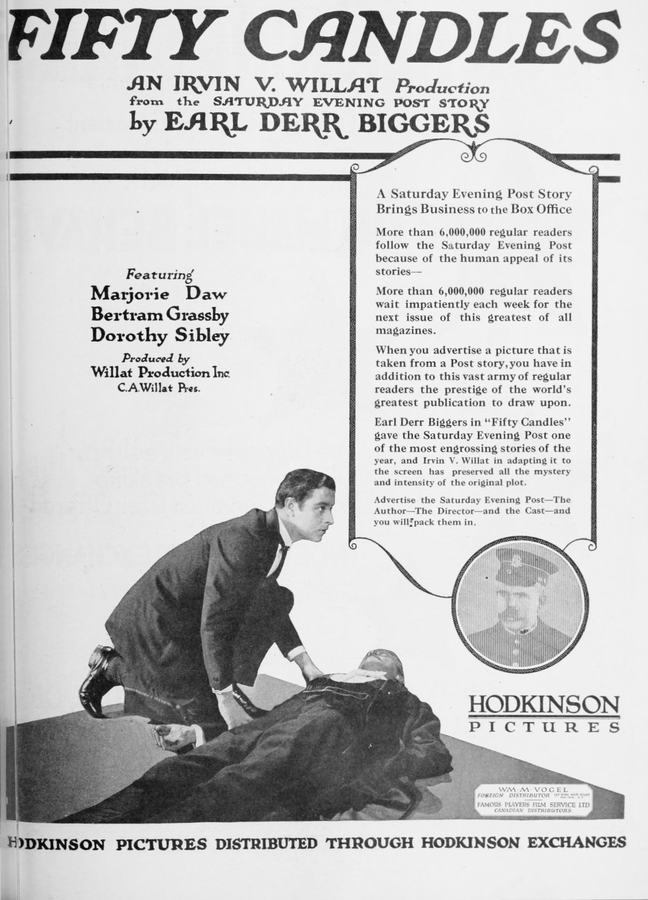
The first time I saw Fifty Candles I was hunting for a 35 mm print rumored to languish in a Pasadena basement, sandwiched between rotting lobby cards for Human Collateral and a mildewed one-sheet of The Bells. What surfaced was a ghost story wearing noir’s clothes: a tale of indentured fate, racialized rage, and the sickle-moon gleam of a jade dagger. Earl Derr Biggers—yes, the Charlie Chan architect—co-wrote this blistering little tragedy, yet the film has slipped into near-oblivion. That’s criminal, because the flicker of those titular tapers along the ship’s bulkhead is more haunting than any chandelier in Destiny or Den Æreløse.
Director L.V. Jefferson shoots exile like a fever dream. Hawaii’s departure is framed through a veil of sugar-cane pollen, the camera drifting past Hung Chin Chung’s silk slippers as they leave the soil that once bowed to his scholarly ancestors. Cut to a coal-black hatchway on the steamer where Edmund Burns—as Ralph Coolidge—clutches Mary-Will’s gloved hand, the yellow galley lights painting their faces the color of old parchment. The chromatic swing from tropical amber to maritime sick-green anticipates the moral whiplash ahead.
“A man may own another’s labor, but never the hourglass inside his breast.”
—Hung Chin Chung
The indenture clause is delivered like a stock-market ticker: twenty years in exchange for a life. George Webb’s Henry Drew never twirls a mustache; instead he radiates the bland cruelty of a banker foreclosing on a widow. Watching him slice a cigar above the contract, one remembers that American silent cinema could indict capitalism without speech. The cigar ash falls—each fleck a year of Hung’s youth.
Inside this gilded cage Hung mutates. Bertram Grassby plays him with cheekbones sharp enough to cut the celluloid, eyes simmering like black tea left too long on the burner. The performance is silent yet orchestral: a clenched fan here, a deferred bow there. Compare that to the histrionic contortions of The Wild Rider or the comic clemency of Alf’s Button; Grassby opts for minimalism, letting the injustice pool in the hollows of his silhouette.
Time folds. We jump to year nineteen aboard the same steamer, now a rust-streaked ghost of itself. Enter Ruth King’s Mary-Will Tellfair—no perky stenographer but a woman whose lacquered composure masks a ledger of unreturnable glances. She types love letters for Ralph yet her pupils dilate whenever Hung enters the saloon. The love triangle is scalene: Ralph desires Mary-Will, Mary-Will orbits Hung’s enigma, Hung nurses a vendetta against the entire vessel.
Then the dagger. A prop later claimed by collectors to be carved from real nephrite, it glints with sea-blue (#0E7490) iridescence under the ship’s converted gaslights. When Drew’s body slumps across the Persian runner, blood appears not crimson but obsidian—thank nitrate decomposition, yet the accident lends the scene a tar-thick morality. Whodunit mechanics kick in: the dagger belongs to Ralph, the motive to half the cast, the cinematographer to German Expressionism. Shadows gouge faces; stairwells tilt like ship masts in a squall.
What elevates Fifty Candles above programmers like Beatrice Fairfax Episode 8 or Shame is its refusal to let the mystery eclipse the metaphysics. Each candle lit in the ship’s dining room marks a year of Hung’s bondage; by the fiftieth, wax stalactites drip like frozen tears. When Hung confesses—his whispered intertitle barely overlays the flicker—we realize the murder is not culmination but emancipation. He chose the dagger to reclaim authorship of his narrative, knowing full well the white justice system will never see him as victim, only perpetrator.
Jefferson’s finale is a masterstroke of chiaroscuro. San Francisco’s fog horns groan while constables drag Hung through a corridor of reporters’ flash pans. Each magnesium burst whites out the screen, erasing his face, hinting that history itself will overexpose his truth. Cut to interior: Mary-Will alone in the dockside office, striking a match to light—what else?—a fresh candle. The flame steadies, her pupils reflect it, fade-out. No execution scene, no sentimental embrace. Just the echo of fifty spent wicks.
Technically the surviving print (Guild Cinematheque, 2019 restoration) is a 1.33:1 2K scan from a 28 mm diacetate positive. Scratches dance like mosquitoes across night skies, yet the tinting—cobalt for ocean, amber for interiors—survives. The new score by Miriam K. Wong blends guzheng tremolos with West-coast jazz upright bass, underscoring the transpacific liminality. Best experienced with headphones; you’ll hear candle wicks crackling like distant rifle fire.
Performances? Marjorie Daw cameos as Drew’s alcoholic spouse, delivering a single close-up—eyes swimming in gin and regret—that out-acts entire reels of Poppy. Edmund Burns, usually a genial second lead, weaponizes his square jaw here; watch how he fondles the dagger before the crime, thumb circling the jade like a lover testing commitment. Dorothy Sibley, as a deckhand’s nosy daughter, provides comic relief that doesn’t derail the tension—a rarity in 1926.
The screenplay trio—Biggers, Rich, Jefferson—layers paradoxes the way the art department layers lacquer. Note how Hung’s Confucian maxim “He who chains my body cannot fetter my qi” is mirrored in Ralph’s Americanized brag “Money buys everything but guts.” Both men will learn the limits of their worldviews at the point of the same blade. Dialogue intertitles alternate between ornate calligraphy for Hung’s thoughts and sans-serif for Yankee pragmatism, a visual dialectic lost in talkie conversions.
Comparative canon? If And the Law Says moralizes and Her Soul’s Inspiration sanctifies, Fifty Candles complicates. Its closest cousin might be Des Prokurators Tochter in its critique of juridical hypocrisy, yet that Weimar tale lacks the racial dimension that makes this film throb like a bruise. Conversely, modern viewers may trace a crooked line from Hung’s plight to the immigrant bargainer in Human Collateral, proving how little the power calculus has shifted in a century.
Feminist readings bloom, too. Mary-Will’s typewriter becomes a Gatling gun of desire—each key strike a bullet of coded courtship. She never once swoons; even when Ralph’s acquittal seems doomed, she trades smiles for information, leveraging patriarchal expectation like a poker chip. The film refuses to punish her sexual agency, an anomaly pre-Code Hollywood would soon stamp out.
Yet the film’s most incendiary current is its critique of contractual servitude as racialized capitalism. Drew’s offer—life in exchange for labor—parrots the coolie treaties that haunted transpacific ports. The camera lingers on the signature scroll: English clauses on white parchment, Hung’s vermilion thumbprint blooming like a blood chrysanthemum. One thinks of today’s H-2 visa narratives, of gig-economy shackles dressed in “flexibility” rhetoric. Jefferson, probably unintentionally, prophesies.
Restoration quibbles? The climax suffers mild jump cuts where censors snipped “excessive violence” in 1928. A 4K re-scan could unearth facial micro-reactions; crowdfunding is rumored for 2025. Also, the guzheng-bass score occasionally swells over dialogue cards—an odd choice for a silent—but the emotional payoff justifies the misdemeanor.
Should you watch? If your noir palate is jaded by monochrome trench coats, Fifty Candles offers polychrome moral rot: gold, jade, sea-spray, candle-flame. It’s a film that understands revenge as deferred autobiography, that sees confession not as closure but as the final clause in an unconscionable contract. Stream it via Guild Cinematheque’s subscription, or catch the rare 16 mm print at the Balboa Theatre’s Midnites for Maniacs series. Bring a jacket; the fog outside will feel like the film seeping through the screen.
Rating? On a scale of one to five guttering wicks, I give it four and a half, docked half only for the missing footage. The half-wick still smolders somewhere in the canister, waiting for an archivist’s splice. Until then, let the fifty candles flicker in your head, each melt-drop a reminder that some debts can only be paid in smoke.
Tags: silent noir, transpacific cinema, early whodunit, Bertram Grassby, Earl Derr Biggers, 2029 crowdfunding
IMDb —
1930
Community
Log in to comment.