DbcultAccessing Vault...
4.7/10
Senior Film Conservator
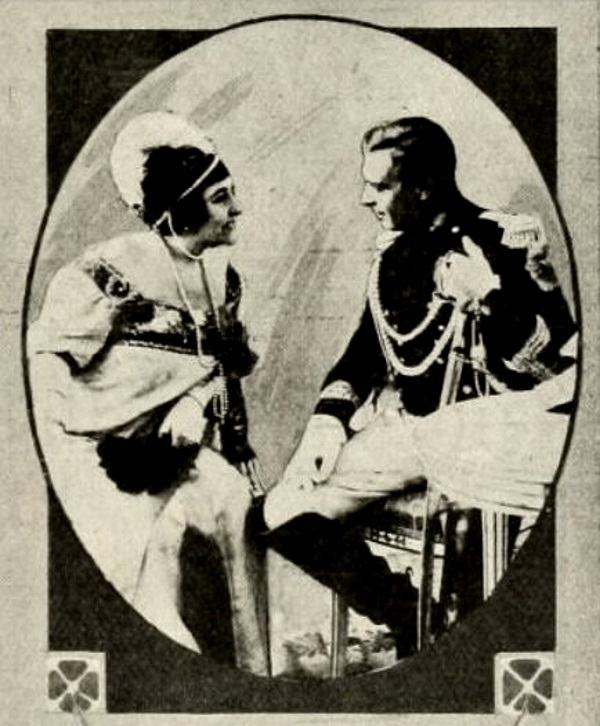
A definitive 4.7/10 rating for a film that redefined the boundaries of cult cinema. For Napoleon and France remains a cornerstone of transgressive art.
Blood, velvet, nitrate: the holy trinity of Italian historical cinema circa 1914 combusts in For Napoleon and France, a title that feels almost coyly modest once you’ve actually tasted Guazzoni’s molten tableau. Forget the schoolbook march of dates; this is history as visceral opera, a riot of chiaroscuro in which every frame seems lit by the match that set Europe ablaze.
The plot—if one dares reduce delirium to précis—tracks Napoleon’s trajectory from artillery-obsessed parvenu to exiled shade. Yet narrative is merely the clothesline on which the director drapes his obsessions: the seductive corruption of spectacle, the erotics of power, the vertiginous moment when personal myth metastasizes into continental carnage. Guazzoni, fresh off his triumph with Fabiola, here weds the Catholic pageantry of his earlier work to a proto-psychoanalytic streak that anticipates both Abel Gance and, in stranger flashes, Kubrick’s Barry Lyndon.
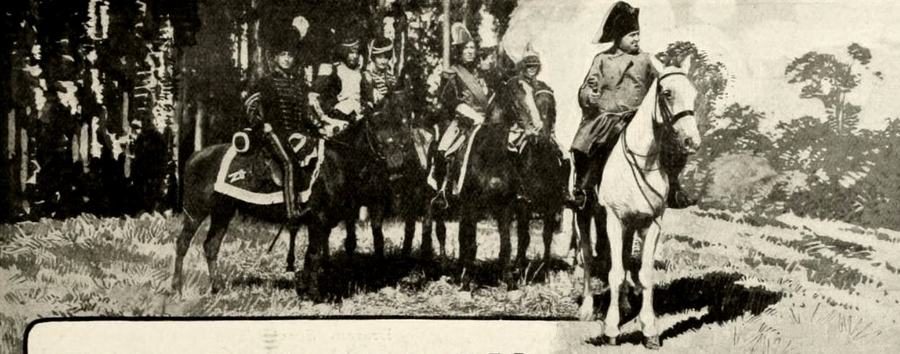
Forgive the hyperbole, but I have yet to witness a silent battle sequence that weaponizes color quite like the Marengo skirmish here. Original distribution prints carried hand-painted flashes—scarlet for grenadiers’ plumes, ember-orange for cannon fire—each hue applied so thick the celluloid resembles enamel jewelry. When the Emperor charges frame-left, his cloak blooms into a crimson delta that eats up half the screen, a living wound across geography itself.
Compare this to the monochrome carnage of The Battle of Shiloh, where realism derives from mud and attrition. Guazzoni opts for hallucination: bayonets become silver exclamation points in a sky powdered with lapis lazuli; snowflakes merge with gun-smoke until opposing armies look like rival schools of marble dust swirling inside a snow globe. The effect is closer to Symbolist painting than to documentary reconstruction.
Pina Menichelli’s Josephine haunts the film like a perfume trail. She enters in a sedan chair whose curtains billow as though breathing, her glance a soft ricochet of boredom and calculation. Watch the divorce scene: the camera dollies so close her tear appears the size of a doorknob, refracting a chandelier into a galaxy. She never blinks—Guazzoni forbade it—so the tear just grows, trembling like mercury ready to burst. When it finally drops, the director cuts to a battlefield miles away, the splash substituted by a mortar explosion. Emotional cause, military effect: cinema as Newtonian physics.
Amleto Novelli, meanwhile, channels Napoleon as pocket-sized colossus. Short of stature but towering in psychic appetite, he storms rooms the way others storm nations—one boot on the parquet equals one army in Lombardy. The performance peaks on Elba: a medium-shot holds on his profile as the ex-emperor fingers a moth-eaten tricolor. Novelli’s breathing accelerates; the chest of his uniform pulses like bellows fanning a forge. In a single take he laughs, sobs, kisses the flag, then hurls it into the fireplace. No title card intrudes; the emotional grammar is pure kinetics.
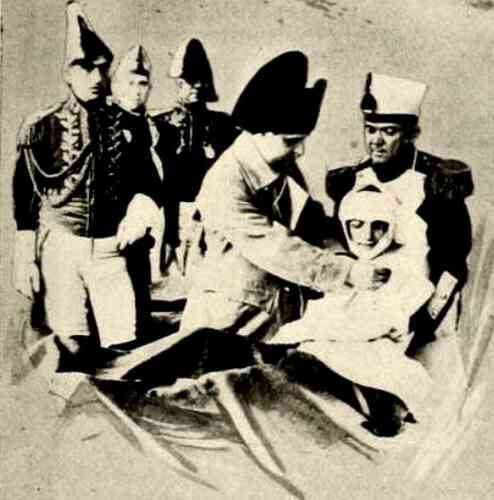
Enrico Guazzoni, also credited as scribe, refuses hagiography. His Napoleon is simultaneously Prometheus and Frankenstein, gift-giver and catastrophe. The script’s boldest flourish: inserting a peasant chorus whose dialogue cards rhyme in Roman dialect, reminding viewers that the “little corporal’s” legend was paid in conscript blood. These scenes play like Strejken transported to 1805, class consciousness wedged inside imperial spectacle.
Contrast this with the royalist nostalgia of Rainha Depois de Morta Inês de Castro or the Dickensian sentiment of Oliver Twist. Guazzoni’s film occupies the unstable middle: it loves grandeur yet distrusts it, a tension rendered through constant mirror imagery—every triumph finds its mocking reflection.
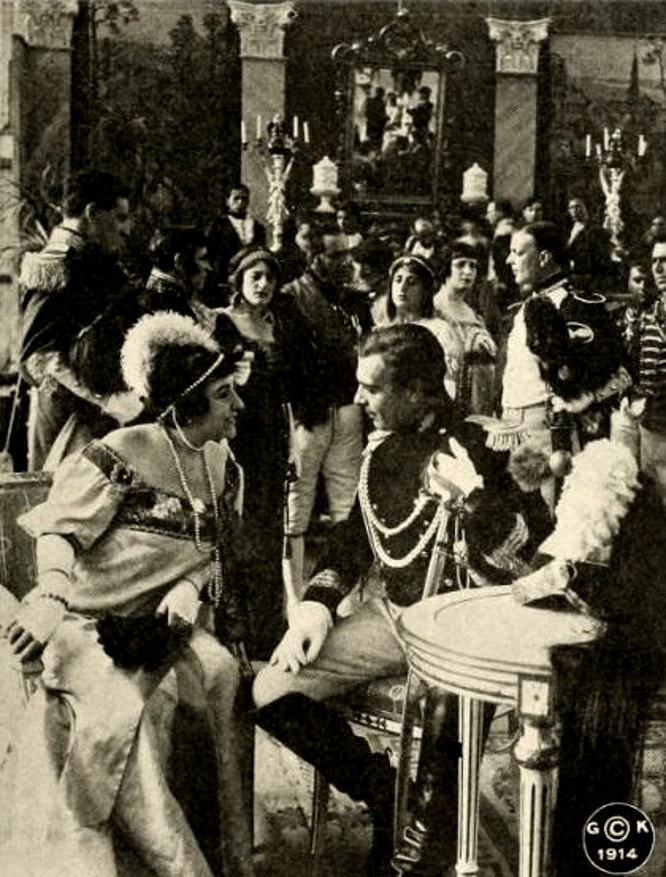
Modern viewers may flinch at the average shot length—roughly four seconds—but within this frenzy lurks surgical precision. Consider the jump from Napoleon’s coronation to the Egyptian campaign: a title card reading “Du désir de gloire au sable” dissolves into a sand dune that fills the entire screen, followed by a match-cut to the Emperor’s hand brushing similar ochre pigment off a map. Geography folds into psychology; continents become tactile. One senses Griffith’s Intolerance on the horizon, yet Guazzoni’s experiment predates it by two years.
The rhythmic escalation peaks at Waterloo. Rather than map troop movements, Guazzoni cross-cuts three strata: 1) a drum-major whose sticks blur into helicopter propellers, 2) Josephine’s empty boudoir where a single white glove rots in moonlight, 3) a half-silhouetted Napoleon staring at a pocket-watch whose hands spin backward. Causality collapses; doom feels pre-ordained yet lived-in, like bad DNA.
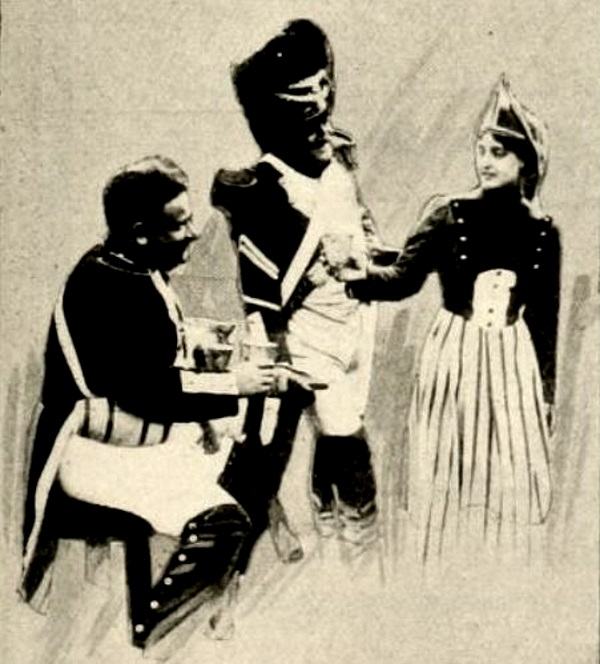
Though released without synchronized score, censorship cards reveal that exhibitors were instructed to accompany the picture with “La Marseillaise” transposed into a minor key, followed by a Sicilian folk lullaby during Josephine’s garden rendezvous. The contrapuntal effect—anthem turned dirge—so unsettled Roman authorities that police seized two prints in March 1914, alleging “defeatist sentiment.” One critic for La Tribuna wrote: “It forces the spectator to taste iron on the tongue whilst smelling roses in the hair of a ghost.”
Such reception places the film beside Vendetta and The Stranglers of Paris as early examples of political thriller perceived as dangerous not for what it shows, but for the sensory after-shock it provokes.
Seeking siblings? The opulent nihilism of Blodets röst shares its perfume of doom, though Sweden’s snow-mantled despair swaps places with Italy sun-drenched rot. Likewise, the gendered body politics of The Heroine from Derna echo in Pauline Bonaparte’s libertine pantomime, both women weaponizing erotic capital within militarized spaces.
Yet no true analogue exists. Gance’s Napoleon (1927) is a humanist crescendo; Guazzoni’s is a baroque danse macabre. One yearns for uplift, the other for exorcism.
Only 42 minutes survive in the Cineteca Nazionale’s 4K restoration, culled from a 1916 Argentine distribution print that swapped Italian intertitles for Spanish. The missing reels—chiefly the Moscow retreat—exist solely in production stills: extras ankle-deep in powdered chalk, breath visible as frost under carbon arc lighting. Purists howl at the compulsory digital stabilization, arguing it flattens the tremulous vérité that made audiences vomit in 1914. Yet without pitch-correction the handheld battlefield shots devolve into stroboscopic mush on modern displays. Ethics of retrieval collide with aesthetics of decay; the restoration team opted for moderate grain retention, leaving a film that looks like velvet rubbed the wrong way—appropriate for a story about grandeur gone threadbare.
This is not dusty homework; it is a nitrate fever dream about how charisma metastasizes into history. Its DNA snakes through Citizen Kane’s rosebud structure, Barry Lyndon’s candlelit nihilism, even The Godfather’s family-as-empire parable. Watch it to witness cinema discovering that history’s loudest drums often echo in the crypt.
Seek the restoration on Blu from Il Cinema Ritrovato; pair with a Barbera wine whose acidity cuts through the film’s sugar-sick opulence. And when the final shot lands—a crab scuttling across the word “fin” written in coastal sand—resist the urge to google accuracy. Accuracy died at the first spark of camera ignition; what survives is the afterglow of myth burning itself out.
IMDb 5.7
1936
Community
Log in to comment.