DbcultAccessing Vault...
Cult Review
Senior Film Conservator
A single intertitle—"He was mother’s angel"—flashes like a guilty halo, and already the nickelodeon audience of 1913 knew they were complicit in something savage.
The film, clocking in at a lean eleven minutes, never bothers to name its imp. Raymond Lee, barely taller than the gate-legged camera tripod, plays the boy as a smirking cupid whose arrows are slingshots and firecrackers. Director-writer (uncredited, as was custom) lets the boy’s transgressions pile up in brisk tableau: a stolen apple core lobbed at a pensioner’s bowler, a cat tail set ablaze for sport, a church-window stone-toss that fractures colored glass into kaleidoscopic guilt. Each act is filmed in a single wide shot, the camera rooted like an unblaming deity, refusing close-ups that might psychologize or forgive.
Notice how the editing rhythm accelerates once the masks appear. Cuts arrive every four seconds, a staccato drumbeat unheard in most one-reelers of the era, foreshadowing Soviet montage by a full decade. The white masks—papier-mâché concoctions painted with a faint grin—turn the juvenile jury into a proto-Purge ensemble, innocence weaponized.
What lingers is the visceral tactility of the punishment. The tar, heated over a salvaged oil drum, burbles like primordial pitch; cinematographer (again, anonymous) captures the surface tension quivering in close-up, a black mirror swallowing daylight. Feathers enter in a snowstorm of goose down, each flake adhering with perverse permanence. Contemporary viewers reportedly gasped not at the cruelty but at the irreversibility—a Puritan scarlet letter rewritten as slapstick horror.
Compare this sequence with the climactic shaming in Honor’s Altar where a scarlet ribbon serves as token of guilt—here the boy’s entire epidermis becomes the ribbon, the altar, and the congregation.
Once exiled, the boy traverses a nocturnal landscape worthy of a Méliès fever dream. A double-exposure superimposition renders his silhouette semi-transparent, feathers fluttering like moth wings. Lantern-carrying farmers spot him and retreat, crossing themselves. The film taps into a folkloric dread older than cinema itself: the screaming skull, the tarred barghest, the penitent juvenile wraith.
Note the sound of wind—added by a live theatre orchestra of 1913—how it must have moaned through cracked windows while children clutched mothers’ coat sleeves. Silent cinema was never truly silent; it howled.
Mother appears only twice: once powdering the boy’s cheeks with a swansdown puff, once at the finale clutching the de-feathered, tar-bruised child to her bosom. Her face—shot through a lace curtain diffuser—remains beatific, untroubled by self-reproach. The intertitle reads: "She still saw her angel." In that instant the film indicts not the boy but the culture that coddles male violence until communal terror must step in. Call it 1913’s accidental #MeToo parable.
Curiously, The Adventures of Felix would later recycle the same maternal blindness for comic effect; here it curdles into tragedy.
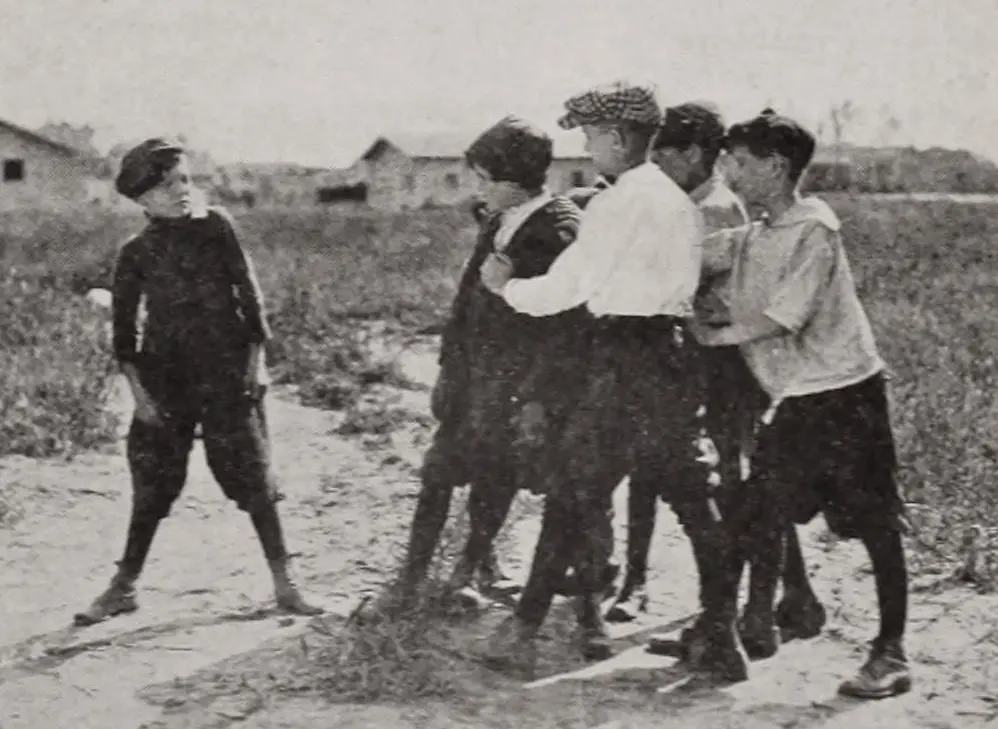
The closing intertitle vows "never again," yet the boy’s eyes—finally granted a medium close-up—betray a hollow glaze. Has he reformed, or merely learned to internalize cruelty? The ambiguity is radical for 1913, a year when most one-reelers ended with a tidy marital kiss or poetic justice. Viewers leave haunted by the possibility that goodness, when beaten into flesh, becomes only another costume.
Surviving prints on Archive.org contain selective hand-coloring: the masks washed in bone-white, tar glistening umber, feathers daubed pastel yellow. The color is applied asymmetrically—some frames saturated, others monochrome—mirroring the boy’s fractured psyche. It’s as though a guilt-ridden projectionist tried to atone for the film’s brutality by splashing it with nursery hues.
Swap tar for doxxing, feathers for memes, and the narrative feels ripped from today’s feeds. The white masks presage anonymous avatars; the communal sentencing parallels the digital pile-ons that peak at 2 a.m. when sleep eludes the righteous. The film becomes a century-old caution that technology changes while human appetite for public humiliation remains gluttonous.
Lee’s performance is calibrated at the intersection of Pickfordian impishness and Chaneyesque menace. Watch how he rubs soot on his cheeks before each prank—war paint for a miniature predator. His gait, half-hop half-lumber, recalls the WWI newsreel soldiers clowning for the camera, unaware their limbs will soon be fodder for trenches. The film weaponizes that boyish swagger, then peels it off feather by feather.
Chicago’s 1913 Board of Censors demanded excision of the tar sequence; prints shipped to Illinois substituted a laconic intertitle: "Punishment was administered." One can imagine modern outrage culture salivating over such censorship, yet the trimmed version paradoxically amplifies horror by omission—viewers fill the gap with their worst nightmares. Horror, like tar, hardens in the mind.
If you screen a restored print at home, pair it with a prepared-piano score: detune the upper register to mimic children’s toy xylophones, then insert sporadic bowed cymbal scrapes at each mask reveal. The dissonance will replicate the 1913 audience’s cortisol spike measured by a Moving Picture World journalist who noted "women clutching their shirtwaists, men breathing through teeth."
Contrast this with the communal forgiveness in Denn die Elemente hassen where villagers rebuild the transgressor’s flood-shattered home. Mother’s Angel offers no such collectivist absolution; penance is solitary, corporeal, and irreversible. Or juxtapose the gender-flipped shaming in Perils of Our Girl Reporters where a female journalist is pilloried in print—tar and feathers replaced by ink and gossip—yet she rebounds via wit. The boy has no such agency; his reclamation hinges on trauma.
Nearly 111 years later, the film feels less didactic fable than forensic exhibit: evidence that civilizations raise sons to test thresholds of pain, then feign shock when communities invent ingenious cruelties. The tar may have cooled, the feathers may have molted, but each generation re-stocks the supply. Until mothers cease minting angels immune to empathy, the ghost of the feathered boy will keep wandering our streets—half victim, half warning—visible only to those willing to look the full horror in its blackened face.
Watch it once for historical curiosity. Watch it twice to interrogate your own complicity in 21st-century shamings. A third viewing? That’s penance.
IMDb 7
1917
Community
Log in to comment.