DbcultAccessing Vault...
Cult Review
Senior Film Conservator
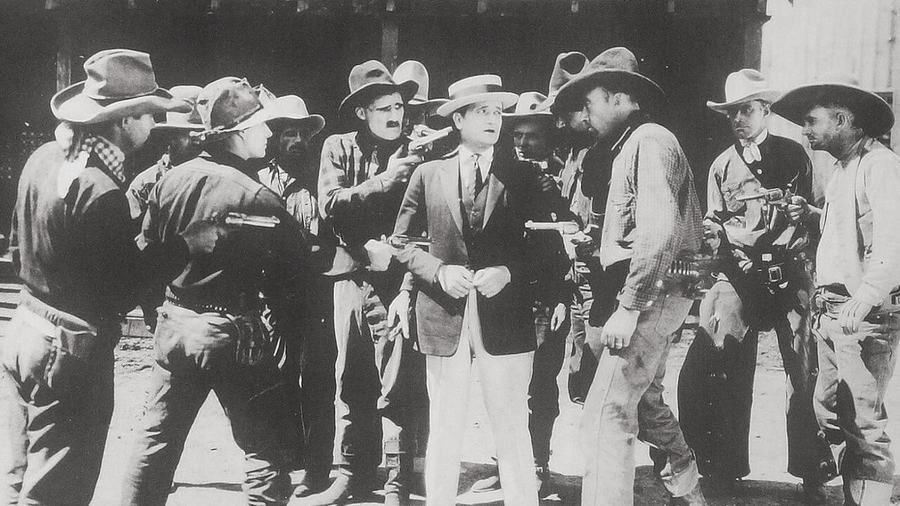
The 1922 oater Gun Shy arrives like a mirage—flickering, sardonic, and unexpectedly bruising. Shot on location in the alkali flats outside Prescott, Arizona, the picture marries the rawboned ethos of early Westerns with a psychological prank: a yellow-bellied dude shambling into mythic shoes he never asked to fill. Director William Wolbert, best remembered for serials that cliff-hung Saturday matinees, here opts for a lean 58-minute tone poem in which silence itself becomes a character. The desert wind howls through perforated soundtrack; nitrate grains twitch like horsehide; and every iris-in feels like a wink from the cosmos.
Strip the narrative to its vertebrae and you discover a Möbius strip: fear masquerading as courage, courage doubling back to devour fear. James Brown—Eastern dandy, patent-leather vowels, spats that never survive the first sandstorm—alights from the noon stage just as the Iron Vultures unleash their fourth assault on the Copper Queen mine. The townsfolk, starved for deliverance, glimpse his city suit and assume only a federal marshal would dress that impractically. Misapprehension metastasizes; before dusk Brown is sworn in, given a Colt he can’t load, and paraded like a talisman. Meanwhile the genuine lawman, Bill Williams, nursing a bullet graze and a sardonic grin, lounges in the saloon’s murk, curious to see how long the masquerade will spin.
The film’s midpoint hinge arrives as a botched lynching: the Vultures string Brown up on a cottonwood, only for the bough to snap, depositing him in a prickly-pear patch. The humiliation is scalding, yet the hangman’s noose leaves a crimson necklace that will later pass for battle scar. From here the tone darkens; slapstick evaporates, replaced by chiaroscuro night raids, the gleam of drawn steel, and a mine-shaft showdown lit solely by the miners’ carbide lamps. When Brown finally squeezes the trigger—hands still trembling, but eyes unblinking—the recoil knocks him backward into legend. Williams steps from the smoke to cuff the outlaw chieftain, but the victory feels communal; a town that once flinched at shadows now trains Winchesters in unison.
Surviving prints, though speckled like a pinto, reveal Wolbert’s visual cunning: day-for-night shots washed with cobalt filters, intertitles hand-lettered in a jittery serif that mirrors Brown’s nerves. Note the repeated orange motif—dust devils swirling like molten ore, a neckerchief aflame at sunset, the copper ingots glowing ember-bright—hinting at wealth that corrodes morality. Against this, the sudden intrusion of sea-blue skies during the coda feels almost subversive, as if the desert exhaled and found mercy.
George F. Marion’s James Brown is a masterclass in staccato physicality: knees that knock, Adam’s apple bobbing like a fishing lure, yet the eyes—those darting, rodent-bright eyes—betray a hunger to transcend the ribcage of self. Opposite him, Franklyn Farnum’s Bill Williams leans into minimalist swagger; every shrug suggests a man who has read the end of the book and isn’t spoiling it. Florence Gilbert, as the mine-owner’s daughter, sidesteps mere ingénue duties, wielding a Derringer and a glare hot enough to solder iron. Meanwhile Bob Kortman’s villain—lank hair plastered to brow—embodies rapacious capital; he doesn’t want ore, he wants the idea of ore, the power to hollow mountains.
Place the film beside contemporaries like Beatrice Fairfax Episode 1 or The Willow Tree and its genre hybridity snaps into focus: part pulp serial, part chamber psychodrama. Released the same year that Cocain titillated urban audiences with underbelly voyeurism, Gun Shy instead mines the frontier psyche, arguing that courage is less a trait than a transaction—bought with public expectation, paid in blood. Its DNA echoes through later transformations-of-tremblers yarns, from The Man Who Shot Liberty Valance to High Noon, yet predates them by decades.
What gnaws at the viewer long after the iris-out is the film’s mercantile view of valor. The town needs a hero; Brown needs an exit; Williams needs a proxy while his clavicle knits. Each party bargains with the same counterfeit coin—reputation—until the moment violence becomes non-negotiable. In that crucible, cowardice transmutes not into bravery but into responsibility, a weight heavier than lead. The final shot—Brown boarding the eastbound stage, no longer flinching at the conductor’s shout—implies that legend, once minted, circulates independently of its alloy.
For decades the picture languished in the ghost-town of lost reels, misfiled under the generic shelf title Desert Law. A 2017 discovery in a Butte, Montana basement yielded a 35mm nitrate print, its emulsion blistered like sunburn. The UCLA Film & Television Archive performed a 4K wet-gate transfer, stabilizing shrinkage and salvaging a lavender-tinted night sequence previously known only from exhibitors’ cue sheets. The resulting Blu-ray, available via Kino Lorber, includes a commentary track that excavates production stills revealing Wolbert’s on-set rapport with the local Yavapai community, who served as both extras and technical advisers.
In an age when CGI spires obliterate horizon lines, Gun Shy reminds us that tension can germinate in the twitch of a trigger finger, that landscapes themselves conspire in storytelling. The film’s compact runtime leaves no fat on the bone; every dusty insert, every fluttering card title, accrues narrative torque. More crucially, it posits that heroism is not congenital but conjured—by circumstance, by gossip, by the simple human refusal to keep running. That revelation, blistered onto nitrate nearly a century ago, still sears like a branding iron. Seek it out, let the desert wind whistle through your speakers, and discover why sometimes the most valiant thing a man can do is stay put when every instinct yells bolt.
IMDb —
1920
Community
Log in to comment.