DbcultAccessing Vault...
Cult Review
Senior Film Conservator
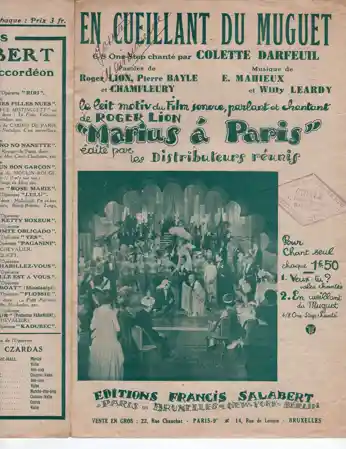
Marius à Paris is a bit of a mixed bag, honestly. If you're into those old, atmospheric French films, especially ones that just *breathe* a specific time and place, you might find something to love here. But if you need a tight plot or a lot of quick action, well, you'll probably just find yourself tapping your foot.
Right from the start, you're hit with this sense of *being there*. The street scenes, even if they're a bit staged, have a certain grittiness that feels real for the era. The sound design, particularly the distant street chatter and café clinks, really pulls you in, even if the dialogue itself can be a little stiff sometimes.
Marius, played by Tony D'Algy, is... well, he's sort of just *there* for a lot of it. He's not a big personality. More like a mirror for the city around him. He drifts from one encounter to the next.
There's this one scene, maybe halfway through, where he's just sitting at a small table outside a café. Madeleine Guitty, as the sharp-tongued propriétaire, comes out to wipe down the table next to him. She doesn't say much, just a grunt or two, but the way she _slams_ the rag down? It tells you everything about her day. That small moment, it just *sticks* with you. You can almost feel her tired exasperation.
The pacing is definitely a thing. It's **slow**. Not always in a bad way, mind you. Sometimes it lets you really sink into the visuals. Like the long, long shot of the Seine, with a lone bateau-mouche chugging along. You just take it all in. Other times, though, it feels like the director forgot to call 'cut'.
Georges Tourreil, as the overly dramatic poet Marius keeps bumping into, is a hoot. Every gesture is so exaggerated, so *French*, in that old melodramatic way. His reading of a truly terrible poem to an utterly bored group of patrons at the café is a highlight. One woman, maybe Marthe Sarbel, just keeps trying to hide a yawn behind her hand. It's great.
The storyline, such as it is, involves Marius trying to sort out some minor debt or a misplaced package. It's not the driving force. The real joy is watching him interact with the various Parisian types. Colette Darfeuil has a brief, but memorable, turn as a flower seller with a quick wit. Her smile just lights up the screen, even if the camera lingers a bit too long on her reaction shot after Marius walks away.
I found myself particularly drawn to the background details. The posters on the walls, the specific style of the gas lamps, the way everyone seems to be smoking. It’s a little window into a time we don’t often see so authentically captured.
There’s a strange little sequence where Marius gets lost in what looks like a market. The camera just follows him, weaving through crowds of people. It’s almost documentary-style. And then suddenly, he bumps into René Lefèvre's character, who's selling some truly peculiar trinkets. The way Lefèvre tries to hawk a tiny, broken porcelain cat? It's oddly specific and a bit sad. He almost convinces you it's a valuable antique.
The film doesn't really build to a big climax. It just sort of… ends. Marius is in the same place, emotionally, as when he started, maybe just a little wiser or more tired. It’s not trying to deliver some grand message about life or love. It’s just showing you a sliver of it.
So, should you watch it? If you appreciate the pace of older cinema, and you're curious about a genuine, unvarnished look at Paris in the early 20th century, then yes. Give it a shot. But if you're looking for plot twists or fast-paced dialogue, you'll be bored stiff. It’s more of a mood piece, a gentle stroll.
IMDb 7.7
1918
Community
Log in to comment.