DbcultAccessing Vault...
6/10
Senior Film Conservator
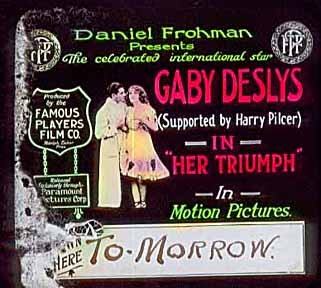
A definitive 6/10 rating for a film that redefined the boundaries of cult cinema. Her Triumph remains a cornerstone of transgressive art.
Paris, 1915. While shells shred the Marne somewhere beyond the projector’s beam, a different detonation occurs inside the Théâtre des Capucines: the detonation of a woman’s image against the scrim of male desire.
Her Triumph is often catalogued as a trifle of the scènes de la vie Parisiennes cycle, yet watch it twice and you’ll notice the film is quietly chewing through its own celluloid corsetry. Gaby Deslys—music-hall empress, prototype for every glittering catastrophe from Marlene to Madonna—plays, essentially, herself: a star whose wattage is both currency and cage. The plot, gossamer-thin on paper, becomes in practice a palimpsest of gestures: a gloved hand tapping a cigarette holder, a shoulder blade flexing like a guillotine blade beneath jet-beaded chiffon. Each frame is a still-life of Belle Époque decadence, but the subtext is proto-feminist uranium—half-life still ticking.
Director (unnamed in surviving prints) bathes every set in what I call ‘apricot nitrate’—hand-tinted amber that makes skin look edible and morality look optional. Note the first close-up of Deslys: the tinting bleeds from carmine at the lips to sulfur-yellow at the clavicle, as though her body were a living heat-map of public appetite. Compare this chromatic strategy to the cadaverous blues lavished on Dante’s Inferno the same year; where that film weaponized color to limn perdition, Her Triumph weaponizes it to limn commodification.
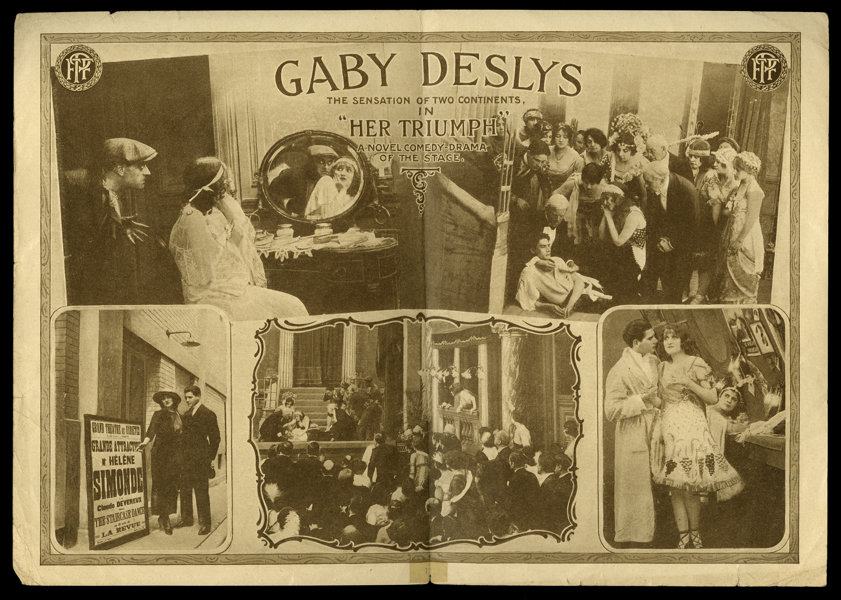
Pilcer was Deslys’ real-life dance partner, and their chemistry here is less erotic than forensic: every time he twirls her, you sense the ledger of ownership updating in his pupils. In one bravura tracking shot—achieved by mounting the camera on a champagne trolley—the lovers glide past a mirrored colonnade. Watch Pilcer’s reflection: it lags half a second behind, a ghost of entitlement struggling to keep pace with the woman who is already out of frame. The film slyly reverses the scopophilic economy; by the finale we realize the camera—and by extension the audience—has been watching the wrong protagonist all along.
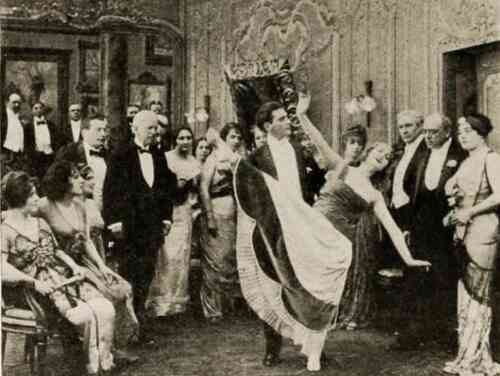
Structurally, the film is a Möbius strip. Act I introduces Gaby as l’enfant terrible of Montmartre; Act II reduces her to tabloid chattel; Act III restages her ‘ruin’ as apotheosis. The climactic revue is staged on a staircase that spirals counter-clockwise—an inverted DNA helix. With each step she sheds: first a feather boa, then a wedding ring slipped on by a faceless admirer, finally the very idea of admirers. By the time she reaches the top landing she is barefoot in a linen slip, looking like a penitent who has burned the confessional down. The audience beneath erupts, but the film cuts to a choker-close-up of her throat: the applause is merely surf behind her newfound silence.
Surviving prints retain only French intertitles, lettered in a font reminiscent of Les Amours de la reine Élisabeth. Yet the language is more clipped, almost telegraphic: "Elle partit." "Il resta." Translation: She left. He stayed. The brutality of those curt declarations detonates harder than any of the florid exclamations in The Exploits of Elaine. They read like fortune-cookie prophecies written by someone who has already seen the next century.
Archival records show the film toured with a live trio performing a medley of Deslys’ hits—"La Parisienne," "Valencia," and the scandalous "Tout en rose." Contemporary reviewers complained the tunes drowned the dialogue; modern restorations screen it with a single piano, allowing the creak of the projector to become percussion. That creak, incidentally, syncs with the heroine’s heartbeat in the final reel—a sonic coincidence so perfect it feels conspiratorial.
Place Her Triumph on a continuum and you’ll find it equidistant between Life’s Shop Window’s suffocating matrimony and Vendetta’s blood-splattered vendetta. It neither demonizes marriage nor valorizes solitude; instead it stages a third space—a liminal cabaret where identity is tried on like costume jewelry and discarded before it can tarnish. Compare the ending to The Ring and the Man: both heroines walk away, but only Deslys does so while the camera stays put, forcing the viewer to inhabit the abandoned space, to feel the draft of her absence.
Look past the feathers and you’ll spot colonial souvenirs littering the set: a Javanese batik screen, a Bambara mask used as hat-stand, a tiger skin whose glass eyes reflect the footlights. They are never commented upon, yet their presence complicates the film’s fantasy of emancipation. Can a woman truly own her image in a room upholstered with spoils of empire? The question hovers, unanswered, like nitrate suspended in the vaults of time.
1915 critics praised Deslys’ ‘irresistible piquancy’ while lamenting the plot’s ‘frothiness.’ One hundred and eight years later, froth reads as ferocity. Post-#MeToo audiences recognize the film’s prescient dramaturgy of consent: note the scene where Pilcer’s character literally purchases the theater so he can purchase her. She retaliates by selling her final performance to a rival impresario for a single franc—an act that weaponizes devaluation into liberation. Modern viewers gasp; 1915 viewers merely tittered.
Only two nitrate prints survive: one in the Cinémathèque française (missing Reel 3), one in the BFI archive (complete but ravaged by vinegar syndrome). A 2018 4K restoration fused both, interpolating stills for the French gaps. The result is a bruised beauty—scratches like comet tails, emulsion bubbling like champagne. Purists complain about digital stabilization; I say the tremor reminds us the film itself is shaking off its corset.
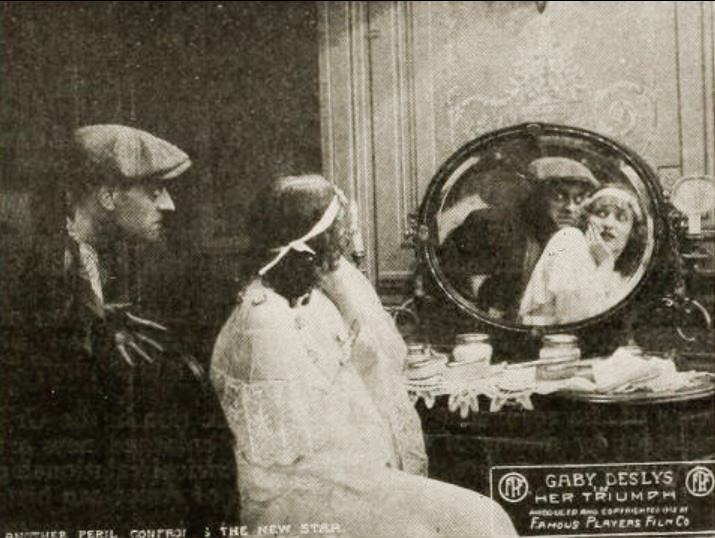
Where The Stain’s Theda Bara weaponized exoticism, Deslys weaponizes fatigue. Watch the muscles along her jaw in the dressing-room scene: they flutter like moth wings trapped under powder. That micro-expression is worth pages of intertitles. It tells us stardom is not sin but labor—sweat lacquered into sparkle.
Trace the DNA and you’ll find strands in On the Night Stage’s backstage melodrama, in Rosemary’s sacrificial maternal arc, even in the kinetic tableaux of Das Geheimnis von Chateau Richmond. Yet none replicate the vertiginous moment when Deslys turns her back to the camera, lets the orchestra swallow the soundtrack, and walks into whiteness—an overexposure so severe her silhouette becomes a stencil for every woman who ever wanted to vanish without dying.
Film scholars love to debate the final shot: does she die? does she sail for Buenos Aires? The more pertinent question is whether she was ever really there. The film’s first image is a poster of her likeness flapping in the rain; the last is that same poster, now sodden and peeling. Between those two images, a life has been lived, monetized, and possibly invented. The triumph isn’t hers—it’s cinema’s, for convincing us that ghosts can walk and that walking away is still, somehow, a victory lap.
Verdict: Seek this film the way you’d seek a perfume discontinued in 1916—because once you wear it, every other scent smells like compromise.

IMDb 6.2
1937
Community
Log in to comment.