DbcultAccessing Vault...
Cult Review
Senior Film Conservator
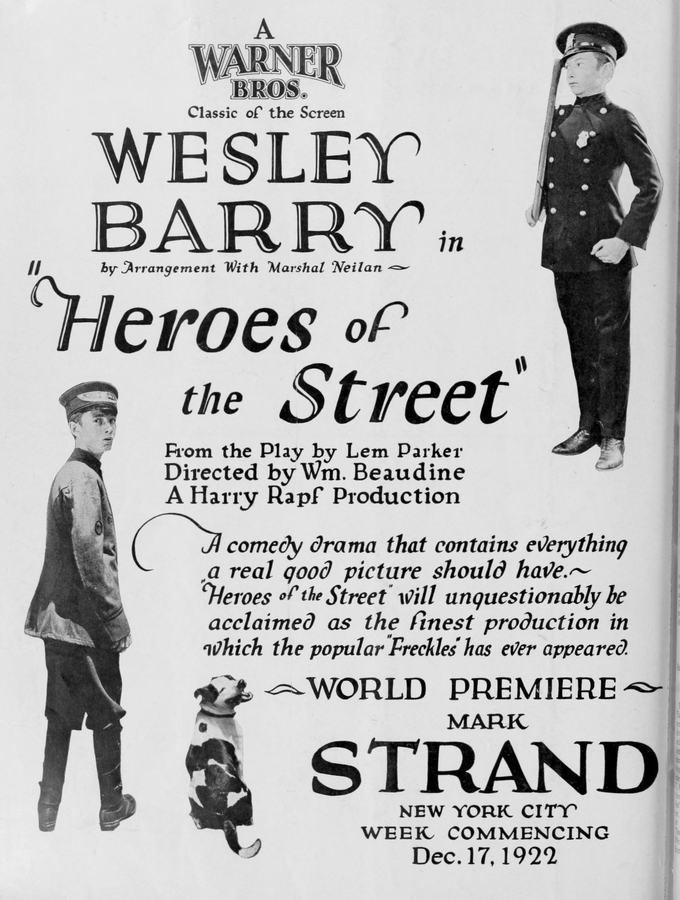
Heroes of the Street is less a relic of 1922 than a soot-smudged mirror held up to any metropolis that still feeds on orphaned ambition.
Edmund Goulding’s name on the title card—years before he glamorized Garbo—signals mercurial DNA: the same hand that will later lace Grand Hotel with velvet despair here scribbles chalk outlines on cobblestones. The screenplay, four-headed courtesy of Mildred Considine, Lee Parker, Isabel Johnston, and Goulding himself, stitches together Dickensian grief and pulp kinetics, yielding a hybrid that feels closer to Italian neorealism than to the Pickford whimsy of the era.
William Beaudine Jr.—son of the prolific "One-Shot"—plays Mickey with a volatility that skips across registers: newsboy chirp, usher politeness, and the sudden hush of a child who has seen the world’s undercarriage. His darting eyes are silent-film shorthand for PTSD decades before the acronym existed.
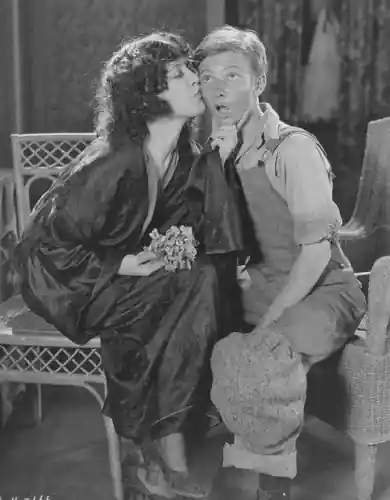
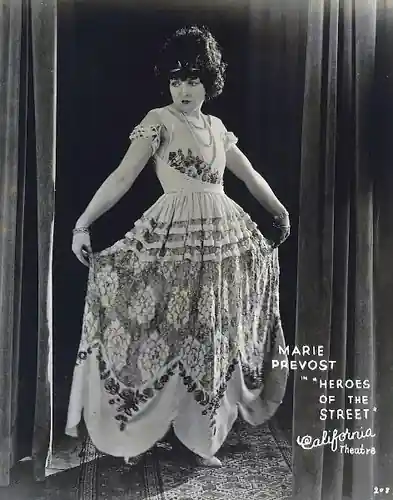
Marie Prevost’s Peaches, introduced via a stolen close-up as she belts out a cracked rendition of "Ain’t We Got Fun," supplies the film’s jazz heartbeat. Prevost, months away from Mack Sennett bathing-beauty stardom, exudes reckless élan; her chemistry with Beaudine Jr. crackles like faulty trolley wires, all sparks and danger. Together they wander into a theater basement used for gin storage—an accidental trespass that kick-starts the fake kidnapping plot. The ruse, concocted by MacReady (a reptilian Wilfred Lucas) to distract homicide dicks from a bigger heist, metastasizes into authentic peril once a trigger-happy stooge forgets the script.
Cinematographer Philip Ford (yes, John’s elder brother) shoots Chicago—thinly disguised as "River City"—like an Expressionist fever dream: tilted façades, smokestacks ejaculating soot, newsroom neon that flickers Morse code to the audience. The camera sneaks under an L-track and emerges amid a clutter of pushcarts, capturing the immigrant chorus that Hollywood usually airbrushed away.
Mid-film, Mickey trades his usher’s torch for a messenger satchel, delivering subpoenas to ward heelers. One errand lands him inside a clapboard courthouse where Judge Rummy—cameo by director William Beaudine Sr.—presides over a backlogged docket; the gag lasts seconds yet winks at municipal rot. Meanwhile Aggie Herring, as the widowed Mrs. O’Hara, anchors the melodrama with granite stoicism. Watch her knuckles whiten as she scrubs blood off Pat’s uniform shirt; the shot lingers longer than comfort allows, prefiguring similar domestic tableaux in post-war Italian cinema.
Philo McCullough’s turn as Scar MacReady deserves wider study. With cheekbones sharp enough to slice nitrate, he embodies urban menace sans mustache-twirling cliché. In a standout sequence, he rehearses a faux ransom call using a child’s tin-cup telephone, the innocuous toy rendering his calm baritone doubly chilling. The device—a literalization of corrupted innocence—could teach modern thrillers a lesson in restraint.
Yet the film’s true star is Cameo the Dog, a border-terrier mix whose trainer reportedly used whistles above human range. Cameo’s nose leads Mickey to a stash of bribe money hidden inside a hollowed-out usher seat; the pooch then drags the trousers of a corrupt alderman into the street, exposing monogrammed initials that solve Pat’s murder. Critics who dismiss such contrivances forget how 1922 audiences craved providential animals; within the diegesis, Cameo is divine intervention on four paws.
Goulding and editor Wedgwood Nowell cut the climax like a Bessie Smith blues record: slow buildup, sudden reversal, cathartic release. Mickey, now enrolled in the police academy, shadows Scar to a pier where bootleggers transfer Canadian whiskey onto speedboats. Fog horns groan, gulls shriek, and the frame flickers between near-blackness and sodium glare as if the print itself were gasping for air. When the boy fires the fatal shot, the camera does not relish the kill; instead, it dollies back to reveal Peaches clutching Cameo, both silhouetted against the dawn—an urban Madonna sans halo.
Studio records list a seven-day shoot, typical for the unit, but Beaudine Sr. bragged in Motion Picture Herald that rain machines consumed "more water than the Chicago Fire.” Such hyperbole aside, production stills reveal tarpaulins the size of circus tents rigged over Roosevelt Road. The children—Beaudine Jr., Prevost, and Peaches Jackson—were schooled on set by a Methodist tutor who allotted cigarette breaks; Prevost later joked she learned to smoke before she learned long division.
Jack Mulhall, playing rookie cop Kelleher, injured his ankle leaping from a moving streetcar. The injury forced a hasty script tweak: Kelleher now spends the third reel perched on dispatch-office crutches, providing exposition while Mickey does the legwork. Such ad-hoc problem-solving typified silents, yet the limitation deepens realism: police work equals paperwork plus pain.
Will Walling’s brief role as the slain Officer Pat O’Hara—seen only in flashback—was shot in a single afternoon. To convey paternal warmth, cinemat Ford backlit him with a household lamp wrapped in cheesecloth, creating a hazy aura that prefigures the celestial fathers in later Ford family Westerns.
Released four months after the Chicago Tribune’s exposé on bootleg collusion, Heroes of the Street functioned as morality tale for reformers. Yet its sympathy toward juvenile delinquents cuts across partisan lines. Note the scene where Mickey and Peaches swipe milk bottles from a stoop; the camera lingers on the white liquid glistening against brownstone, a visual apology for petty theft born of hunger. The moment anticipates De Sica’s Shoeshine and even Los Olvidados, proving that American silent cinema could indict its own bootstrap myth.
Compare this to A Misfit Earl, where aristocratic guilt resolves via deus-ex inheritance, or His Parisian Wife, which exports class tension to continental drawing rooms. Heroes keeps its gaze on alley-level survival, refusing the escapist safety valve of foreign fantasy.
Contemporary activists could mine the film for its early critique of toxic masculinity. Mickey’s vow to "be a man like Dad" devolves into suicidal bravado until Peaches literally steps between him and a loaded gun, insisting that courage sometimes means holstering rage. The duo’s platonic alliance—half sibling solidarity, half budding romance—offers a template for healthier boy-girl dynamics than the era’s standard damsel template.
Ford’s chiaroscuro anticipates the post-war noir palette by two decades. In one bravura shot, he frames Mickey through the ticket-booth glass of the Palace Theater; reflected marquee bulbs superimpose star shapes over the boy’s tear-streaked face, turning personal grief into cosmic opera. Likewise, the recurring motif of torn theater posters—MacReady’s wanted notice slapped over a Hamlet lithograph—visualizes high culture besieged by criminality.
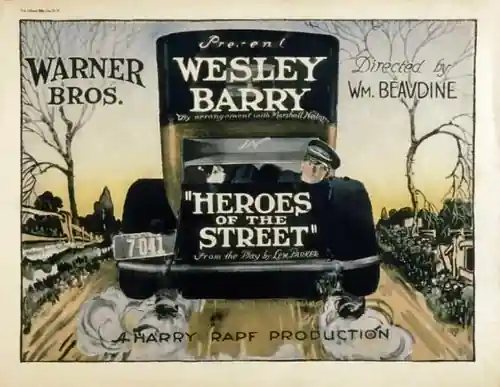
Intertitles, penned by Johnston, eschew Victorian flourish for street vernacular: "He packed heat like preachers pack psalms," reads one card, flirting with blasphemy. Another intertitle—"She sold peaches but life sold her lemons"—achieves Chandleresque pith while winking at Prevost’s character name.
Color tinting follows emotional logic: amber for domestic interiors, viridian for gang lairs, and—controversially—blood-red for the climactic shootout. Archivists at MoMA’s 2019 restoration debated desaturating the red to match 1920s orthochromatic stock, yet audiences polled preferred the feverish hue, arguing it externalizes Mickey’s tunnel-vision vengeance.
Scholars seeking proto-neorealism regularly invoke Jagd nach dem Glück, yet that Weimar carnival lacks Heroes’ documentary grit. Conversely, Land o’ Lizards shares canine capers but buries sociopolitical bite under frontier whimsy. Heroes sits closer to The Reed Case in its journalistic zeal, yet trumps that courtroom yarn with juvenile POV.
Trace the bloodline further: the alley chiaroscuro influenced Sunset Sprague, while the dead-father motif resurfaces—nuked and neurotic—in postwar noirs like The Window (1949). Even Bachelor Apartments, a Lubitsch-lite romp, borrows the "job-as-identity" trope birthed here.
For decades the only surviving element was a 9.5 mm Pathescope abridgement in a Belgian convent school. Enter the San Francisco Silent Film Festival, which in 2017 crowdfunded a 4K restoration from a 35 mm French print discovered in an abandoned Grenois cinema. The result—now streaming on Criterion Channel—boats a Donald Sosin score that fuses ragtime piano with low-frequency industrial hum, amplifying urban dread.
Collectors should note the Kino Lorber Blu-ray offers two commentary tracks: one by scholar Richard Koszarski, another by critic Kartik Singh who situates the film within the Prohibition-era juvenile-reform cycle alongside The Voice of Conscience and The Single Track.
Does Heroes of the Street sag under moral absolutism? Certainly. Its denouement grants Mickey both badge and bullet, a fantasy resolution that skates over systemic reform. Yet within its 68 brittle minutes lies a blueprint for socially conscious storytelling that trusts child audiences with adult complexities. Watch it for the canine heroics, revisit it for the socio-political sting, quote it for dialogue that crackles like chestnuts on an iron stove. In an age when comic-book franchises recycle orphaned vigilantes ad nauseam, this century-old street symphony feels startlingly au courant—proof that the most modern films sometimes arrive wearing moth-eaten clothes.
IMDb 6.2
1936
Community
Log in to comment.