DbcultAccessing Vault...
Cult Review
Senior Film Conservator
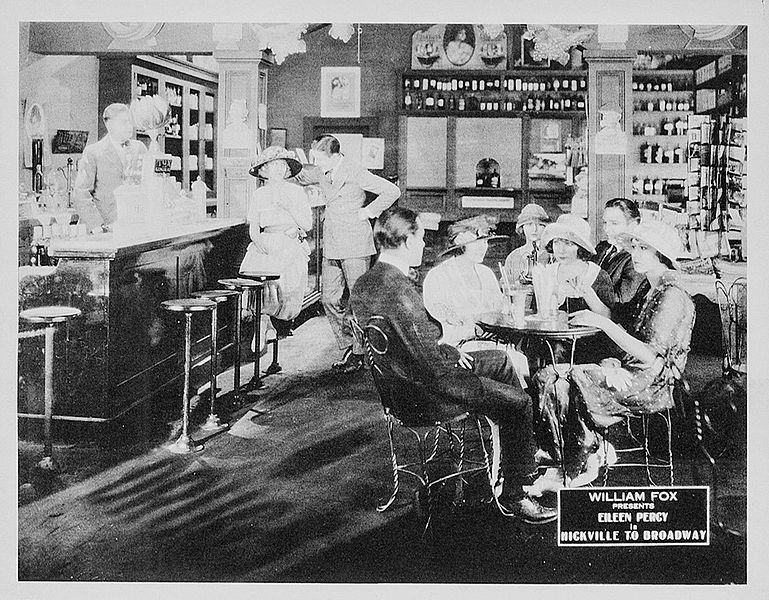
Broadway’s electric marquees once promised escape to every farm boy clutching a moth-eaten suitcase; Hickville to Broadway simply literalised the fantasy, then struck a match to its illusions.
Picture a canvas where Grant Wood’s furrowed fields bleed into Joseph Stella’s neon cathedrals. Ralph Spence and Carl Harbaugh stitch that impossible seam: corn-silk naïf Anna Mae Neil, played by Eileen Percy with eyes like rain-soaked flax, confronts the chromium seductions of Manhattan. The inciting deity is Sibyle Fane—Paul Kamp in silk cloche and predatory grin—who arrives in Hickville like a touring comet trailing footlight dust. One whiff of applause and Virgil Cole (William Scott) liquefies his drugstore into hard coin, chasing the siren glow of curtain calls. Cue the film’s first jolt of irony: the provincial druggist, so adept at measuring syrups, proves blind to the dosage of his own hunger.
Sibyle’s Machiavellian wit soon dispatches Anna Mae to precede her fiancé, swaddled in borrowed couture and rechristened “model” to cloak the hay still clinging to her past. The city becomes hall-of-mirror morality: Violet Garden (Margaret Morris) chisels marble torsos by day and trades in avant-garde gossip by night; Pinky Hale (Edmund Burns) tickles ivories and trouble in equal measure. Jazz spills from basement hatchways; gin fizzes in teacups; and Anna Mae learns that a well-timed Charleston can cleave a room as decisively as any sermon back home.
Eileen Percy balances barefoot honesty with newly minted urban guile; her pupils telegraph every micro-betrayal when Virgil—oblivious—fails to recognise the farm girl beneath the ostrich-feather boa. William Scott’s Virgil is less a cad than a man hollowed by possibility, pupils dilating at each fresh spectacle until they resemble two vacant opera house balconies. Paul Kamp’s Sibyle prowls every frame like a panther who’s read Nietzsche; her languid cigarette gestures imply she’s already bored with the plot she engineers.
Margaret Morris sculpts more than stone; her half-smile whenever Anna Mae lands a correct jazz kick feels like the city itself applauding. Edmund Burns, as Pinky Hale, supplies caffeinated comic relief, but watch his eyes during a late-reel ballad—there’s a bruise of melancholy hinting that he knows every syncopated beat is a stay against loneliness.
Director Carl Harbaugh never met a tableau he couldn’t tilt into kineticism; a static two-shot in the druggist’s store detonates into a staccato montage of cash-register chimes, pill bottles somersaulting, and train-ticket fragments—an Eisensteinian gag four years before Soviet theories hit American cine-clubs. Broadway’s re-creation is rendered through painted glass slides and forced perspective, yet the illusion shimmers, particularly when Anna Mae’s reflection fractures across a restaurant’s mirrored colonnade, foreshadowing her fractured engagement.
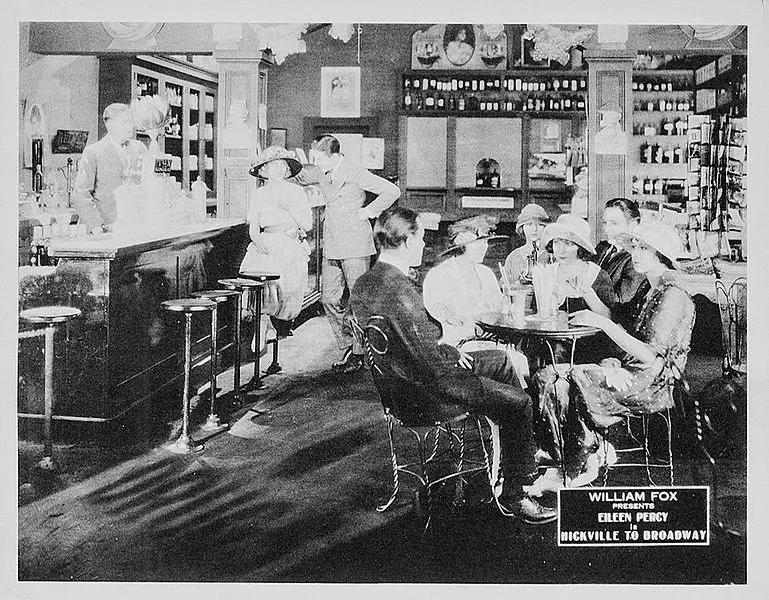
Cinematographer Ray Howard bathes night exteriors in cyan gels that anticipate the cyan/magenta neon palette of mid-century musicals; interiors glow amber where tungsten bulbs kiss mahogany. The palette—sea-blue chill for deception, molten orange for epiphany—operates like a synesthetic score.
Where many silents treat jazz as mere sonic footnote, this film translates rhythm into gesture: flapper foot-flick semaphore, sculptor mallet as drumstick, even cigarette exhale timed to phantom hi-hat. When Pinky pounds a stride-piano flourish, the camera answers with a pirouette; intertitles discard exposition for scat syllables: “Bee-bop-a-loo!” becomes both punch-line and prophecy.
Critics often slot 1920s melodrama into binary virgins/vamps, yet Hickville to Broadway lets Anna Mae weaponise performance itself. She doesn’t rail or weep when Virgil strays; she simply upgrades her partner, selecting Peter Van Reuter (J.P. Lockney) whose artistry needs her authenticity as muse. The final freeze-frame—Anna Mae’s gloved hand slipping into Peter’s paint-flecked palm—feels less capitulation than coronation.
Against the fatalistic determinism of The Only Road, this film chooses self-reinvention. While Broken Barriers wallows in saccharine redemption, Hickville prefers astringent clarity. Even the cosmopolitan shenanigans of The Millionaire Baby feel nursery-rhyme tame beside Anna Mae’s calculated romantic arbitrage.
The surviving 35 mm element—stored for decades in a disused Masonic lodge—bears nitrate ulcers and emulsion scabs. Current preservationists crowd-fund for a 4K wet-gate pass; every lost frame gnaws at our cultural vertebrae. Stream the tattered 720p rip online and you glimpse genius through gauze; imagine a world where a pristine Blu-ray places this gem beside It or Safety Last!
This 63-minute whirlwind is a shot of bathtub gin: sharp, illicit, liable to make the uninitiated cough and the enlightened grin. It dissects the American myth that geography—rural past or urban future—dictates destiny, arguing instead that identity is a costume trunk one may raid with audacity. For collectors chasing the next rediscovered masterpiece, for scholars mapping proto-feminist cinema, or for any viewer who craves a yarn that pirouettes between barnyard sincerity and skyscraper cynicism, Hickville to Broadway demands resurrection.
Watch it once for the historical frisson; watch it twice to savour how Eileen Percy’s pupils mirror your own dawning realisation that the pasture and the pavement are only ever a state of mind apart.
IMDb —
1927
Community
Log in to comment.