DbcultAccessing Vault...
6/10
Senior Film Conservator
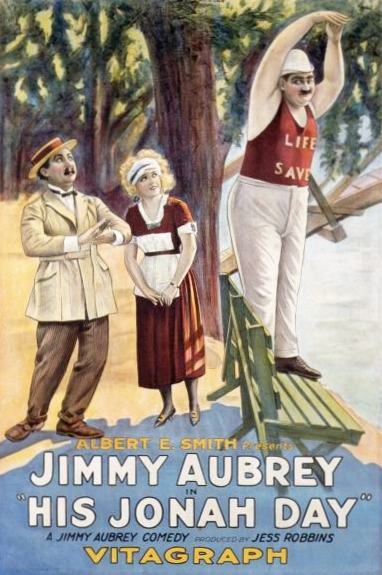
A definitive 6/10 rating for a film that redefined the boundaries of cult cinema. His Jonah Day remains a cornerstone of transgressive art.
The year 1920 represents a peculiar inflection point in the history of American comedy. It was an era where the grammar of the gag was still being codified, and His Jonah Day stands as a testament to this volatile creativity. Directed by Jess Robbins, the film eschews the burgeoning sophistication of feature-length narratives like The Dictator or the melodramatic weight of Rags, opting instead for a visceral, almost hallucinatory commitment to physical comedy. At the center of this maelstrom is Jimmy Aubrey, a performer whose kineticism often bordered on the frantic, yet who possessed an innate understanding of the bathos inherent in the human condition.
The premise is deceptively simple: a man enjoying the surf is swallowed by a whale. However, in the hands of Robbins and Aubrey, this biblical trope is merely a springboard into a series of increasingly improbable confrontations. Unlike the somber, fate-driven narratives found in The Undying Flame, the world of His Jonah Day is one governed by the capricious whims of the slapstick gods. The whale itself is a marvel of early special effects—a lumbering, theatrical beast that serves less as a predator and more as a portal to a different dimension of comedy.
Once inside, or perhaps in the immediate aftermath of his regurgitation, Aubrey’s Jimmy finds himself in a pugilistic struggle that defies biological reality. The battle with the octopus is a masterclass in choreographed chaos. It lacks the haunting atmosphere of The Girl of Lost Lake, replacing mystery with a relentless, rubbery violence. Aubrey’s ability to sell the weight and resistance of an invisible or prosthetic adversary is what elevates the short from mere filler to a significant piece of performance art. He treats the octopus not as a monster, but as an annoying bureaucrat of the deep, a sentiment that resonates even a century later.
For modern audiences, the primary draw of His Jonah Day is undoubtedly the presence of Oliver Hardy. Long before his legendary partnership with Stan Laurel, Hardy was a ubiquitous presence in silent shorts, often playing the heavy or the foil. Here, his comedic timing is already razor-sharp. While the film doesn't reach the satirical heights of Hitting the High Spots, Hardy provides a necessary gravitational pull to Aubrey’s more erratic orbit. His reactions to the unfolding madness provide the audience with a surrogate through which to process the absurdity.
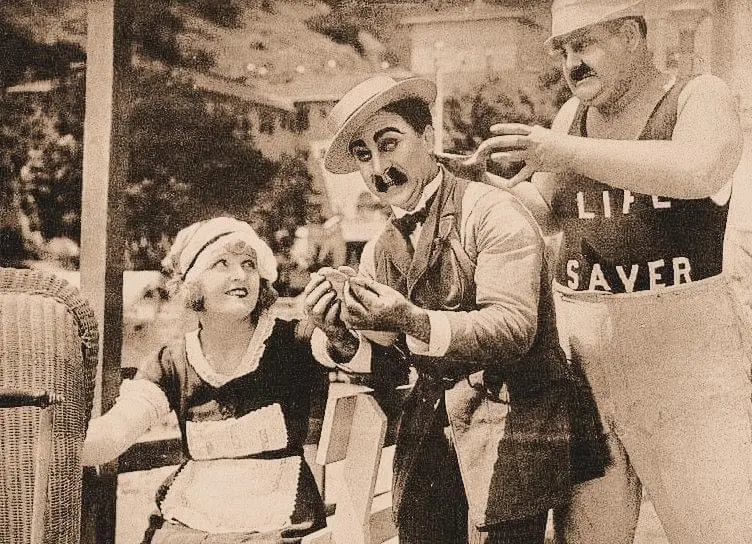
The interaction between the cast—which includes stalwarts like George Fox and Jack Lloyd—creates a tapestry of 1920s social types. The lifeguard, distracted by the "bathing beauties," is a recurring motif in the Vitagraph and Mack Sennett era. This character serves as a scathing, if unintentional, critique of masculine duty. While the world literally ends for Jimmy Aubrey in the maw of a leviathan, the guardian of safety is preoccupied with the ephemeral charms of the shore. This juxtaposition of life-and-death struggle with trivial vanity is a hallmark of the era’s darker undercurrents, similar to the tonal shifts seen in False Evidence.
Perhaps the most surreal sequence involves Jimmy’s fight with a palm tree. It is here that the film moves away from the maritime and into the realm of the purely abstract. Why fight a tree? In the lexicon of Jess Robbins, the environment itself is a character. This anthropomorphism of the landscape is something we see echoed in Monkey Stuff, where the natural world refuses to cooperate with human intent. The palm tree becomes a rigid, unyielding opponent, mirroring the stubbornness of the octopus. It is a brilliant bit of physical business that highlights Aubrey's background in the English music hall tradition.
Technically, the film is a fascinating relic. The cinematography doesn't strive for the moody shadows of Die ewige Nacht or the European elegance of A Szeszély. Instead, it utilizes a flat, bright aesthetic that emphasizes the clarity of the action. Every fall, every strike, and every splash is captured with a documentary-like insistence on the physical reality of the stunt. This clarity is essential for slapstick; the audience must see the impact to feel the laugh. The editing, too, is surprisingly brisk, maintaining a tempo that prevents the viewer from questioning the increasingly thin plot.
When comparing His Jonah Day to its contemporaries, one notices a distinct lack of the sentimentality that often bogged down films like Love's Prisoner or La belle Russe. There is no moralizing here, no attempt to reform the protagonist or offer a lesson in maritime safety. It is a pure distillation of the "comedy of errors" pushed to its most extreme logical conclusion. Even An Even Break, which deals with its own set of social mishaps, feels grounded compared to the whale-induced delirium of Aubrey’s journey.
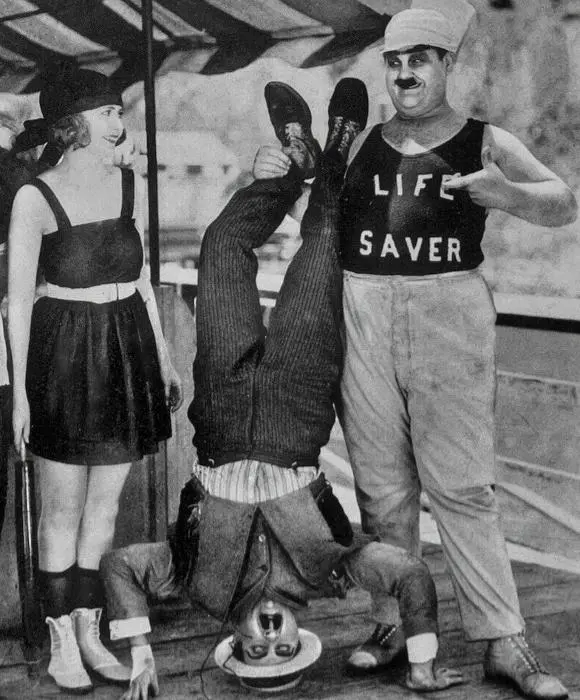
The film also avoids the propagandistic undertones found in Berlin Via America or the stagey traditionalism of Conn, the Shaughraun. It is unpretentious, joyous, and deeply weird. The presence of Estelle Harrison and Evelyn Nelson as the aforementioned beauties provides a visual counterpoint to the grit and salt of the action sequences, though their roles are unfortunately relegated to the periphery—a common trope of the time that nonetheless adds to the film's historical value as a sociological document.
In the final analysis, His Jonah Day is more than just a footnote in Oliver Hardy’s filmography. It is a vibrant, albeit chaotic, example of the Vitagraph style. It captures a moment when cinema was still playful, still discovering how to manipulate the viewer's sense of reality through editing and physical prowess. The film’s resolution, where Jimmy "saves the day" despite the negligence of the authorities, offers a satisfying, if ironic, conclusion to his aquatic ordeal. He emerges from the whale not as a prophet, but as a survivor of the ultimate slapstick gauntlet.
For those interested in the evolution of the genre, or those who simply wish to see a man fight a tree after being eaten by a whale, this film is essential viewing. It lacks the polish of later comedies, but it possesses a raw, unbridled energy that is often missing from modern, over-sanitized humor. It reminds us that at its core, comedy is about the resilience of the human spirit in the face of an indifferent, and occasionally predatory, universe. Whether it's a whale or an octopus, Jimmy Aubrey—and by extension, the audience—finds a way to keep swimming. Much like The Girl from Beyond, it explores the boundaries of the known world, only to find that the unknown is mostly just a place for more pratfalls.
Reviewer's Note: This film should be viewed with an appreciation for the technical constraints of 1920. The "whale" is a masterpiece of low-budget ingenuity, and the performance by Aubrey is a high-water mark for the Vitagraph shorts of the period.
IMDb —
1922
Community
Log in to comment.