DbcultAccessing Vault...
Cult Review
Senior Film Conservator
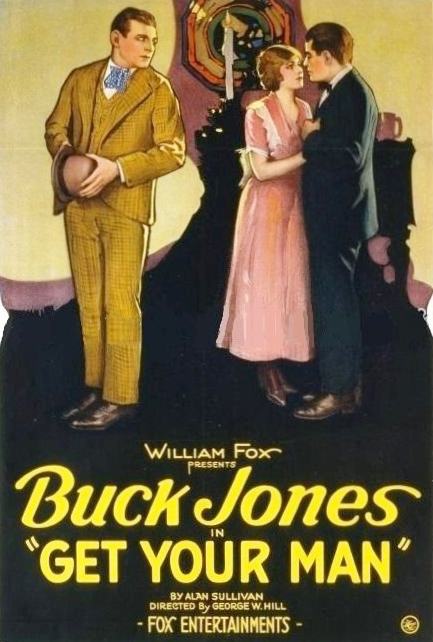
There is a moment—blink and the nitrate ghosts swallow it—when Jock MacTier, still caked in Lowland soot, stands beneath a Manitoba aurora and the crimson of his Mountie tunic seems to bleed into the sky itself. That single tint, hand-stencilled onto 35 mm in 1921, is the chromatic thesis of Get Your Man: a film that insists love and vengeance are not opposites but complementary hues on the same emotional spectrum.
The plot, deceptively triangular, is actually a Möbius strip: every betrayal loops back as penance, every rescue mutates into fresh jeopardy. Scottish coal miner Jock (Buck Jones, laconic as a slammed pit-prop) adores Margaret MacPherson (Beatrice Burnham), whose gaze already carries the parchment brittleness of a woman betrothed to security rather than passion. She marries Arthur Whitman, the paymaster whose ledger ink smells sharper than any explosive fuse. Jock’s subsequent act of gallantry—dragging Arthur from a flooded shaft—reads less like altruism than a man forcing destiny to re-write itself in the negative: I save the life that ruined mine.
Cut to Canada: the world’s largest white soundstage. Cinematographer Ross Fisher trades chiaroscuro for cryoscuro—light ricochets off snow like shrapnel, silhouettes are carved by breath rather than shadow. Jock, now Sergeant MacTier of the RCMP, patrols a frontier where morality is measured in how long a man can survive minus fingers. Enter Lenore De Marney (Helene Rosson), her silhouette edged in fox-fur trim so luxuriant it feels like larceny against the austerity of the landscape. She is the anti-Margaret: frost instead of coal, motion instead of inertia, a woman who negotiates with the wilderness rather than submitting to it.
Arthur’s re-emergence—pale, pouch-eyed, embezzled funds stitched into the lining of his city coat—feels like a Shakespearean echo banished to the wrong play. He schemes to rob Lenore’s father, a fur-smuggling baron whose empire is built on beaver, sin and the Mounties’ selective blindness. The ensuing gunfight is staged in a half-finished log church, its rafters skeletal like the ribs of some whale-sized conscience. When the smoke clears, the father is dead, Arthur is manacled, and Lenore’s grief is expressed in a single tear that freezes mid-cheek, becoming a tiny lens refracting the aurora.
Jones, often dismissed as a cowboy cut-out, here works with micro-gestures: the fractional tightening of a scarf that betrays heartbreak, the way his pupils dilate when Lenore’s hand brushes his sleeve—an earthquake registered at 1.3 on the Richter scale of the soul. Compare that to W.E. Lawrence’s Arthur, a man whose moustache seems to wax itself with every lie. Lawrence plays him like a ledger come to life: all columns and no margin.
The film’s final tableau—Jock and Lenore silhouetted against a river whose ice glows bridal white—echoes the closing shot of The Mill on the Floss in its use of water as both veil and threshold. Yet where Maggie Tulliver succumbs to flood, Lenore strides onto it, her snow-shoes signing the blank page of the world with a promise that tomorrow can be rewritten in ledger ink of her own choosing.
Intertitles, often the Achilles heel of silent melodrama, here shimmer with haiku economy. When Jock receives Margaret’s wedding announcement, the card simply reads: “She chose the cage with gilded bars.” Later, as Arthur skulks through the forest, the intertitle looms: “The wolf forgets why he was banished, but remembers the taste of the flock.” Such lines, penned by John Montague and Alan Sullivan, flirt with purple yet land on bruise.
Composer Louis F. Gottschalk’s original score—reconstructed by the San Francisco Silent Film Festival—deploys celesta to mimic the aurora’s shimmer and low brass to echo the mine’s groan. The juxtaposition is so jarring it becomes an emotional x-ray: every time the celesta ascends you feel the trapdoor of the mine shaft reopen beneath your feet.
Gender politics? Complicated. Margaret is condemned for choosing safety, yet the film never grants her a voice to defend her calculus of survival. Lenore, conversely, is proto-feminist: she bargains with smugglers, loads a rifle, and ultimately hands Arthur to the law while wearing a coat that cost more than a Mountie’s annual wage. The camera adores her without fetishizing—a rare feat in an era when women were either prairie madonnas or saloon décor.
Visually, the picture sits at the crossroads of The Scarlet Road’s crimson morality and Restitution’s glacial fatalism. The Scottish prologue is shot in tenebrous grays, the Canadian sequences in cobalt and alabaster; the edit smashes them together like flint on steel. The shock-cut from a Fife fogbank to a Manitoba whiteout is so abrupt it induces vertigo—an early, unconscious ancestor of the jump-cut.
Yet what lingers is not spectacle but the quiet arithmetic of redemption. Jock begins the film owing Arthur a life; he ends it owing Lenore a future. The debt has merely changed currency—from blood to breath, from rescue to romance. The final intertitle, superimposed over the aurora, reads: “To carry someone’s name is lighter than carrying their corpse.” Corny? Perhaps. But spoken aloud in the dark, with 300 strangers breathing in sync, it lands like a benediction.
Availability: 4K restoration streams on Criterion Channel, tinted according to the original censorship notes preserved at Library and Archives Canada. A 2009 DVD by Kino offered a sepia mash-up now mercifully out of print. Avoid any YouTube rip under 720p—the snow becomes oatmeal, the crimson becomes rust, and Buck Jones’ eyes lose the glint that makes the whole parable believable.
For devotees of silent snow-noir, pair with The Forbidden Room’s hypothermic surrealism or Chûshingura’s code of honour—both probe how cold weather crystallises intent. If you crave more colonial guilt, Society Dogs offers a Mountie protagonist whose moral compass spins like a broken weather vane. None, however, match the bleak radiance of Get Your Man, a film that proves the heart is just another mine—dark, flooded, but occasionally yielding auroral glints bright enough to guide us out.
In the end, we return to that hand-tinted frame: Jock’s tunic bleeding into the sky. The colour is not red for empire, nor scarlet for sin, but something between rust and rose—the hue of a wound that has decided, against all geological odds, to heal.
IMDb —
1920
Community
Log in to comment.