DbcultAccessing Vault...
6.7/10
Senior Film Conservator
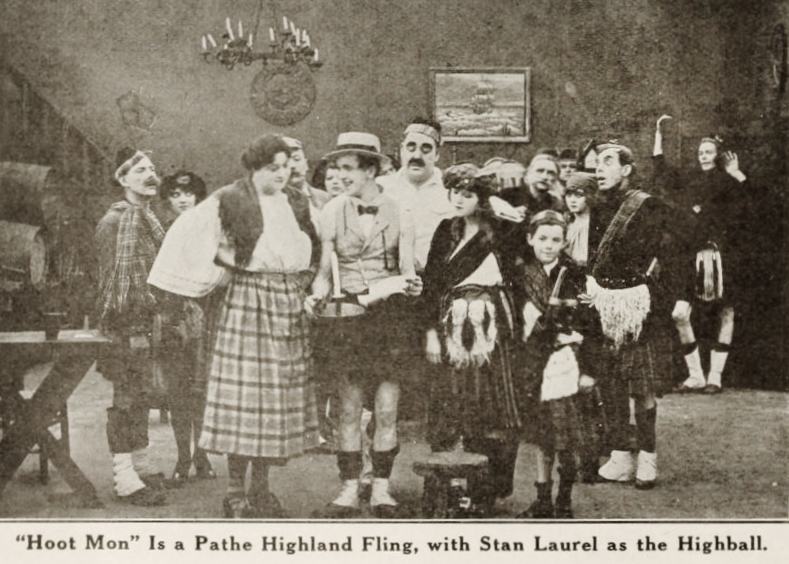
A definitive 6.7/10 rating for a film that redefined the boundaries of cult cinema. Hoot Mon! remains a cornerstone of transgressive art.
Stepping back into the silent era is often a journey of rediscovery, unearthing cinematic gems that, despite their age, resonate with an unexpected vitality. Among these, 'Hoot Mon!' stands as a testament to the universal appeal of fish-out-of-water narratives, especially when anchored by a performer of Stan Laurel's nascent genius. The premise, deceptively simple—an American, Stan, acquires 'The Blue Coo Inn' in Scotland—unfurls into a rich tapestry of cultural misunderstandings and delightful physical comedy. It's a film that, even without spoken dialogue, articulates volumes about identity, adaptation, and the enduring humor found in the clash of worlds.
The allure of 'Hoot Mon!' lies not just in its comedic beats, but in its shrewd observation of character and place. Stan Laurel, even in these earlier, less defined roles, possesses that inimitable blend of wide-eyed innocence and bumbling earnestness that would later define his iconic partnership with Oliver Hardy. Here, he navigates the foreign landscape of Scottish innkeeping with a distinctively American blend of optimism and bewildered charm. The 'Blue Coo Inn' itself is more than a setting; it's an entity, imbued with the spirit of its locale, presenting Stan with a series of delightful quandaries that challenge his metropolitan sensibilities. The film cleverly exploits the inherent humor in an outsider's struggle to assimilate, transforming mundane tasks into elaborate comedic set pieces.
While 'Hoot Mon!' predates the full blossoming of the Laurel and Hardy phenomenon, it offers invaluable insights into the formative stages of Stan Laurel's comedic persona. His performance here is a masterclass in silent expression, relying on exaggerated gestures, expressive facial contortions, and a palpable sense of vulnerability. Unlike the more aggressive, often cynical humor of some contemporaries, Laurel's comedy is rooted in an almost childlike bewilderment at the world's complexities. This makes his Stan character in 'Hoot Mon!' immediately sympathetic, even as he inadvertently creates chaos. We laugh not at his malice, but at his sheer inability to grasp the nuances of his new environment, a trait that would become a hallmark of his enduring appeal. His physical comedy, though perhaps less refined than in later works, already showcases a remarkable precision, turning spills and stumbles into moments of genuine hilarity.
The specific challenges of running a Scottish inn—the unfamiliar customs, the local dialect (implied through context and character reactions), the unique clientele—provide ample fodder for Laurel's brand of humor. One can almost envision the exasperated sighs and knowing glances of the Scottish locals as Stan attempts to navigate the intricacies of a dram of whisky or the proper way to address a Highlander. This cultural chasm is the film's comedic engine, and Laurel is its chief mechanic, constantly tinkering and often breaking things in the most endearing way possible. It's a performance that, even without sound, speaks volumes about the human condition and our universal struggles with adaptation.
While Stan Laurel rightly commands much of the attention, the supporting cast of 'Hoot Mon!' deserves considerable praise for their contributions to the film's overall vibrancy. Actors like Dan Albert, Bunny Bixby, Harry Clifton, Caroline Fowler, Wally Howe, William Petterson, Lillian Rothchild, James Fitzgerald, Gus Leonard, Noah Young, Jerome LaPlanche, Belle Mitchell, James Parrott, Mildred Reardon, Emmy Wallace, Margaret Joslin, Dorothea Wolbert, Bud Jamison, and Marie Mosquini, though many playing smaller, often uncredited roles, collectively form the rich tapestry of Scottish life that Stan so clumsily stumbles into. Their reactions, ranging from bemused tolerance to outright frustration, provide the necessary counterpoint to Laurel's antics, grounding the fantastical elements of the comedy in a believable, if exaggerated, reality.
Gus Leonard, a veteran character actor of the era, likely brought his signature curmudgeonly charm to a Scottish elder, while Noah Young, often a formidable presence, might have embodied a stern Highlander. The subtle interplay between Laurel and these seasoned performers elevates the film beyond mere slapstick. They are not simply props for Stan's jokes; they are active participants in the comedic drama, their expressions and body language communicating volumes in the absence of dialogue. It is this collective effort that imbues 'The Blue Coo Inn' with a palpable sense of community and character, making Stan's integration (or lack thereof) all the more humorous.
'Hoot Mon!' excels in its visual storytelling, a hallmark of the silent film era. The cinematography, though perhaps not groundbreaking for its time, effectively captures the essence of the Scottish setting, contrasting its rugged beauty with Stan's often clumsy intrusions. The use of intertitles, while necessary, is sparse enough to allow the visual gags and character expressions to carry the narrative weight. This reliance on visual cues demands a keen eye from the viewer, rewarding careful observation with layers of comedic detail.
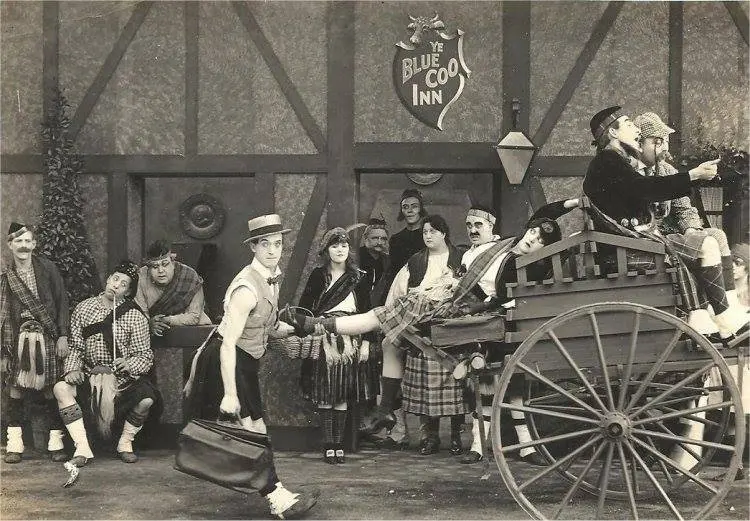
Beyond the laughs, the film touches upon themes of cultural identity and the universal human experience of encountering the 'other.' Stan's journey isn't just about running an inn; it's about confronting his own assumptions and adapting to a world fundamentally different from his own. This thematic depth elevates 'Hoot Mon!' beyond a simple comedy, hinting at the more profound observations often found in silent cinema. It's a gentle reminder that humor can be a bridge across cultural divides, even if that bridge is perpetually under construction.
While 'Hoot Mon!' stands firmly on its own comedic merits, it's intriguing to consider its place within the broader tapestry of early cinema, particularly in how it explores themes of displacement and adaptation. One might draw a thematic, if not tonal, parallel to films like Peggy Leads the Way, where a protagonist embarks on a journey of self-discovery or encounters new environments, albeit with vastly different dramatic stakes. Both films, in their own ways, are about characters navigating unfamiliar territories, be they physical or emotional. The sheer novelty of Stan's situation in Scotland echoes the sense of wonder or bewilderment experienced by characters venturing into the unknown, a common narrative device across genres.
Furthermore, the film's gentle exploration of cultural differences, even if played for laughs, can be seen as a precursor to more serious cinematic inquiries into identity and belonging. While 'Hoot Mon!' is lighthearted, the core idea of an individual grappling with a new cultural framework is a universal one. This thread, albeit in a much more dramatic context, can be found in films that delve into the complexities of human experience when confronted with societal norms or personal upheaval, such as Who Shall Take My Life?, which explores profound existential questions within a specific social setting. Of course, the comedic lens of 'Hoot Mon!' offers a vastly different emotional journey, but the underlying tension between individual and environment remains.
Even in its comedic approach, 'Hoot Mon!' shares a lineage with other films that derive humor from societal contrasts. The silent era was rife with such explorations, often using exaggerated stereotypes to highlight differences. Consider films like Miss U.S.A., which, while focusing on a different kind of cultural representation, also examines the public perception and societal roles within a specific national context. 'Hoot Mon!' uses the 'American abroad' trope to similar effect, contrasting assumed national characteristics with local realities. It's a common comedic wellspring, drawing laughter from the often-awkward dance of differing customs and expectations.
Despite its age and the limitations of silent film technology, 'Hoot Mon!' retains a remarkable freshness. It serves as a delightful time capsule, not only offering a glimpse into early 20th-century filmmaking but also reminding us of the timeless nature of good comedy. Stan Laurel's performance is a particular highlight, showcasing the raw talent that would soon captivate audiences worldwide. It's a film that proves that laughter transcends language barriers and the passage of time, a testament to the universal appeal of human foibles.
For aficionados of silent cinema, and especially for those keen to trace the evolutionary path of comedic genius, 'Hoot Mon!' is an essential viewing experience. It's a charming, witty, and surprisingly insightful film that, despite its brevity, leaves a lasting impression. The cultural clash, the endearing protagonist, and the wonderfully expressive supporting cast all contribute to a cinematic experience that continues to entertain and enlighten, proving that even the simplest premises, in the right hands, can yield profound and lasting comedic gold. It's a gentle reminder of the enduring power of silent film to communicate complex emotions and hilarious situations with an elegance that modern cinema often struggles to replicate. The film's unassuming nature belies its depth, as it subtly comments on themes of belonging, the allure of the exotic, and the often-humorous struggle to find one's place in an unfamiliar world.
In a world often saturated with bombastic blockbusters, there's a particular joy in returning to the understated brilliance of films like 'Hoot Mon!'. It invites us to slow down, to observe, and to appreciate the artistry of visual storytelling. The film's quiet humor and character-driven narrative offer a refreshing counterpoint to contemporary comedic trends, proving that sometimes, the loudest laughs come from the most subtle of observations. It's a cinematic embrace of the awkward, the charmingly inept, and the universally human desire to simply fit in, even when faced with a 'blue coo' that refuses to be tamed. The journey of Stan, the American innkeeper, is a delightful microcosm of the immigrant experience, rendered with a light touch and an abundance of heart.
Ultimately, 'Hoot Mon!' is more than just an early Stan Laurel vehicle; it's a vibrant piece of cinematic history that continues to resonate. Its unpretentious charm and genuine humor make it a timeless classic, inviting new generations to discover the magic of silent film and the inimitable talent of its stars. The film stands as a delightful cultural document, showcasing not only the comedic sensibilities of its era but also enduring human truths about connection and community. Its simplicity is its strength, allowing the performances and the inherent humor of the situation to shine through, unencumbered by the complexities of sound. It's a film that whispers its jokes, yet they echo with a clarity that few modern comedies achieve.
IMDb 4.1
1920
Community
Log in to comment.