DbcultAccessing Vault...
7.3/10
Senior Film Conservator
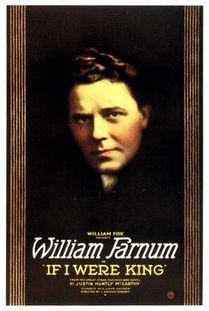
A definitive 7.3/10 rating for a film that redefined the boundaries of cult cinema. If I Were King remains a cornerstone of transgressive art.
The flickering nitrate of If I Were King lands like a wineskin hurled across centuries, drenching the screen in crimson ambition and gutter smoke. Director J. Gordon Edwards—seldom name-dropped outside archives—marshals a cast worthy of a royal court and a thieves’ kitchen in the same breath, letting William Farnum’s rangy swagger as François Villon carve space between cathedral spire and rat-infested alley.
From the first iris-in on a fog-choked quay, the film luxuriates in contradiction: opulence versus offal, piety versus profanity. Edwards’ camera, gliding on early boom arms, swoops over banqueting tables glittering with pewter while a half-starved child gnaws a bone beneath them. That visual dialectic—feast and famine clasped in macabre waltz—propels the narrative like a siege engine.
Intertitles, penned with arch flamboyance by E. Lloyd Sheldon, detonate like small printed fireworks. One card reads: “A kingdom is but a bauble in the palm of a poet who has measured the girth of eternity.” Such bombast could curdle, yet Farnum sells it through the kinetic arrogance of his shoulders, the half-shut eyes that seem forever scribbling couplets on the inside of his eyelids.
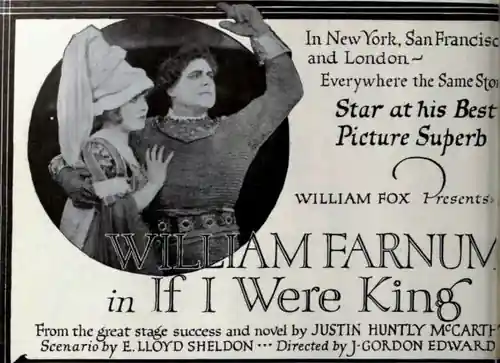
Silent-era audiences, accustomed to moral simplicity, encountered here a protagonist who pickpockets sacramental bread and later doles it to the poor as communion. Villon’s religiosity is a shattered stained-glass window—light refracted into iridescent shards, beautiful yet perilous to step upon barefoot. That moral slipperiness feels startlingly modern; one senses the rumblings of the antihero decades before the term existed.
The plot’s MacGuffin—that Louis XI would hand temporal power to a vagabond for seven days—sounds like drunken boast. Yet the film roots it in the king’s Machiavellian calculus: let the scamp expose court corruption, then sweep the refuse to the guillotine when convenient. Thus the temporal fulcrum of the story becomes a chess match played with living pieces, each move scored by chiming bells across the Île de la Cité.
Renita Johnson’s poised Katherine de Vaucelles supplies the obligatory romantic foil, but her role transcends mere placeholder. She embodies the aristocracy’s guilty conscience, a woman whose silk glove hides ink-stained fingers, having transcribed Villon’s outlaw verses in secret. Their liaison—conducted amid crypts and moonlit parapets—charges every glance with textual tension: she loves the poet, yet fears the revolution coiled within his rhymes.
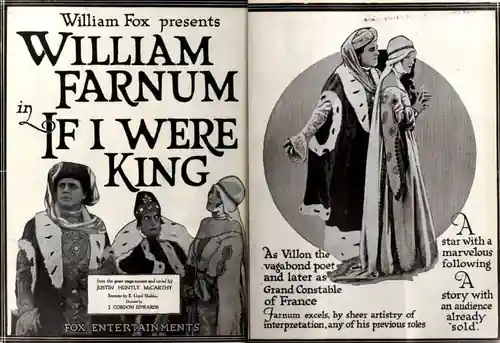
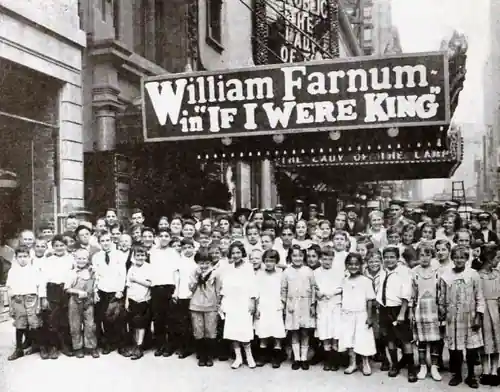
Shot in the winter of 1919 within Fox’s sprawling New York studio, the picture spared no expense. Carpenters erected a 300-foot replica of the Pont Neuf, then aged it with boiling vinegar and tar to mimic centuries of soot. Costume designer Betty Ross Clarke prowled Parisian antique stalls, returning with moth-chewed doublets whose musty aroma reportedly made extras sneeze mid-take—an authenticity seldom demanded, yet here lavished like gold leaf.
Cinematographer Claude Payton, unsung pioneer of diffused backlighting, bathes torchlight across stone corridors so that shadows drip like viscous pitch. Notice the sequence where Villon, cornered by the Constable’s guards, escapes via a subterranean ossuary: bones gleam cobalt under Payton’s arc lamps, turning catacombs into a danse macabre rendered almost three-dimensional through subtle double exposure.
William Farnum, whose stage credits ranged from Shakespeare to melodrama, attacks Villon with barnstorming gusto—every guffaw ricochets off vaulted ceilings, every whispered stanza curls like cigarette smoke. Yet beneath theatrical flourish lurks genuine ache; watch the moment he learns his week of kingship is a death sentence. His shoulders sag as though Atlas set the globe on them, and the swagger evaporates into a childlike bewilderment that silent-era close-ups magnify to heart-stopping intimacy.
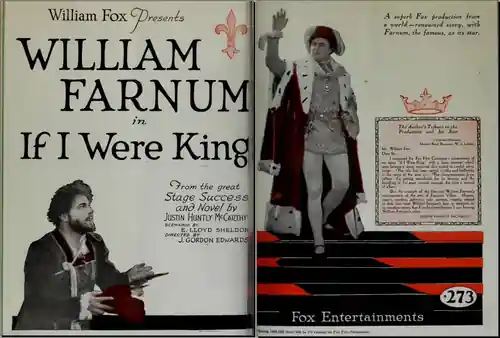
Fritz Leiber—senior, not the sci-fi scion—imbues Louis XI with spiderish cunning, a monarch who weighs words like a banker counting clipped coins. His scenes opposite Farnum crackle with Machiavellian electricity; one senses history pivoting on the hush between two adversaries pretending to be allies.
Though released sans synchronized score, urban theaters often engaged house orchestras to improvise accompaniment. Surviving cue sheets recommend “La Marseillaise” slowed to dirge tempo during Villon’s sentencing, juxtaposed with jaunty cabaret numbers for tavern revels. Modern home viewers can replicate the effect via curated playlists; try coupling Saint-Saëns’ “Danse Macabre” with the climactic bell-tower brawl—syncopation aligns uncannily, as though composer and cinematographer conspired across a century.
Cinephiles tracking rags-to-royalty narratives will recall The Cinderella Man, yet where that tale sanctifies upward mobility, If I Were King weaponizes it, exposing monarchy as costume jewelry easily shoplifted. Similarly, The Storm harnesses tempestuous fate, but lacks the socio-political bite that makes Villon’s transient reign feel like proto-republican agitprop.
Conversely, Saved in Mid-Air toys with deus-ex-machina rescue tropes, whereas Edwards’ film refuses tidy salvation; its hero survives through wit, not providence—a secular redemption narrative sneaking into pious medieval terrain.
Original prints languished in Fox’s East-coast vault until a 1978 nitrate fire nearly obliterated them. What survives—two incomplete 35 mm reels and a 16 mm classroom dupe—now rests in the Library of Congress, digitally scanned at 4K though gaps remain. Streaming platforms occasionally host 1080p transfers with Library-supplied intertitles; purists should seek the Kino Classics Blu-ray, which interpolates stills and production photos to bridge narrative lacunae without editorializing.
Viewed through modern optics, If I Were King is both artifact and arrow. Its gender politics, though progressive in granting Katherine agency, still frame her as muse rather than co-author of revolt; its class commentary, daring for 1920, never questions monarchy’s legitimacy outright, preferring the safer balm of righteous ruler over systemic upheaval. Yet within those constraints the film whispers a perennial truth: power lies not in scepters but in stories, and stories belong to those who can spin straw into lyric gold.
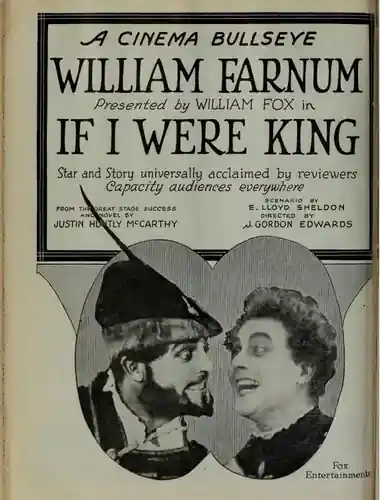
The celluloid may crackle, the intertitles may yellow, but Villon’s defiant laughter—captured in Farnum’s irrepressible grin—echoes past the footlights of history, reminding us that every crown is a loan, every throne a perch, every poet a king in the republic of ink.
Grade: A- (for ambition, visual opulence, and literary audacity; minus for fragmentary survival and occasional staginess inherited from its stage source.)
For further swashbuckling romance, sample Madame Spy; for tempestuous destiny, consult The Flame of Passion. Yet return here when you crave a tale where a poet filches the sun, if only for a week, and scorches his initials across the dawn.
IMDb 2.3
1929
Community
Log in to comment.