DbcultAccessing Vault...
Cult Review
Senior Film Conservator
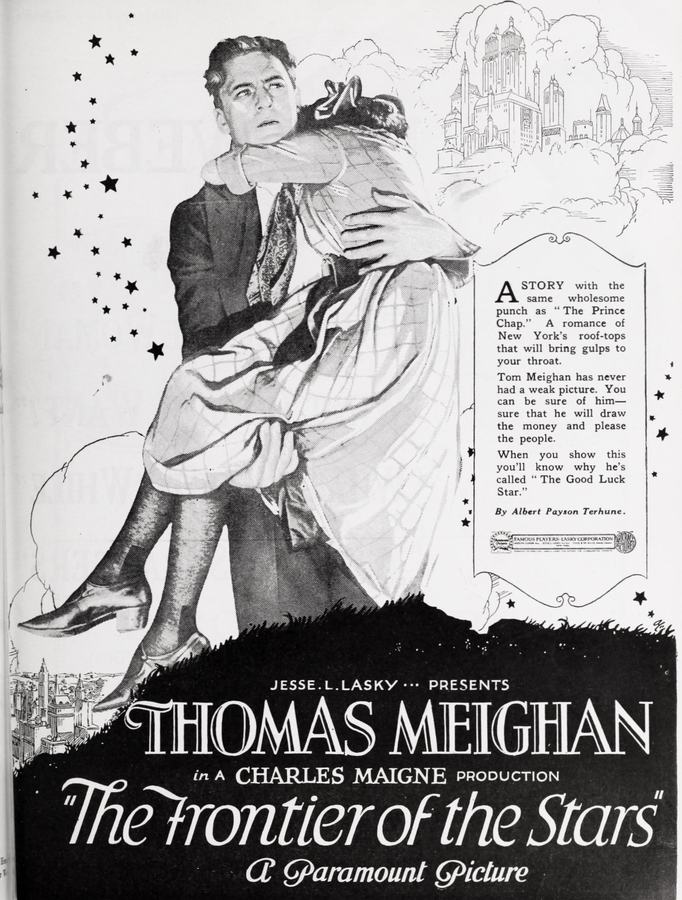
Frontier of the Stars is a film that crackles with the tension of a world on the brink—a world where the shadows of tenement rooftops harbor both sin and salvation. At its core is Buck Leslie, a gangster whose rugged exterior masks a soul in flux, and Hilda Shea, a woman whose quiet resilience becomes the axis of his transformation. The narrative, though anchored in the conventions of early 20th-century crime dramas, transcends its genre through its emotional depth and visual lyricism.
Edward Ellis, as Buck Leslie, embodies the archetype of the conflicted antihero with a ferocity that is both captivating and unsettling. His portrayal is a study in contrasts—his physicality conveys brute strength, yet his glances are often laced with a self-awareness that hints at his inner turmoil. Florence Johns, as Hilda, brings a delicate poise to the role, her stillness communicating volumes about her character’s inner fortitude. The chemistry between Ellis and Johns is the film’s emotional nucleus, a dynamic that evolves from wary coexistence to mutual salvation.
The film’s most striking achievement lies in its ability to use visual motifs to underscore its thematic preoccupations. The tenement roof—where Buck first encounters Hilda—serves as both a literal and metaphorical threshold. It is a space of refuge and reckoning, where the urban sprawl’s grit meets the ethereal promise of redemption. The color palette, dominated by deep blues and stark whites, mirrors the duality of Buck’s journey: a descent into darkness followed by an ascent into the light of moral clarity.
The fire that consumes the tenement is not merely a plot device but a symbol of purification. In its flames, the old Buck is incinerated, making way for a man reborn. Hilda’s miraculous recovery of mobility—achieved in the film’s most audacious moment—parallels this rebirth, suggesting that love and sacrifice can transcend even the most entrenched physical limitations. This interplay of fate and free will is handled with a subtlety that elevates the film beyond its B-movie trappings.
Gus Weinberg’s direction, while occasionally steeped in the rigid formalism of early cinema, demonstrates a keen understanding of visual storytelling. His use of close-ups—particularly in the scenes where Buck and Hilda exchange glances across a smoky room—captures the unspoken tension between them. The staging of action sequences, such as the rooftop confrontation with Detective Phil Hoyt (Thomas Meighan), is taut and precise, though it lacks the stylistic flourishes that define later Hollywood classics.
The supporting cast, including Alphonse Ethier as the enigmatic chemist Gregory and Faire Binney as a morally ambiguous figure, provides a sturdy foundation for the central narrative. Their performances, though less showy, are essential in fleshing out the film’s moral ambiguity. The dialogue, penned by Charles Maigne and Albert Payson Terhune, is crisp and laden with subtext, particularly in the exchanges between Buck and Hoyt, which serve as a microcosm of the broader conflict between law and disorder.
Frontier of the Stars shares thematic echoes with Dead Men Tell No Tales, another period piece that explores the intersection of crime and personal redemption. However, where the latter leans heavily on melodrama, Frontier of the Stars tempers its emotional stakes with a more restrained, almost classical narrative structure. Similarly, the film’s use of fire as a transformative element can be likened to the climactic destruction in The Marble Heart (1916), though here the flames are less a symbol of vengeance than of catharsis.
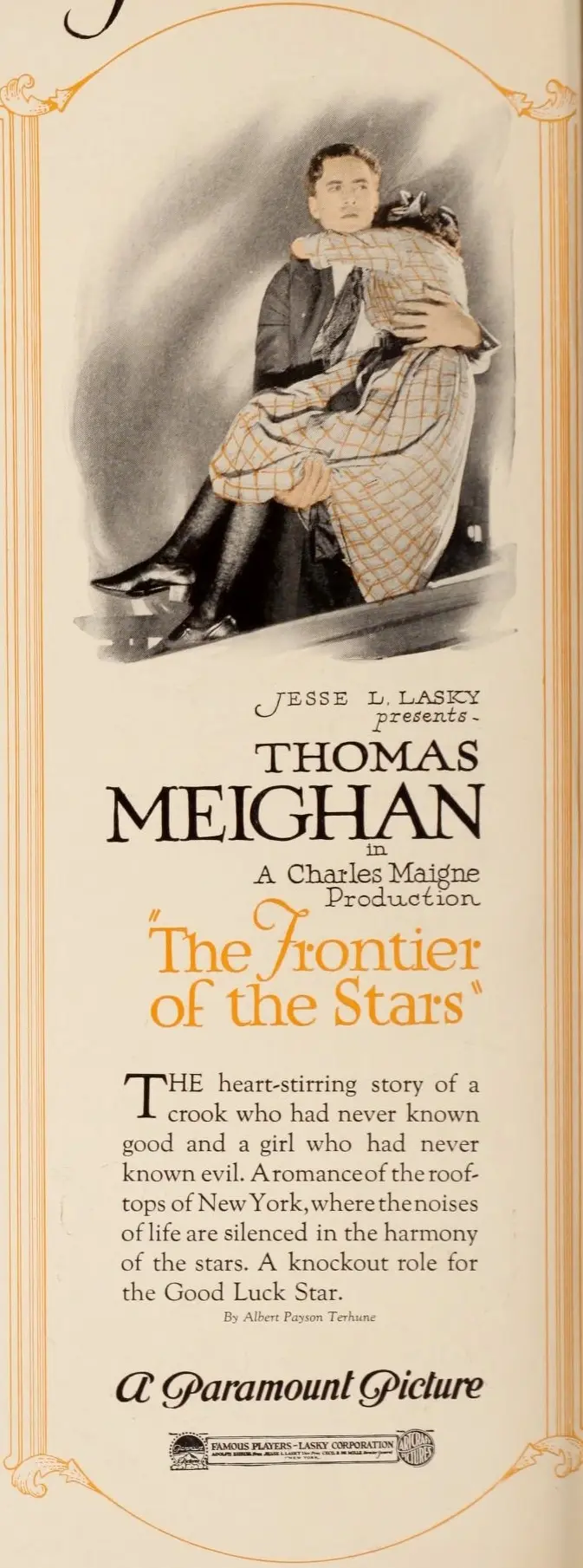
In contrast to the stark realism of Driftwood, which focuses on the plight of the displaced, Frontier of the Stars injects a romantic idealism into its gangster milieu. This duality is reminiscent of Soldiers of Fortune (1919), where camaraderie and conflict coexist in a war-torn landscape. Yet, the film diverges in its emphasis on individual redemption over collective action, a choice that reflects the era’s evolving cinematic sensibilities.
Though a silent film, Frontier of the Stars is not without auditory richness. The absence of spoken dialogue amplifies the emotional weight of its visual cues, particularly in the scenes where Buck and Hilda share tentative moments of connection. The intertitles, concise yet evocative, act as a bridge between the characters’ internal landscapes and the audience’s interpretation. The score, though not documented in detail, is likely to have employed a mix of somber piano and swelling strings to underscore the film’s dramatic pivots.
Frontier of the Stars occupies a curious space in early American cinema—a bridge between the slapstick humor of slapstick’s heyday and the more complex character studies of the coming sound era. Its exploration of moral ambiguity and personal agency resonates with later works such as The Rough Lover and The Woman Michael Married, which similarly grapple with the tension between societal expectation and individual desire.
For modern audiences, the film’s value lies in its unflinching portrayal of a man’s struggle to reconcile his past with his aspirations for the future. It is a story that, while rooted in a specific historical context, speaks to universal themes of transformation and the power of love to transcend even the most entrenched cycles of violence. In an age where streaming platforms inundate viewers with remakes and reboots, Frontier of the Stars stands as a testament to the enduring power of originality and emotional authenticity.
In sum, Frontier of the Stars is more than a relic of its time. It is a richly layered narrative that, despite its technical limitations, manages to convey a profound sense of human complexity. The interplay of light and shadow, the quiet intensity of its performances, and the symbolic richness of its imagery combine to create an experience that is both immersive and intellectually rewarding.
For those seeking a deeper understanding of early American cinema’s narrative possibilities, this film is an essential watch. It challenges the notion that silent films are merely primitive precursors to modern storytelling, proving instead that they were capable of nuance, sophistication, and lasting emotional impact. Frontier of the Stars may not have the name recognition of Madame Butterfly (1915) or The Little Duchess, but its contributions to the cinematic lexicon are undeniable.
As the credits roll and the final image of Buck and Hilda walking into the horizon fades, one is left with the impression that the film’s true frontier is not a physical place but a psychological and moral space—a realm where redemption is possible, and love, in its purest form, is the ultimate frontier.
IMDb 4.5
1924
Community
Log in to comment.