DbcultAccessing Vault...
Cult Review
Senior Film Conservator
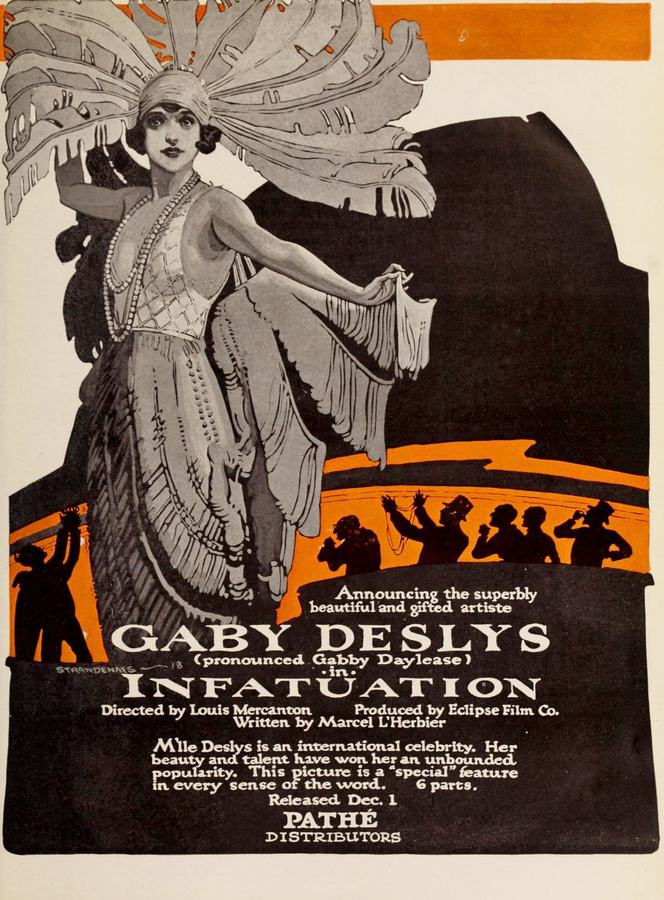
The year 1918 stood as a precipice in cinematic history, a moment where the visceral grit of the Victorian era began to dissolve into the avant-garde experimentation of the Roaring Twenties. Within this transformative vacuum emerged Infatuation, a film that serves as both a swan song for the legendary Gaby Deslys and a fascinating blueprint for the psychological dramas that would soon dominate European screens. To watch this film today is to witness the intersection of music-hall celebrity and the nascent language of narrative film, all wrapped in a Parisian melodrama that feels both archaic and startlingly modern in its grasp of trauma and memory.
Gaby Deslys was a phenomenon that the modern era struggles to categorize. She was more than an actress; she was an icon of fashion, a pioneer of the jazz age, and a woman whose presence could command the attention of kings. In Infatuation, she portrays Flora Nys with a vulnerability that belies her real-world status as a global superstar. The transition from the flower girl—a trope well-worn in films like The Vicar of Wakefield—to the sophisticated stage star is handled with a nuanced physicality. Deslys doesn't merely change her clothes; she alters her gait, her gaze, and the very cadence of her gestures.
Her chemistry with Harry Pilcer, her real-life partner, provides the film with an emotional anchor that many of its contemporaries lacked. While other films of the period, such as As Man Made Her, often leaned into the theatricality of the 'fallen woman' narrative, Deslys brings a sense of agency to Flora. Even when she is being manipulated by the nefarious Gray Stanton, there is a sense that her choices are born of a complex inner life rather than simple plot necessity.
Though Marcel L’Herbier is primarily remembered as a titan of the French Impressionist cinema, his work as a writer on Infatuation reveals an early fascination with the darker corners of the human condition. The character of Le Baron is not your standard mustache-twirling villain found in early serials like Lucille Love: The Girl of Mystery. Instead, he represents a systemic oppression—the landlord as a predator, the witness as a blackmailer. His decision to trample Flora’s flowers is a sequence of startling cruelty, a visual metaphor for the crushing of the proletariat's only means of beauty and survival.
The narrative structure echoes the moral complexities found in The Easiest Way, where the lure of luxury acts as a centrifugal force pulling the protagonist away from her moral center. However, where other films might offer a purely Puritanical condemnation, L’Herbier and the director allow Flora a path toward redemption that is rooted in psychological labor rather than divine intervention. The 'brain fever' suffered by Paul Bernard (Gabriel Signoret) serves as a physical manifestation of the psychic break caused by betrayal, a common but effective trope in 1910s cinema, seen also in works like The Neglected Wife.
Visually, Infatuation is a masterclass in using location to dictate mood. The early scenes in the cramped quarters of the Parisian poor are shot with a claustrophobic density. The shadows seem to cling to the walls, a stark contrast to the expansive, light-drenched stages of the theatre where Flora later finds her fame. This dichotomy between the 'real' world of poverty and the 'artificial' world of the stage is a recurring theme in European cinema of this era, notably explored in Il fiacre n. 13.
The department store sequence, where Flora steals the fur, is particularly striking. It captures the burgeoning consumer culture of the early 20th century—a world of glittering temptations that offered a fast track out of poverty at the cost of one's soul. This thematic thread connects Infatuation to American social dramas like Life's Shop Window, highlighting a global cinematic anxiety regarding the moral hazards of the modern city.
The film's climax is perhaps its most daring conceptual move. The idea that a man’s lost memory can be restored through a meticulously staged reenactment of his most cherished moment is a proto-Proustian concept. When Flora dons her old, ragged clothes and sits by the fire, she is not just performing for her husband; she is performing for her own soul. It is a moment of meta-theatricality—an actress playing a character who is herself playing her former self. This layer of artifice-within-artifice elevates Infatuation above the standard melodrama.
Compare this to the more straightforward moralism of The Christian, and you see the difference in the French approach. There is a belief here in the power of the image and the costume to heal the mind. The restoration of Paul’s memory is not a miracle in the religious sense, but a triumph of the theatrical spirit. It suggests that our identities are tied to the narratives we construct and the roles we play for one another.
In the broader landscape of 1918, Infatuation stands as a bridge between the simplistic morality of early shorts and the complex feature-length narratives that were becoming the standard. While films like Anything Once or Framing Framers were experimenting with genre conventions in the United States, the French were refining the 'social drama' into something more aesthetically rigorous. The inclusion of Max Maxudian as Gray Stanton provides a weight to the antagonist role that feels more grounded in the reality of the upper-class 'rounder' than the caricatures often seen in The Last Egyptian.
Furthermore, the film’s portrayal of the theatre world offers a rare glimpse into the actual stagecraft of the era. The dance sequences, though limited by the technology of the time, capture the kinetic energy that made Gaby Deslys a household name. Unlike the more static presentations found in Un día en Xochimilco, there is a rhythmic editing style here that suggests the influence of the burgeoning 'montage' movement that would soon sweep across Europe.
Is Infatuation a masterpiece? Perhaps not in the sense of a perfectly polished diamond. It suffers from some of the pacing issues common to the era, and the 'brain fever' resolution might strike modern audiences as a convenient plot device. However, as a cultural artifact, it is indispensable. It captures the essence of a world in flux, where the old codes of honor (seen in A Case at Law) were being challenged by the new, frenetic energy of the urban landscape.
The film also serves as a poignant reminder of Deslys's talent, occurring just two years before her untimely death. Her performance as Flora Nys is a testament to her range, moving from the desperate survivalism of a flower girl to the poised elegance of a star, and finally to the humbled, loving wife. It is a journey of the self that mirrors the journey of cinema itself—from simple attraction to complex, psychological depth.
For those interested in the evolution of the social secretary trope or the 'working girl' narrative, Infatuation offers a fascinating counterpoint to The Social Secretary. While the latter focuses on the wit and charm required to navigate the upper echelons of society, Infatuation focuses on the grit and the cost of that navigation. It is a darker, more resonant exploration of what it means to be 'made' by a man, and then to find the strength to remake oneself.
In the end, the film's lasting power lies in its final image: the flicker of recognition in a husband's eyes, brought about by the sight of a woman in a tattered dress. It is a reminder that while the world may change, and while we may ascend to heights of fame and fortune, the core of our humanity is often found in the simplest, most honest versions of ourselves. Infatuation is not just a story of a woman’s rise and fall; it is a story of her return to grace, through the very medium—theatre—that once threatened to consume her.
The technical prowess of the film, for 1918, is commendable. The lighting in the final Christmas scene creates a chiaroscuro effect that rivals the best work in Herregaards-Mysteriet. It is this attention to visual storytelling, combined with a script that treats its characters with psychological dignity, that ensures Infatuation remains a vital chapter in the annals of silent film history.
IMDb —
1921
Community
Log in to comment.