DbcultAccessing Vault...
7.2/10
Senior Film Conservator
A definitive 7.2/10 rating for a film that redefined the boundaries of cult cinema. One Stolen Night remains a cornerstone of transgressive art.
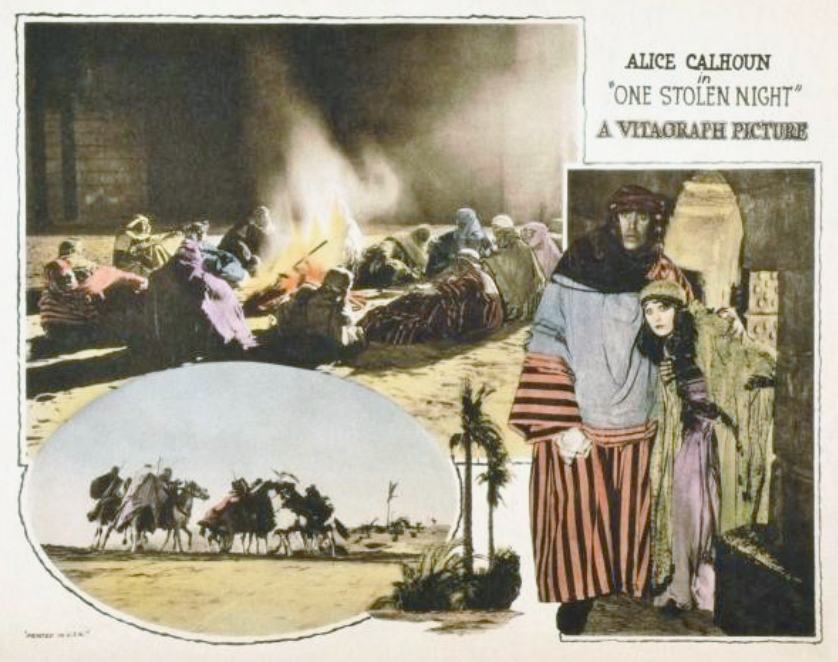
In the annals of early cinematic history, certain films emerge not just as entertainment, but as cultural artifacts, reflecting the prevailing anxieties, fascinations, and narrative conventions of their epoch. D.D. Calhoun and Bradley J. Smollen's collaborative effort, 'One Stolen Night,' a 1923 silent film directed by the uncredited, yet profoundly influential, Herbert Heyes, stands as a testament to the era's enduring allure with exotic locales and the timeless trope of mistaken identity. This feature, starring Adele Farrington and Heyes himself, plunges its audience into a world where the shimmering heat of the Sahara serves as a potent backdrop for a romance shrouded in mystery and societal expectation. It is a narrative that, while perhaps quaint by contemporary standards, offers a fascinating glimpse into the nascent storytelling techniques of Hollywood's golden age, particularly its penchant for grand gestures and dramatic reveals.
The film commences with Diantha Ebberly, portrayed with a subtle blend of naiveté and burgeoning independence by Adele Farrington, embarking on a journey of profound consequence. Accompanied by her parents, she travels to the very fringe of the formidable Sahara desert, a landscape as alien as the circumstances awaiting her. Her destination is a meeting with Herbert Medford, her long-term betrothed, a man she has, astonishingly, never encountered. This premise alone—the arranged marriage to an unknown suitor—immediately establishes a tension between duty and personal desire, a theme frequently explored in the melodramas of the time, from the stoic adherence to tradition in Heart o' the Hills to the more whimsical, yet equally binding, expectations found in The Goose Girl. Diantha's world is one dictated by societal norms, yet her spirit yearns for something more authentic, a sentiment that quickly propels the narrative forward.
Her arrival in this foreign land is not without incident. A chaotic swarm of local beggars descends upon her, a scene designed to evoke both peril and exoticism for the Western audience. From this tumultuous situation, Diantha is dramatically rescued by a mysterious figure, a man presented to the audience and to Diantha herself simply as an 'Arab.' Herbert Heyes, who takes on this pivotal dual role, imbues the character with an immediate sense of heroism and an undeniable charisma, even beneath the layers of 'native' costume. This initial rescue is more than just a plot device; it's the catalyst for Diantha's awakening, a moment where her carefully constructed world begins to fray at the edges, hinting at the thrilling, and perhaps dangerous, possibilities that lie beyond her prescribed path.
Driven by an irresistible curiosity and perhaps a burgeoning desire for autonomy, Diantha takes a bold step, slipping out at night, disguised in local dress. This act of rebellion, of embracing the 'other,' is where the film truly begins to weave its romantic spell. She encounters her rescuer once more, and it is under the vast, star-dusted canopy of the desert night that their connection deepens. The silent film medium, reliant on visual storytelling and the expressive power of its actors, brilliantly conveys the burgeoning affection between them. Their love story, unfolding against the backdrop of ancient sands, feels both fated and forbidden, echoing the passionate, often illicit, undertones of films like Dangerous Love or The Forbidden Lover, where societal strictures clash violently with personal yearning.
The narrative takes a darker turn with the abduction of Diantha by the nefarious Sheik Amud. Russ Powell, as the formidable Sheik, embodies the stereotypical villain of exotic romances, a figure of menace and raw power. This plot point, while a classic damsel-in-distress scenario, serves to heighten the stakes and further cement the 'Arab's' heroic status. The urgency of the rescue, the implicit danger Diantha faces, and the dramatic confrontation between her captor and her clandestine lover are all handled with a flair for the theatrical, characteristic of the era's filmmaking. The return of Diantha, safe and sound, by her mysterious 'Arab' reinforces the deep emotional bond they have forged, a bond tested by peril and strengthened by shared experience.
The climax, or rather, the grand reveal, arrives with the morning light. Diantha awakens to a truth that reconfigures her entire understanding of the preceding events. Her fiancé, the man she was destined to marry, and the 'Arab' who stole her heart and saved her life, are one and the same: Herbert Medford. This dramatic unmasking, a staple of romantic comedies and dramas alike, from Shakespearean disguises to later cinematic twists in films like The Spy or In Treason's Grasp, where hidden identities drive much of the suspense, provides the satisfying resolution the audience craves. It validates Diantha's emotional choices, proving that her heart, despite circumstances, led her to the 'correct' partner, albeit through a circuitous and adventurous route.
Adele Farrington, as Diantha, delivers a performance that navigates the complexities of her character's journey from sheltered debutante to adventurous lover. Her expressive eyes and gestures, crucial in the silent era, convey a spectrum of emotions—curiosity, fear, love, and ultimately, joyous recognition. Herbert Heyes, not only directing but also starring, masterfully handles the dual role of the refined Herbert Medford and the dashing 'Arab.' His portrayal of the latter is particularly compelling, embodying the romantic ideal of the exotic hero. The physical transformation, however subtle, allows for the suspension of disbelief necessary for the final revelation to land with impact. Russ Powell's Sheik Amud, while a stock character, is effective in generating the required tension, his imposing presence a stark contrast to Heyes's more nuanced hero.
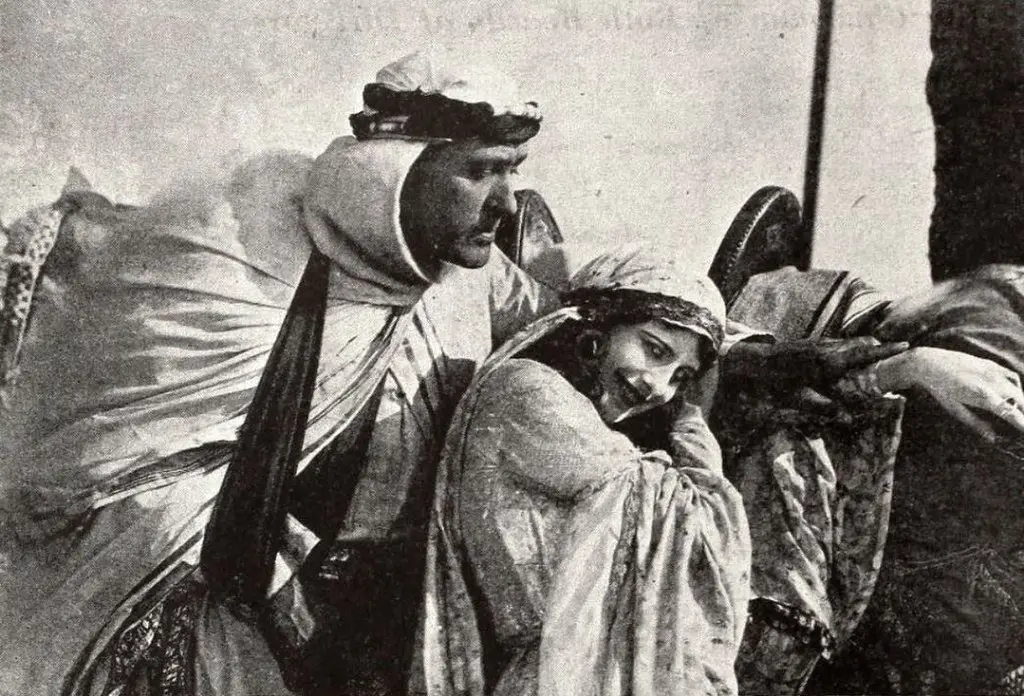
The supporting cast, including Otto Hoffman and Alice Calhoun, provides solid contributions, anchoring the film's domestic and adventurous elements. Hoffman, likely playing one of Diantha's parents, would have provided the paternal gravitas or concern, while Calhoun's role, though not explicitly detailed in the plot, would have added another layer to the ensemble, perhaps as a confidante or another member of the traveling party. The effectiveness of a silent film often hinged on the collective strength of its performers to communicate without dialogue, relying on pantomime, facial expressions, and body language to propel the narrative and convey emotional depth.
The visual language of 'One Stolen Night' is also noteworthy. The Sahara setting, whether achieved through location shooting or elaborate studio sets, plays a character in itself. The vast, undulating dunes, the stark contrast of light and shadow, and the exoticism of the 'native' costumes all contribute to the film's immersive quality. The cinematography, a crucial element in silent film, would have utilized dramatic lighting and framing to emphasize emotional states and plot developments. The sense of adventure and romance is intrinsically tied to the visual splendor (or imagined splendor) of the desert, a motif that captivated audiences in countless films, from lavish epics like Samson und Delila to more intimate desert romances.
'One Stolen Night' is undeniably steeped in the Orientalist aesthetic prevalent in early 20th-century Western culture. The portrayal of the 'Arab' and the desert setting, while romanticized, often veered into stereotypical representations. However, within this framework, the film explores universal themes: the tension between societal expectations and individual desire, the thrill of the unknown, and the transformative power of love. Diantha's journey is as much an internal one as it is a physical adventure. Her initial acceptance of an arranged marriage gives way to a spirited pursuit of genuine connection, even if it appears to violate convention. The film champions the idea that true love transcends superficial appearances and even cultural divides, a message that, despite its exotic packaging, resonates across eras.
The narrative also plays with the concept of identity, not just for Herbert/the 'Arab,' but also for Diantha. Her donning of 'native' dress is an act of temporary self-reinvention, an exploration of a different facet of her being. This kind of masquerade, where characters adopt new personas to achieve their goals or explore hidden desires, is a recurring motif in cinema, from the playful deceptions in The ABC of Love to the more serious implications of hidden identities in The Broken Silence. The film suggests that sometimes, to truly find oneself, one must step outside the confines of their established identity and embrace the unknown.
D.D. Calhoun and Bradley J. Smollen's screenplay, while adhering to the dramatic conventions of the time, cleverly constructs a narrative that builds suspense around the hidden identity. The writers understand the power of delayed gratification, allowing the audience to invest emotionally in the 'Arab' as a separate entity before revealing his true connection to Diantha's pre-ordained life. This narrative strategy ensures that the audience roots for the romantic pairing, making the ultimate revelation not just a surprise, but a satisfying affirmation of their burgeoning love. The film avoids making the audience feel that Diantha 'settled' for her fiancé; instead, it demonstrates that her heart instinctively chose him, regardless of his disguise.
'One Stolen Night' might not possess the grand scale of some contemporary epics, nor the profound social commentary of other silent films, but its enduring appeal lies in its straightforward yet engaging storytelling. It's a classic example of how early cinema leveraged exotic settings and romantic intrigue to captivate mass audiences. The film's themes of love, duty, adventure, and the discovery of one's true desires remain timeless, albeit presented through a lens of early 20th-century sensibilities. While it may not be as widely discussed as some of its more famous counterparts, it holds a significant place in understanding the popular entertainment landscape of its time.
For modern viewers, 'One Stolen Night' offers more than just a historical curiosity. It's an opportunity to appreciate the artistry of silent film, where emotions are writ large on faces and bodies, and narratives are propelled by visual spectacle and dramatic irony. The uncredited direction by Herbert Heyes, alongside the collaborative writing efforts of D.D. Calhoun and Bradley J. Smollen, results in a cohesive and entertaining piece of filmmaking that, despite its age, still manages to charm and surprise. The film is a reminder that the foundational elements of storytelling—a compelling protagonist, a dashing hero, a villain, and a twist—are as effective today as they were a century ago, proving that a well-crafted narrative, even without spoken dialogue, can transcend time and cultural shifts.
In conclusion, 'One Stolen Night' is a delightful relic of an era obsessed with adventure and romance. It serves as a fascinating study of early Hollywood's narrative strategies and its ability to craft engaging stories with limited technical means but boundless creativity. It solidifies its place as a quintessential desert romance, a testament to the enduring power of love to overcome obstacles, whether they be societal expectations or a clever disguise. Its narrative, while straightforward, is executed with a charm and dramatic flair that ensures its continued resonance for those willing to delve into the rich tapestry of silent cinema. The film, much like a hidden oasis, offers a refreshing draught of classic storytelling amidst the vast desert of cinematic history.
IMDb —
1920
Community
Log in to comment.