DbcultAccessing Vault...
4.4/10
Senior Film Conservator
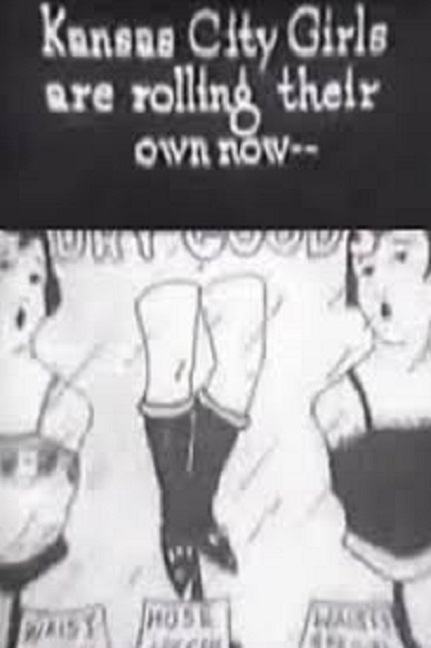
A definitive 4.4/10 rating for a film that redefined the boundaries of cult cinema. Kansas City Girls Are Rolling Their Own Now remains a cornerstone of transgressive art.
In the brittle glow of early 20th-century cinema, Kansas City Girls Are Rolling Their Own Now emerges as a curious artifact: a single-frame Disney drawing that defies easy categorization. This 1928 work, often dismissed as a mere sketch, reveals itself as a complex palimpsest of urban observation, mechanical abstraction, and proto-cartoon experimentation. As the camera (or rather, the artist's fixed perspective) lingers on three young women navigating a bustling sidewalk, Walt Disney's signature style begins to crystallize in ways both familiar and startlingly original.
The film's most arresting quality lies in its paradoxical stillness. Though technically a single static image, the frame throbs with kinetic energy through Disney's masterful use of line weight and negative space. The girls' movements are rendered as a series of frozen gestures, each one a perfect distillation of motion. The central figure, clutching a newspaper, becomes a human metronome, her body language echoing the staccato rhythms of Kansas City's interwar streets. This visual staccato prefigures the rubber-hose animation techniques Disney would later refine, yet here it exists in a raw, almost Cubist form.
Disney's choice of Kansas City as a setting is revelatory. The city's architectural silhouette—those angular Art Deco storefronts, the hazy smog clinging to the skyline—becomes a character in itself. The girls' interactions with this urban landscape are imbued with a proto-surrealist quality: a newspaper unfurls like a fanfare, a shop window reflects the sky as a fractured mirror. These touches recall the dreamlike realism of The Forbidden Path while anticipating the whimsical urbanism of The Spider and the Fly.
What distinguishes this work from Disney's later cartoons is its deliberate ambiguity. The narrative thread—three women on a daily errand—is secondary to the painterly composition. A passing car becomes a streak of light across the canvas; a shadow on the sidewalk morphs into a abstract shape. This formal preoccupation recalls the geometric abstractions of Homunculus, 6. Teil, yet remains tethered to the human scale. The result is a film that exists in multiple temporal registers at once: a frozen moment, a looping cycle, and an evolving morphosis.
The color palette, though monochromatic, is anything but flat. Disney's use of cross-hatching creates a chiaroscuro effect that suggests depth without perspective. The girls' dresses, rendered in varying weights of line, create a visual rhythm that mimics musical notation. This rhythmic composition anticipates the synchronized animation of later Disney works while retaining a hand-drawn intimacy that feels almost tactile. When compared to the more narrative-driven The Love Swindle, this film's lyrical abstraction becomes even more pronounced.
What makes Kansas City Girls particularly fascinating is its position in Disney's oeuvre. Created just two years after his first synchronized sound experiments, it exists in an interstitial space between silent film aesthetics and the emerging possibilities of animation. The girls' movements suggest a proto-synthesizer approach—each gesture a note in a visual score. This technique anticipates the kinetic poetry of Captain Grogg on the Great Ocean, yet remains uniquely grounded in urban realism.
The film's most daring element is its treatment of time. While the single frame suggests immobility, Disney's linework creates an illusion of perpetual motion. The city itself becomes a clockwork mechanism, its gears visible in the rhythmic ticking of the girls' footsteps. This mechanical vitality resonates with the industrial futurism of The Merry Cafe, yet here it's filtered through a distinctly American lens. The Kansas City depicted is both a real place and a construct of lines and shadows, a palimpsest of memory and invention.
In its final act, the film spirals into abstraction. The girls' faces blur into smudges of charcoal, their individuality dissolving into the collective energy of the city. This metamorphosis from representational to abstract mirrors the evolution of Disney's own artistic journey. By the time he created The Girl in the Taxi, Disney had fully embraced character design; here, the characters are almost incidental to the larger visual symphony.
Comparisons with Vichitra Gutika are instructive. Both films explore urban life through stylized abstraction, but Disney's approach remains rooted in mechanical precision where the Indian film embraces organic fluidity. This contrast highlights the divergent paths of early 20th-century animation: Disney building towards the technical perfection of Snow White, while others experimented with more fluid forms of expression.
The film's greatest legacy may lie in its formal audacity. By treating a single frame as a narrative container, Disney plays with the fundamental parameters of cinema itself. This conceptual experimentation would influence later works like The Mysteries of Myra, which also employs unconventional framing to create narrative tension. Yet Kansas City Girls remains singular in its ability to suggest motion within stasis, a paradox that continues to intrigue scholars of early animation.
Despite its brevity, the film is rich with subtext. The girls' roles as observers and participants in their own environment mirror Disney's dual position as both artist and innovator. Their interactions with the cityscape—gazing at shop windows, reacting to street performers—become metaphors for the creative process itself. This layering of meaning elevates the work beyond mere experimental sketch to a meditation on artistic identity.
In the pantheon of Disney's early works, Kansas City Girls occupies a liminal space. It is neither fully animation nor traditional film, but something in between—a hybrid form that anticipates many of the studio's later innovations while retaining its own unique voice. When placed alongside The Coiners' Game, which shares a similar urban setting but more conventional narrative structure, the experimental nature of Kansas City Girls becomes even more apparent.
The film's influence can be traced in various directions. The rhythmic abstraction of the girls' movements prefigures the synchronized animation techniques of That Sort, while the treatment of the urban landscape echoes the geometric concerns of Jess of the Mountain Country. Yet each of these later works simplifies and refines what makes Kansas City Girls so compellingly raw and immediate.
Ultimately, this film stands as a testament to the exploratory spirit of early animation. Disney's willingness to experiment with form and narrative in this work laid the groundwork for his later successes. The Kansas City girls, frozen in an instant yet vibrating with eternal motion, become metaphors for the creative process itself—simultaneously rooted in the specific and transcendent in their universality.
In an era of algorithmic content and formulaic production, Kansas City Girls Are Rolling Their Own Now reminds us of the radical possibilities of cinema's early days. It is a work that embraces contradiction—stillness and motion, abstraction and realism, experimentation and convention—that continues to challenge and inspire. For anyone interested in the origins of animation, this single frame offers a universe of meaning, waiting to be deciphered.
Community
Log in to comment.