DbcultAccessing Vault...
Cult Review
Senior Film Conservator
Is this historical relic worth your time in the age of 4K streaming? Short answer: Yes, but only if you view it as a crime scene investigation rather than a polished sports broadcast.
This film is for the boxing purist, the sports historian, and those fascinated by the early 20th-century spectacle; it is emphatically not for those who require rapid-fire editing or high-definition clarity.
1) This film works because it provides the only objective perspective on the most controversial five seconds in boxing history, transcending its role as entertainment to become a legal and historical document.
2) This film fails because the static camera placement and 1920s lens technology cannot capture the nuanced footwork and micro-expressions that define modern sports cinematography.
3) You should watch it if you want to witness the exact moment that sports officiating and the 'neutral corner' rule changed the trajectory of a global icon.
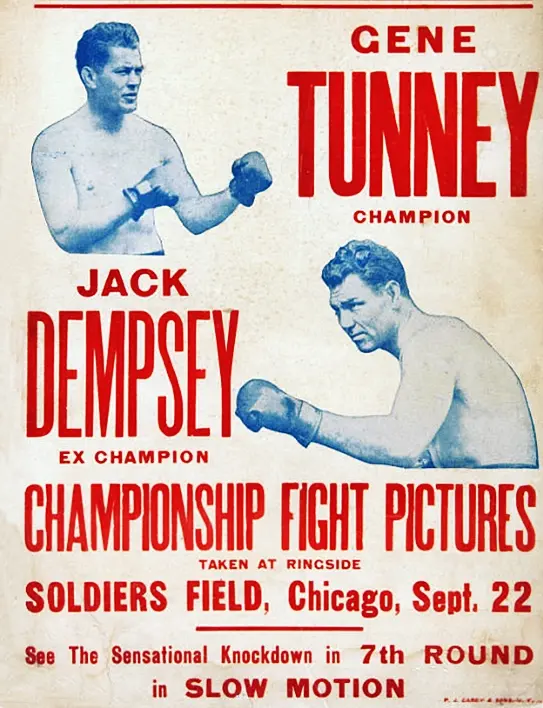
Watching the official motion pictures of the Tunney-Dempsey rematch feels like peering through a dusty window into a lost world. This isn't the choreographed violence of a modern blockbuster. It is raw, mechanical, and hauntingly quiet. The film captures an era where boxing was the undisputed king of sports, and the stakes felt existential.
The sheer scale of the event is the first thing that hits you. The cameras pan across a sea of hats—over 100,000 people packed into Soldier Field. It makes the grandiosity of contemporary films like North of 36 look like a small-town gathering. The scale is staggering.
The cinematography is functional, yet there is an accidental art to it. The high-angle shots provide a tactical view of the ring that modern broadcasts often sacrifice for intimacy. You see Tunney's lateral movement in a way that feels like a chess match. It’s a stark contrast to the melodramatic framing found in Anna Karenina from the same era.
The heart of this film is the seventh round. This is the sequence that justified the ticket price in 1927 and justifies the restoration today. When Dempsey finally catches Tunney with a devastating combination, the champion goes down. The world stops. This is the moment the 'Long Count' begins.
The film clearly shows Dempsey hovering over Tunney, refusing to go to the neutral corner. The referee, Dave Barry, is seen gesturing wildly. Because of the era’s film speed, the seconds feel elongated, adding a surreal, nightmarish quality to Tunney’s recovery. It is a masterclass in unintentional tension.
Unlike the serialized drama of Who Is Number One?, there is no script here. The drama is emergent. You see Tunney’s eyes clear, his body regain its tension, and his eventual rise at the count of nine—which was actually thirteen or fourteen seconds. The camera doesn't blink. It just records the robbery or the recovery, depending on your allegiance.
For anyone who claims to love the 'sweet science,' this film is mandatory. It is the bridge between the bare-knuckle past and the televised future. It offers a level of authenticity that even the best biopics cannot replicate. You are seeing the actual sweat, the actual fatigue, and the actual confusion of the officials.
However, for a casual viewer, the lack of sound and the flickering frame rate can be a barrier. It requires patience. It is a slow burn that culminates in a few minutes of chaotic brilliance. If you can appreciate the historical weight, it is more gripping than most modern documentaries.
There is no 'director' in the traditional sense, but the editing choices are fascinating. The film spends considerable time on the pre-fight rituals. We see the fighters in their robes, the tension in the corners, and the legendary figures in the crowd. It builds a sense of dread that is surprisingly effective.
The pacing mirrors the fight itself. The early rounds are a blur of movement and missed jabs. Tunney is playing the long game, much like the patient narrative structures seen in The Other Side of the Door. Then, the explosion happens. The film doesn't need music to convey the shift in momentum.
The grain of the film adds a layer of grit. When Dempsey lunges, he looks like a predator from a silent horror film like The Mysteries of Myra. He is a force of nature being outsmarted by a technician. This visual contrast is the film's greatest strength.
Pros:
Cons:
When you compare this to fictionalized accounts of boxing or even other 1927 releases like Believe Me, the difference in 'truth' is palpable. This film doesn't care about your feelings. It doesn't care if the hero wins. It is a cold, hard receipt of a robbery—or a victory, depending on how you read the rules.
The technical limitations are actually a benefit. Without the distraction of color or sound, you focus entirely on the geometry of the fighters. You see how Tunney uses the entire ring, a strategy that was often criticized as 'boring' at the time but looks like genius today. It reminds me of the methodical pacing in Thirty a Week.
Dempsey, conversely, is a relic of an older, more brutal style. The film captures his frustration perfectly. Every time he misses a hook, you can see the kinetic energy go to waste. It’s a tragedy in motion. He was the king of the jungle being defeated by a man with a stopwatch.
The Official Motion Pictures of the Tunney-Dempsey Heavyweight Contest is a cinematic time machine. It is flawed. It is flickering. It is silent. But it is also deeply, undeniably real. It captures a moment where human error and athletic brilliance collided to create a legend.
It works. But it’s flawed. The film doesn't offer the emotional catharsis of a movie like His Father's Son, but it offers something better: the truth. Or at least, as much of the truth as a 1927 camera could handle.
"The Long Count wasn't just a mistake in time; it was a moment where the old world of brawling met the new world of regulation, and the camera caught every agonizing second."
Ultimately, this film is the gold standard for sports documentation. It survived prohibition, the Great Depression, and the advent of television. It remains the most important boxing film ever made because it doesn't just tell us what happened—it shows us why we are still talking about it 97 years later.
Community
Log in to comment.