DbcultAccessing Vault...
6.1/10
Senior Film Conservator
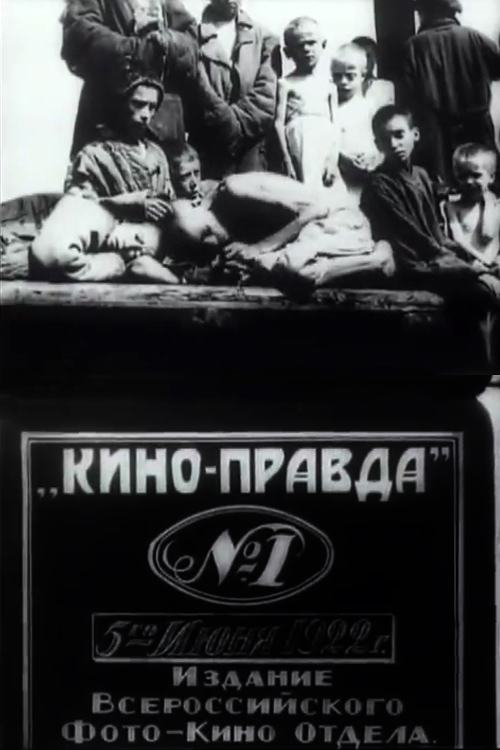
A definitive 6.1/10 rating for a film that redefined the boundaries of cult cinema. Kino-pravda no. 1 remains a cornerstone of transgressive art.
Imagine a strip of nitrate racing past your eyes at twenty-four lies per second, each lie so earnest it forgets to fib. That is the paradox Vertov serves in Kino-pravda no. 1, a cinematic samovar boiling Bolshevik urgency with documentary residue. The title itself—cinema-truth—is a dare, a philosophical hand-grenade lobbed at every melodrama that dared fake life inside painted sets while civil war scars still stank outside.
We open on ice-choked canals: slate-gray water coughing up slabs like history regurgitating monarchs. Cut to a funeral cortege for an unknown martyr; the camera perches on a balcony, voyeuristic yet reverent. Notice how Vertov withholds the corpse’s identity—revolutionary anonymity as narrative hook. The mourners are not characters; they are data points in a living histogram of grief.
Vertov’s lens treats Petrograd like a gigantic orrery whose gears are human sinew. Tram bells sync with intertitles that read like telegram poetry: "Coal for the furnaces of the future." A peasant unloads sacks, his forearms chiseled by scarcity; the next frame shows a bureaucrat stamping ration cards, his ink pad a miniature red square. The montage equation is simple yet lethal: labor + paperwork = utopian calculus.
Compare this kinetic bookkeeping to Three Sevens, where urban ennui gets spritzed with escapist lotto fantasies. Vertov refuses the narcotic of luck; his citizens win bread through sinew, not sevens.
Elizaveta Svilova, often relegated to footnote matriarch status, is the phantom surgeon here. She slices on movement, not blink: a soldier’s boot heel pivots, and presto—match-cut to a locomotive wheel. The body politic and iron horse share a tendon of motion. This is Eisensteinian collision two years before Eisenstein crystallized theory, yet gentler, more playful. Where Sergei will wield dialectics like sledgehammers, Svilova opts for staccato gossip.
Her tempo accelerates during the bread-line sequence: faces loom, dissolve, overlap. You taste flour dust on tongues that never chewed anything today. Hunger becomes a visual refrain, but the montage never wallows; it agitates, then pivots to a shot of telegraph wires humming with promises. The effect is cinematic adrenaline minus sentimental anesthesia.
Mikhail Kaufman—Vertov’s brother, occasional mortal enemy—operates the apparatus like a gymnast betrothed to danger. He straps the camera to motorcycles, dangles it over bridges, lets it slide along icy gutters so the audience imbibes cold through their retinas. In one bravura passage, the camera ascends a smokestack exterior via ropes, surveilling the factory floor below. Workers glance up, some wave, others scowl. The gaze is authoritarian yet flirtatious: state surveillance recognizing its own voyeuristic libido.
This proto-drone shot predates our era of police helicopters and TikTok livestreams, but it also humanizes the watcher; the lens trembles, breathes, almost slips. Technology wobbles, and that wobble is tender.
Detractors dismiss the Kino-pravda series as agitprop pamphlets. True, intertitles trumpet party slogans, yet the images overflow those rhetorical gutters. A child licking spilled flour off his palm undercuts slogans of abundance; two veterans arm-wrestling beside a heating pipe radiate camaraderie more potent than any scripted homily.
Thus the film sits in schizophrenic limbo: commissioned to instruct, compelled to record. That tension births accidental modernism. You could truncate every intertitle and still possess a pulsating visual symphony, akin to watching Sunshine and Gold on mute, letting tap shoes narrate the plot.
Contemporary screenings often append dissonant Shostakovich or rave synths. Both betray the original ethos. Vertov’s ideal spectator composes an internal soundtrack: clacks of printing presses, distant rifle fire, the metallic sigh of a tram rounding bend. Silence foregrounds texture; you hear the emulsion hiss in your mind.
I once attended a basement projection where the accompanist played only a single looped recording of boots stomping wet pavement. That humble thud synced uncannily with the marching shots, proving that minimalism can excavate ghosts simpler than orchestral pathos.
Viewed today, the flicker of Kino-pravda no. 1 feels like a corrupted hard drive vomiting social media fragments. Jump-cuts anticipate doom-scrolling; crowds resemble protest footage geotagged “somewhere global.” The parallel births uncanny déjà vu. When the film lingers on a woman registering to vote, her cautious half-smile could belong to any first-time electorate posting an “I voted” selfie.
Meanwhile, influencers staging authenticity in beige lofts owe Vertov royalties. His candid street portraits pioneered the genre: citizens glance at the lens, unsure whether to perform or bolt. That flicker of decision—captured in 1922—replays endlessly on Stories and Reels.
Histories often segue from Méliès’ trickery to Griffith’s narrative, leapfrogging newsreels. Vertov’s installment demands a corrective. Without these agitated vignettes, would Italian neorealists have smuggled grainy truth onto screens? Would the Nouvelle Vague have birthed cinéma vérité? Even the selfie-documentary impulse—see The Stubbornness of Geraldine—traces lineage here, though Geraldine’s narcissism would make Vertov sneer.
Modern 4K scans iron out blemishes, yet those scratches tell stories: fire, flood, bureaucratic neglect. One damaged segment—featuring a poster of Lenin half-torn—mirrors Russia’s own ideological erasures. To restore is to risk anesthesia; to leave decay is to honor history’s bruises. Archives currently adopt a hybrid ethic: stabilize, don’t cosmetically blanch.
If you stream a pristine edition, project it onto a wall, then superimpose your own shadow occasionally. You become rephotography, a living watermark acknowledging time’s abrasion.
Yes, but not as homework. Treat it like a mixtape from a tipsky comrade who bootlegs reality. Watch on a laptop at 3 a.m., headphones in, city sirens bleeding through your window. Note how the past slivers into your present, how the montage neurons spark recognition.
Then go outside at dawn and film a street-cleaner hosing trash. Upload it raw. Congratulations—you’ve joined Vertov’s eternal newsreel, whether algorithms boost you or not.
Seventeen minutes of Kino-pravda no. 1 won’t dictate utopia, but they remind us that every image is a vote for the society we’re silently scripting—frame by frame, cut by cut.
IMDb —
1921
Community
Log in to comment.