DbcultAccessing Vault...
Cult Review
Senior Film Conservator
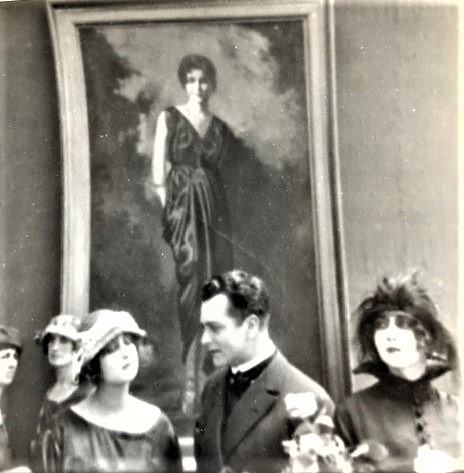
Imagine a canvas so saturated with cobalt spite that the pigment itself seems to throb like a bruise; now imagine that canvas is a marriage. La verità nuda drags the viewer through the splintered corridors of that marriage, past busted plinths and half-chiseled torsos, until the only thing left unsculpted is the scream lodged in Adeline’s throat. Marcello—yes, the one-hit enigma who vanished into Fascist fog—never gives that scream a soundtrack; instead he lets the intertitles burn like after-images, white scars on black leader.
The film opens on the Rome Salon, a cathedral of gaslight and envy. Adeline’s Persephone Unbound stands center stage: marble so alive it appears to inhale. Pierre’s triptych beside it—The Flaying of Marsyas—drips carnelian across the floorboards. Together they form a diptych of creation and flaying, a prophecy the couple is too drunk on applause to heed. Marcello’s camera glides past velvet elbows and gilded laurels, finally resting on Adeline’s gloved hand as it squeezes Pierre’s wrist—possessive already, a sculptor marking her clay.
“Glory is a corrosive pigment; it eats the canvas from within.”
Enter Countess Wanda, shot like a shard of obsidian against the Salon’s chalky opulence. Helena Makowska plays her with the languid cruelty of a cat who has already lapped the cream and now wants the dish. She commissions Pierre with a single sentence that sounds like a perfume ad: “Paint me as the moment before a scream.” He obliges, not knowing the commission is a Trojan horse wheeled straight into Adeline’s studio.
The pivotal seduction amid Hadrian’s ruins is staged like an archaeological rape. Moonlight is chiseled by broken columns into prison-bar patterns across Wanda’s back. Marcello superimposes a slow dissolve of Adeline atop the arch, a ghosted witness whose eyeballs become the film’s first casualty. Blindness arrives not with a melodramatic swoon but with a cutaway to a lizard blinking—one frame of darkness, then permanent night. The symbolism is scalding: to see too much is to be struck sightless by the gods, a reverse Actaeon torn apart not by hounds but by perspective itself.
Back in Rome, Adeline’s atelier resembles a morgue. Marble dust hangs like flour in a butcher’s back room. She gropes her unfinished Orpheus, fingers tracing the hollow where the head should be. Marcello traps her in a diagonal chiaroscuro: work-lamp from below, windowless void above. Each chisel strike lands with the thud of a spade on wet earth. When the statue’s arm snaps under her trembling grip, the fracture sounds like a tibia—an audio cue the film repeats later when Pierre’s rib is nicked by the bullet. Art and flesh share identical bones.
Unable to sculpt, Adeline fondles the revolver the way a nun fingers rosary beads. The weapon is a blunt metaphor, yes, but Marcello desexualizes it: the barrel is never phallic, rather a black pupil staring back at her absent gaze. Suicide, she whispers, is “the final exhibition where the critic is oneself.”
Meanwhile, Pierre’s studio glows arsenic-green—the color of decadence and mold. Wanda lounges on a divan upholstered in peacock feathers, whispering logistics: Swiss sanatoriums, forged dementia papers, the slow erasure of a wife. Their dialogue is intercut with Adeline’s soundless corridor crawl, her white hand dragging along the wall like a slug leaving phosphorescent mucus. The cross-cutting builds to a crescendo: Adeline’s palm smears green paint from the doorframe, a tactile omen that she is already inside the conspiracy, pigment under her nails.
When she kicks the door open, the revolver is already speaking in Morse code—three blind stabs of light. The bullet’s trajectory is shown in an avant-garde insert: a cigarette burn on the negative that travels the length of the corridor, bisects the green room, and finds Pierre’s side. Blood blooms on his smock like vermilion brushwork he never intended.
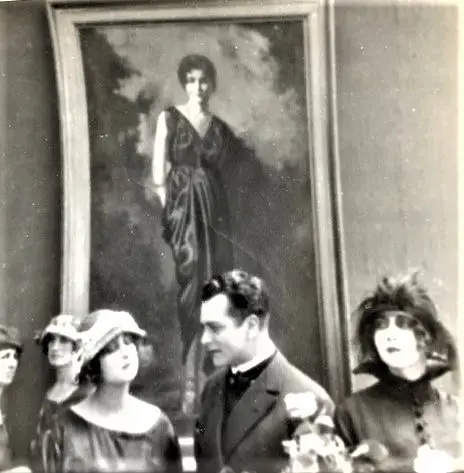
Now comes the film’s most perverse miracle. Adeline kneels, smears her husband’s blood across her eyelids like Pentecostal paint. Her sight returns in a strobic flash—four frames of overexposed white, then clarity. The act is neither medical nor mystical; it is contractual. She has traded death for vision, a barter as old as Persephone’s seeds.
The final reel is a triage of repentance. Pierre, bedridden, becomes her living sculpture. She bandages him with strips of her own abandoned marble dust bags, turning the white cloth umber. In a reverse Pygmalion, the artist is carved by the act of tending. The last shot: Adeline’s hand guides Pierre’s across a fresh canvas, their shared palm-print a bloody iris staring back at us. Fade to carmine.
Livio Pavanelli, usually a cardboard leading man, here plays Pierre like a man who suspects his own pulse is forged. Watch the micro-twitch when Wanda mentions Adeline’s blindness: his pupils dilate as if inhaling poisoned ether. Helena Makowska’s Wanda slinks with fin-de-siècle fatigue, every exhale a bored curse. But the film belongs to Pina Menichelli’s Adeline—her face a battleground where marble dust and tears mix into stucco anguish. In the blind studio sequence she acts with her clavicles: they rise and fall like the broken wings of Icarus, measuring the distance between flight and floor.
Marcello’s cinematographer, Ugo Pericoli, pioneered what scholars now call chiaroscuro sonore: shadows so deep they seem to absorb sound. Notice how Adeline’s silhouette swallows the edges of the frame after her blindness, while Wanda is perpetually haloed by a sickly rim light that makes her look embalmed. The ruins of Villa Hadriana are shot at 4 p.m. Roman winter light—sun low enough to turn every column into a gnomon counting down to catastrophe.
Surviving prints lack composer credits, but the rhythm is baked into the visuals: the scrape of chisel, the wet thunk of clay, the metallic cough of the revolver. Modern restorations often slather it with mournful strings, betraying Marcello’s intent. He wanted the audience to hear their own heart valves slamming shut during Adeline’s blind rampage—a meta-diegetic score of viewer complicity.
Where The Heart of a Painted Woman aestheticizes female suffering into rotable tableaux, La verità nuda grinds suffering into pigment and smears it back on the lens. Conversely, Panopta I uses blindness as cosmic irony; Marcello uses it as moral indictment. The closest tonal cousin might be Hattie’s Hoodoo where vengeance is also a restoration of sight, albeit through supernatural rather than psychosomatic means.
For decades La verità nuda languished in the shadow of Rossellini’s Rome, deemed too baroque for neorealist tastes, too vicious for bourgeois salons. Yet its DNA splices everywhere: in Obsession’s green-room paranoia, in Basic Instinct’s predatory brushwork, even in Portrait of a Lady’s ruin-kisses. The film’s true heir is Paul Verhoeven, who borrowed its venereal color palette for Basic Instinct and its moral vertigo for Elle.
To sit through La verità nuda is to emerge with pupils scorched, as if you’ve stared at an eclipse through the barrel of a gun. It is not a film about betrayal; it is betrayal—an act committed upon the viewer’s comfort. Every frame scratches the retina, every intertitle leaves papercuts on the conscience. Watch it once for the narrative thorn-twist, again for the visual libretto, a third time to measure how much marble dust you still carry under your own nails.
In an age that mistakes confession for art, Marcello offers art as confession—bloody, blind, and unforgivably naked.
IMDb 5.6
1922
Community
Log in to comment.