DbcultAccessing Vault...
Cult Review
Senior Film Conservator
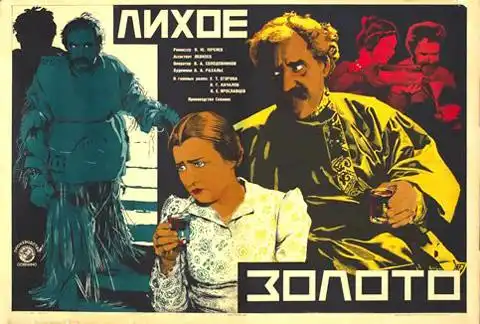
Alright, so Likhoe zoloto. If you’re one of those folks who enjoys digging through old silent films, the kind that feel like a dusty photograph brought to life, then yeah, this might be worth a look. It’s got this real raw, almost unpolished energy to it.
But for anyone needing quick cuts or even, you know, spoken dialogue? You’ll probably find yourself checking your watch quite a bit. It’s a definite niche watch, not for the casual Friday night.
The whole premise, without giving too much away, is about a group of people, kinda desperate, chasing after some hidden gold. But it’s not just any gold; the title itself, Likhoe zoloto, hints at something dangerous, something that brings trouble.
And boy, does it deliver on that trouble. Not in a flashy, action-packed way, but in a slow, creeping sense of dread.
Ivan Kachalov, playing what feels like the main opportunist, really shines here without saying a word. His face, especially those intense, calculating eyes, just tells you everything you need to know about his character’s inner turmoil. You can practically *see* the greed take root behind his gaze.
There's this one scene where he’s just staring at a flickering lantern, and you can feel the gears turning in his head, almost hear the unspoken schemes. It lingers for a long time, maybe too long for some, but it absolutely sells the moment.
Yelena Yegorova, her character feels like the moral compass trying to hold on, or maybe just the one caught in the crossfire. There's a particular shot where she’s framed against a bleak landscape, her shoulders slumped, and it’s just heartbreaking. Like she knows exactly where this whole gold chase is going to end.
You can almost feel the weight of her choices, or lack thereof, pressing down on her.
The film opens on this really stark, almost barren setting, which immediately sets a somber mood. You get a sense of isolation right from the start.
Then there's the initial discovery of the map. It's not some grand reveal; it’s almost an accidental stumble, a quick hand reaching into a dusty corner. But the sudden shift in everyone’s posture, how their eyes snap to attention, that’s where the tension really ratchets up.
One detail I kept noticing was the sheer amount of hand gestures. Since there’s no sound, everyone is *really* selling their emotions with their hands and bodies. Sometimes it feels a little over-the-top, but mostly, it’s just mesmerizing to watch.
There's a sequence where they’re traversing a rocky path, and the camera just follows them, slowly, for what feels like an eternity. It’s not thrilling, but it does make you feel the sheer *effort* of their journey, the weariness setting in.
And the hats! Everyone has these incredibly serious, almost character-defining hats. Kachalov’s hat is practically an extension of his ambition, always slightly tilted, giving him a sort of sly look.
The pacing of Likhoe zoloto is... well, it’s all over the place. Some scenes crawl, allowing you to really soak in the expressions and the atmosphere.
Then suddenly, there's a frantic dash, a sudden betrayal, and it feels like the editor just decided to speed things up for a few frames. It’s a little jarring, honestly, but it also keeps you on your toes.
There’s this one minor character, a grizzled old prospector, who just appears in the background of several key scenes, watching the main group with this knowing, almost melancholic expression. He doesn't do much, doesn’t speak. He's just *there*.
His presence adds this weird, almost supernatural layer to the unfolding greed, like he's seen this story play out a hundred times before. Or maybe he’s just a random extra who really liked being in front of the camera. Hard to tell with these old films!
The climax, if you can call it that, is less about a big bang and more about a quiet implosion. The gold itself, when it's finally unearthed, isn't even shown in all its glittering glory. It's more about the *faces* of the people around it, twisted with obsession and despair.
That choice, to focus on the human reaction rather than the treasure, is actually quite powerful. It makes the 'bad gold' feel less like a physical object and more like a contagious disease.
Honestly, the ending doesn't really offer any clean resolutions. It just sort of… stops. Leaving you to ponder the wreckage of what could have been, and what was lost. Which, for a film this old, feels surprisingly modern in its ambiguity.
If you're into films that make you think, even if they don't always entertain in the conventional sense, give this one a shot. Just remember to bring your patience, and maybe some snacks. It’s a strange, compelling little piece of history.

IMDb 5.4
1935
Community
Log in to comment.