DbcultAccessing Vault...
6/10
Senior Film Conservator
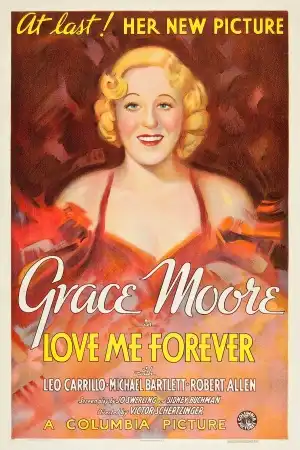
A definitive 6/10 rating for a film that redefined the boundaries of cult cinema. Love Me Forever remains a cornerstone of transgressive art.
So, is Love Me Forever worth digging up today? Well, if you like old Hollywood musicals and don’t mind a story that really leans into the drama, then yeah, probably. It’s got that classic opera diva feel, big emotions, and a bit of heartache. Folks who want something fast-paced or super realistic might find themselves checking their watch, though. This one is for a specific kind of mood.
The whole thing circles around Grace Moore as Margaret, an opera singer trying to make it big. Then there's Leo Carrillo as Mr. D'Andrea, this restaurant owner who just *adores* her. Not in a creepy way, mostly.
He sees her talent, believes in her, and basically throws everything he has at getting her to the top. This happens even though it's clear she doesn't love him back. It’s a classic setup for serious longing looks and grand gestures.
One scene sticks with me. D'Andrea, he's just watching Margaret perform. You can see it in his eyes. He’s not just an admirer, he’s truly invested.
It’s not just about her voice. It's about what she represents to him, some pure beauty. He's practically glowing. Even when she's singing to someone else, or when she's just oblivious to him. It’s a *heavy gaze*, that one.
The musical numbers are, as you'd expect, a big part of it. Grace Moore really belts it out. Her voice is strong, no doubt.
But sometimes the opera scenes feel a bit... long. You know? Like the movie pauses for a full concert. Some are great, sure.
There’s a particular moment where she’s singing. The camera just pushes in slowly. It shows the crowd’s reaction. It’s effective.
Then another number starts. You think, "Okay, we get it, she can sing."
And the sacrifices D'Andrea makes. He loses his restaurant, goes into debt. All for her career. It’s this endless well of devotion.
There’s a moment he's talking to his old business partner. The partner is just baffled by D'Andrea’s choices. D'Andrea just shrugs.
It's like it's the most obvious thing in the world to give up everything. For a woman who doesn't even see you that way. It’s kind of heartbreaking, but also, you want to shake him a little. 🤦♂️
The pacing, sometimes it drags its feet. There are these long stretches of talking. Characters explain their feelings. It doesn’t always move things along.
Then suddenly, something big happens. Like a *major* career break. It feels a bit rushed. The film tries to convince you this moment is huge, but it just kind of… happens.
It’s interesting how the film handles the "does she know?" question. Margaret seems genuinely appreciative. But also a little self-absorbed, as divas often are.
There’s a scene where she gives him a small gift. A thoughtful gesture. But it’s clear she views him as a very dedicated friend, a patron. Not the great love of her life.
And D'Andrea just takes it. Accepting his role. Which is just… *oof*. You feel for the guy.
Other characters drift in and out. There’s a tenor, Michael Bartlett. He's a rival for Margaret's attention. He’s pretty generic, honestly.
Just a handsome face to complicate things. His scenes felt a little like filler. To give D'Andrea something to be jealous about, I guess. He doesn’t really leave much of an impression beyond "the other guy."
The ending, without giving anything away. It leaves you with a feeling. Not necessarily happy, not necessarily sad. Just… resolved.
Like, "this is how these stories go." It doesn't tie everything up in a neat little bow. I actually appreciate that. It lets the lingering emotions just hang there a bit.
A small detail I noticed: the way they showed the change in D'Andrea's fortunes. One minute he's in his bustling restaurant. The next he’s in a much smaller, quieter place, looking worn. They don't make a big deal of it.
No dramatic music or anything. It's just *there*. A quiet visual cue that spoke louder than any dialogue. That was nicely done.
If you're into films from the 30s. Especially ones centered on music and *big* feelings. Give it a shot. It's not a masterpiece that redefines cinema. But it’s a solid melodrama.
It’s a good example of that era’s storytelling style. A bit theatrical. But with a genuine heart struggling underneath all the opera.
IMDb 6.7
1933
Community
Log in to comment.