DbcultAccessing Vault...
8.2/10
Senior Film Conservator
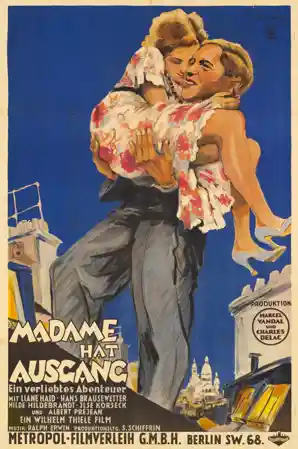
A definitive 8.2/10 rating for a film that redefined the boundaries of cult cinema. Madame hat Ausgang remains a cornerstone of transgressive art.
So, you’re wondering if Madame hat Ausgang is worth digging up these days? Well, it’s not for everyone, for sure. If you love early talkies, especially German ones with that particular charm from before things got really dark, then yes, it's a curious little gem. Folks who need modern pacing or big twists might struggle, but if you appreciate a simple story about finding yourself, it's a sweet watch. Think of it as a nice, quiet evening with a piece of film history. 🕰️
The premise is pretty straightforward: a wealthy woman, Evelyn, played by the lovely Liane Haid, finds out her husband, Robert (Ernst Pröckl), is being unfaithful. Instead of throwing a fit or a plate, she decides to just… leave. Not permanently, not exactly a divorce, but she takes on a whole new identity as a chambermaid, Mathilde, for a nice, regular guy named André (Albert Préjean). It’s her way of figuring things out, I guess, and maybe making her husband realize what he’s lost.
Liane Haid is just radiant in this role. There’s a scene where she first tries on the maid’s uniform, and you can see this mix of playful mischief and genuine uncertainty on her face. It’s not just a costume; it’s a whole new world opening up for her. Her eyes really sell the transition, from the bored society wife to someone a bit more alive, even with an apron on. ✨
Albert Préjean as André is also quite endearing. He’s got this easygoing, almost melancholic vibe that works so well against Haid's brightness. You can almost feel the movie trying to convince you this moment matters when he gives her a simple compliment about her work, and she just beams. It’s a quiet kind of romance building, not flashy at all. Just two people slowly connecting, unaware of her real background.
The pacing, naturally, is a bit slower than what we're used to now. There are these long takes, letting scenes breathe, which is kind of nice. But then, some moments feel a touch stretched, like when André is just staring out a window for what feels like a minute. You almost expect something profound to happen, but no, just a man looking at a window. Still, it makes you pay attention to the little things, like the way the light hits the wallpaper. ☀️
There's this moment when Evelyn, as Mathilde, is trying to clean something, and she’s just… not good at it. She’s fumbling with a broom, looking utterly lost. It’s a small detail, but it makes her transformation feel more real. It’s not just an instant switch; she actually has to learn how to be a chambermaid. It’s actually quite funny to watch. 🧹
And the husband, Robert? He’s sort of a secondary plot point for a while. You see him getting increasingly frantic, trying to find his missing wife, which is satisfying in its own way. He starts to look a bit haggard, realizing the depth of his mistake. It’s not overly dramatic, but you get the picture. He’s paying for his actions, you know?
The film doesn't lean too heavily on grand pronouncements. It’s more about the little gestures, the shifts in expression. The dialogue is snappy enough for an early talkie, especially when Haid gets to deliver a wry line or two. You can tell they’re still figuring out sound, sometimes the music swells a little awkwardly, then fades too fast. A little charming, actually, the imperfections. 🎶
One thing that sticks with me is the sheer contrast between Evelyn’s two lives. Her old apartment is all heavy fabrics and ornate furniture, almost suffocating. Then her new "work" environment, while modest, feels lighter, more open, even a little cozy. It’s a simple visual trick, but it really works to underscore her emotional journey. She’s trading gold for genuine connection, maybe.
If you're into the history of cinema, especially how actors adapted from silent films to talkies, Haid and Préjean offer a good case study here. They don't overact their lines, which could easily happen with early sound. They keep it understated, letting their expressions do a lot of the work, a skill carried over from the silent era. It’s something to appreciate. And hey, for a bonus, check out The Stolen Jools to see even more early sound experiments with various stars. That one’s a hoot. 😉
Is the ending totally satisfying? Well, it ties things up in a neat little bow, as these kinds of stories often do. It doesn't break new ground, but it leaves you with a warm feeling. It’s a gentle resolution. You don't get a huge, dramatic confrontation; it’s more subtle. Like, "Oh, so that's how it plays out."
This isn't a film that’s going to redefine your understanding of cinema. It’s a pleasant, slightly old-fashioned diversion. A peek into a different time, with some genuinely charming performances. Worth a watch if you're in the mood for something quiet and sweet, and don't mind a leisurely pace. Don't expect fireworks, but you might find a little spark. ✨
IMDb 5.7
1928
Community
Log in to comment.