DbcultAccessing Vault...
Cult Review
Senior Film Conservator
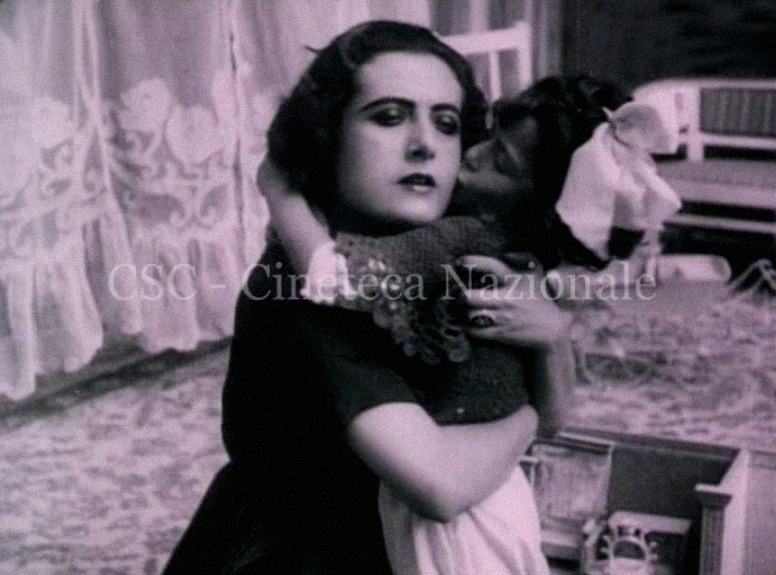
In the chiaroscuro twilight of 1914 Italian cinema, when the medium itself was still learning to breathe, Maddalena Ferat arrives like a chandelier hurled into a crypt—an Émile Zola adaptation that refuses to behave like polite heritage. It is less a film than a séance: Francesca Bertini, the ur-diva of the silent era, incarnates the eponymous heroine with the feral languor of a cat that has memorised every corner of its cage and now tests the tensile strength of its own claws.
The plot, skeletal on paper, becomes viscous on celluloid. A married woman, a former lover, a husband whose sanity unspools like frayed organza—none of these are archetypes here; they are geological strata, each tremor registering on the faces of actors who understand that in silent film the close-up is both scalpel and confession booth. Director Vittorio Bianchi stages adultery not as titillation but as thermodynamics: every glance exchanged between Maddalena and Jacques (Giovanni Gizzi) sucks oxygen from the room, leaving the supporting players literally gasping in softer focus.
Cinematographer Giuseppe Pierozzi shoots interiors through veils of cigarette haze and lace curtains—an oneiric softening that turns marble floors into black ponds. When Maddalena glides across them in heeled mules the sound you almost hear is not footfall but ice fracturing. Note the recurrent motif of mirrors: each reflection is fractionally delayed, so the viewer senses a ghost-self trailing the heroine like an uncredited double. By the time she peels off her gloves to press palm-to-palm with her own reflection, the film has already told us that desire is a form of autophagy.
Bertini’s acting manifesto was "to redden from within"; watch the arterial blush that creeps up her clavicles when Jacques brushes past her in the hallway. It is not rouge—early colour tinting was hand-applied frame by frame, and the amber wash on her décolletage pulses like a heart murmur. Opposite her, Gizzi wields stillness as weaponry: his Jacques leans against balustrades with the negligent cruelty of someone who already knows the final page of the book. Mario Parpagnoli, as the cuckolded husband, performs madness by degrees—first the distracted straightening of non-existent cufflinks, later the operatic tearing of silk drapes, each rip synchronized to intertitles that grow shorter, more staccato, finally dissolving into single words: "MADDALENA. MADDALENA. MADDALENA."
Zola’s novel Madeleine Férat is a forensic study of sexual memory; transplanted to Lombardy, the story absorbs Catholic guilt the way fabric absorbs wine. The screenplay excises the novelist’s determinism but keeps the hereditary taint—look for the cameo of a syphilitic uncle skulking in the garden, his cane tapping a Morse code of ancestral doom. The Italian censors of 1914 demanded that suicide be punished; Bianchi obeys by punishing the audience instead with a final shot that lingers forty-seven seconds longer than comfort allows, the lake’s surface re-solidifying over Maddalena as though she had never broken it.
Contemporary exhibitors were encouraged to accompany the last reel with Chopin’s Marche funèbre played adagio sostenuto. Yet in the 2021 restoration screened at Il Cinema Ritrovato, the curators opted for a minimalist drone that swells imperceptibly until it matches your own heart rate, then cuts to absolute quiet the moment Maddalena’s head slips beneath water. The effect is not sadness but sensorial amputation—you become aware of the phantom limb of sound, a negative space louder than any chord.
Place Maddalena Ferat beside Malombra and you see two Italian divas weaponizing madness against the backdrop of belle-époque decay; both films stage female pathology as architecture—villas that breathe, corridors that menstruate. Contrast it with Sins of Ambition, where adultery is a social transaction, and you realise how radically Bianchi refuses to moralise. Or set it against Please Get Married, a comedy of remarriage released the same year—watching both in a double bill would be like sipping absinthe after bubble tea.
Read post-colonial undertones in the husband’s silkworm enterprise: cocoons imported from China, white mulberry groves irrigated by diverted rivers—capital extraction mirroring marital consumption. Maddalena’s body becomes the final colony, mapped, exploited, abandoned. Yet the film also whispers a counter-myth: her suicide is not defeat but a refusal to be inscribed any longer on ledgers of male property. The lake is not grave but portal; the ripples rewrite her name in unreadable alphabets.
Until 2018 only a 9.5 mm Pathé fragment survived, mislabelled as A Black Sheep. A nitrate print surfaced in a São Paulo monastery vault, complete except for the second reel which had decomposed into what restorers poetically call "honeycomb lace". The Cineteca di Bologna used AI interpolation to reconstruct missing frames, then toned them sepia to distinguish art from artefact; the result is ghostly but never gimmicky. Stream the 4K restoration on Criterion Channel or purchase the region-free Blu-ray from Il Nuovo Cinema Edizioni, which includes an essay on Bertini’s influence on La voix d’or.
To watch Maddalena Ferat is to consent to a mild haunting. Days later you may find yourself pausing at reflective surfaces, half-expecting a delayed echo of your own gesture. The film survives as both artefact and wound, a reminder that early cinema did not merely record bodies but x-rayed souls. In an age when every frame can be memed and flattened, here is 71 minutes that refuse to fit a TikTok attention span—they spill, they stain, they refuse to be wiped clean. Accept the stain; it is the colour of extinct roses, and it will not come out in cold water.
IMDb 5.7
1920
Community
Log in to comment.