DbcultAccessing Vault...
6.3/10
Senior Film Conservator
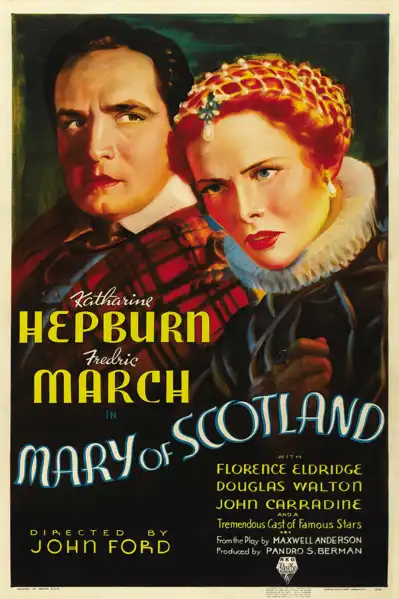
A definitive 6.3/10 rating for a film that redefined the boundaries of cult cinema. Mary of Scotland remains a cornerstone of transgressive art.
If you are looking for a historically accurate documentary, go watch Nanook of the North instead. But if you want to see Katharine Hepburn wearing collars so big they look like satellite dishes, Mary of Scotland is absolutely worth your afternoon. 🏰
People who love old-school studio melodrama with lots of fog and shadows will eat this up. Anyone who gets annoyed by Americans pretending to be Scottish with zero effort will probably turn it off in ten minutes.
John Ford directed this, which feels weird because there are no cowboys or dusty trails. Instead, we get a very theatrical, slightly clunky adaptation of a stage play that sometimes feels like it's trapped in a very expensive cardboard box.
Hepburn plays Mary Stuart, who comes back to Scotland to rule but basically everyone is a jerk to her. Her half-brother is plotting, the lords are whispering, and then there is Fredric March.
March plays Bothwell, and I swear he didn't even try to do a Scottish accent. He just shouts his lines with this big, boisterous American theater voice, like he walked into the wrong movie set on his way to a pirate film. 🏴☠️
Yet, somehow, it kind of works?
There is this one scene early on where Mary arrives in the thick Scottish fog, and the lighting is just gorgeous. It looks like a painting, even if you can tell the fog is coming from a machine just off-screen.
I kept staring at John Carradine’s hands in this movie. He plays David Rizzio, Mary’s Italian secretary, and he has these incredibly long, spindly fingers that seem to have a performance of their own.
Also, did anyone else notice the guard in the background during the first court scene? His helmet is totally crooked, and he keeps trying to nudge it back with his shoulder without anyone noticing. 😂
When Rizzio gets murdered—which isn't a spoiler, it's history—the shadows on the wall are incredibly creepy. Ford really knew how to use shadows, even when the script got a bit wordy and dry.
Speaking of the script, Dudley Nichols wrote it, and he sometimes forgets that people need to breathe between sentences. It's very noble, very dramatic, and occasionally very boring.
If you've seen the 1932 Madame Butterfly, you know how these 1930s studio films love to pile on the tragic romance until it hurts. This one does that too, especially in the second half.
The romance between Mary and Bothwell feels... rushed? One minute they are arguing, and the next they are looking at each other like they want to eat each other's faces.
And then we have Florence Eldridge playing Queen Elizabeth. She is fantastic, honestly. She plays Elizabeth like a cold, calculating chess player who is also slightly insecure about her hair.
Her scenes are the best part of the movie, even though she and Hepburn only share the screen at the very end (which never happened in real life, but who cares about history anyway?).
That final trial scene is where Hepburn really shines. She stands there, looking absolutely tiny against these massive stone walls, but her voice just cuts through the room like a knife. 🗡️
You can feel the movie trying so hard to make you cry at the end. It almost works, but then the music swells up so loud it kind of ruins the mood.
Still, there's a charm to this kind of big, messy studio filmmaking. It's not perfect, and it definitely runs about fifteen minutes too long.
But if you want some heavy-duty 1930s drama with great lighting and John Carradine being weird, you could do a lot worse.
IMDb 6.5
1925
Community
Log in to comment.