DbcultAccessing Vault...
Cult Review
Senior Film Conservator
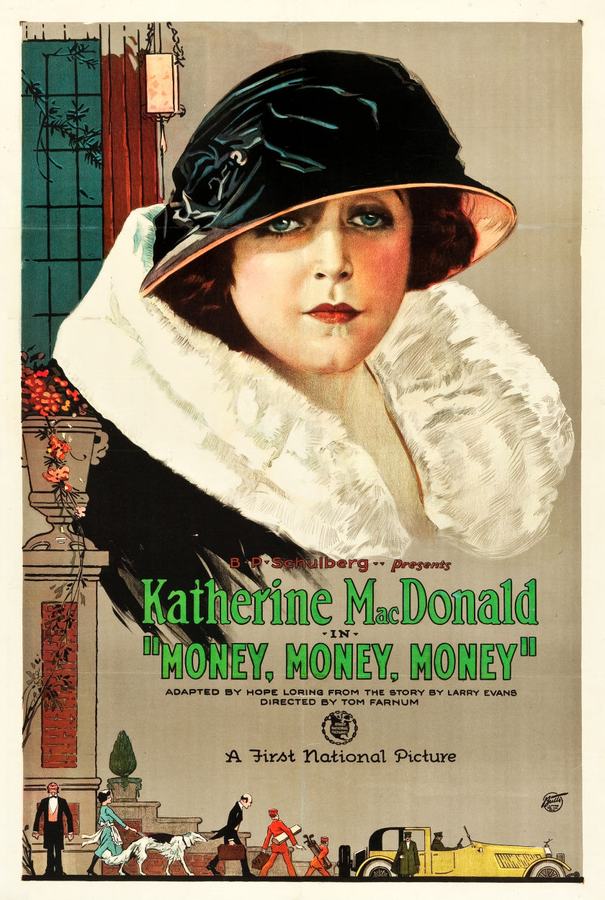
The silent era often functioned as a cultural mirror, reflecting the anxieties of a burgeoning American middle class obsessed with the veneer of aristocracy. In the 1923 production Money, Money, Money, writers Hope Loring and Larry Evans craft a narrative that is less about the currency itself and more about the psychological weight of social perception. It is a film that navigates the treacherous waters of debt and desire with a sophistication that belies its age.
The narrative architecture of Money, Money, Money rests upon the shoulders of Priscilla Hobbs, portrayed with a nuanced blend of vulnerability and calculated ambition by Margaret Loomis. Priscilla is not a villain, yet her actions precipitate a near-catastrophic collapse of her family's stability. Her insistence on borrowing against an unverified inheritance is a quintessential motif of the era—the gamble on a future that may never arrive. This thematic preoccupation with the "big score" or the "sudden windfall" echoes the sentiments found in other contemporary works like The Belle and the Bill, where the promise of wealth dictates the trajectory of human relationships.
George C. Hobbs, played by the capable Carl Stockdale, serves as the emotional anchor of the film. He represents the old-world industrialist—a man of tangible assets (the factory) who is seduced by the intangible promises of his daughter’s social circles. When he enters into a pact with the snobbish Mr. Carter, the film transitions from a domestic drama into a corporate thriller. Carter is the personification of the predatory lender, a character type that would become a staple in American cinema. His desire to acquire the Hobbs factory isn't merely financial; it is a quest for the power that comes with owning the means of production, a theme explored with different tonal shifts in A Girl of the Timber Claims.
The introduction of Reggie Grey, portrayed by Paul Willis, provides the necessary counterpoint to Carter’s cynicism. Reggie is the "New Man" of the 1920s—wealthy by birth but possessing a moral compass that points toward equity rather than exploitation. His realization that Carter is utilizing Priscilla's naivety to stage a hostile takeover introduces a layer of suspense that keeps the viewer engaged. Willis brings a certain athletic grace to the role, a stark contrast to the stiff, over-leveraged postures of the older generation. His intervention is not merely a romantic gesture but a calculated financial maneuver, highlighting the film's sophisticated understanding of banking and partnership.
"Wealth in this film is portrayed as both a shield and a shackle; it protects the ego while binding the conscience to the whims of the market."
Technically, the film excels in its use of interiors. The Hobbs residence is depicted with an increasing sense of claustrophobia as the debt looms larger, while the factory scenes possess a rhythmic, almost mechanical energy. This visual dichotomy underscores the central conflict: the struggle between the productive labor of the factory floor and the parasitic nature of high-finance social climbing. One cannot help but compare this visual storytelling to the gritty realism found in Der Seelenverkäufer, though Money, Money, Money maintains a more polished, Hollywood-centric aesthetic.
The screenplay by Hope Loring and Larry Evans is remarkably tight. Loring, who would later go on to write for major hits, demonstrates an early mastery of pacing. The revelation that the inheritance is significantly smaller than expected is a masterstroke of dramatic irony. It strips away the Hobbs family’s pretenses, leaving them exposed to Carter’s whims. This moment of vulnerability is where the film finds its heart. It forces Priscilla to reconcile her aspirations with her reality, a character arc that mirrors the protagonist's journey in Wanted: A Husband, albeit with higher industrial stakes.
The resolution—a partnership between the Grey and Hobbs families—serves as a metaphor for the stabilization of the American economy post-WWI. It suggests that the volatility of individual ambition can be tempered by the institutional weight of established banking. While some modern critics might find the marriage-as-solution trope a bit convenient, within the context of 1923, it represented the ultimate form of social and financial security. It is a happy ending that feels earned because it is built on the ruins of a failed deception.
Furthermore, the supporting cast adds significant texture to the world-building. Frances Raymond and Brenda Fowler provide the necessary domestic backdrop, illustrating the quiet pressures of the matriarchal side of the household. Their performances remind us that in the 1920s, a family's reputation was a currency just as valuable as gold. This focus on family dynamics and the preservation of honor is a recurring motif in silent cinema, often seen in films like Everywoman's Husband, which deals with the domestic fallout of financial and social choices.
In the broader context of silent film history, Money, Money, Money stands as a testament to the era's ability to tackle complex economic themes through the lens of melodrama. It avoids the slapstick tendencies of something like Pop Tuttle's Clever Catch, opting instead for a grounded, if slightly heightened, exploration of class tension. It is a film that demands to be seen not just as a relic of the past, but as a precursor to the modern financial thriller.
The cinematography, though standard for the period, makes effective use of lighting to differentiate between the warm, albeit false, security of the Hobbs home and the cold, calculating environment of Carter’s office. There is a specific shot of the factory gates that lingers in the mind—a symbol of the lifeblood of the community that is nearly extinguished by the greed of a single man. This visual metaphor for the vulnerability of the working class is a poignant touch that elevates the film beyond mere romance.
Comparing it to the political overtones of Gira política de Madero y Pino Suárez might seem like a stretch, yet both films deal with the shifting tides of power and the impact of those shifts on the common man. Whether it is a political revolution or a corporate takeover, the underlying anxiety remains the same: the fear of losing one’s livelihood to the whims of the powerful.
As we reflect on the legacy of Money, Money, Money, we must acknowledge its role in shaping the narrative tropes of the self-made man and the redemption of the social climber. Priscilla’s journey from a deceptive dreamer to a pragmatic partner is a compelling one. It mirrors the national transition from the Gilded Age’s excess to the more structured industrialism of the mid-20th century. The film’s ability to weave these large-scale themes into a personal, romantic story is what makes it a lasting piece of cinema.
In conclusion, for those interested in the evolution of the American Dream on screen, this film is essential viewing. It offers a window into a world where the stakes were high, the villains were snobbish, and the heroes were those who understood the value of a solid partnership. It may not have the frantic energy of The Road Demon, but its intellectual speed is far more impressive. Money, Money, Money is a rich, rewarding experience that pays dividends to the attentive viewer.
Part of the Silent Era Industrial Retrospective Series
© 2023 Film Critic Collective. All rights reserved.
IMDb 6.8
1925
Community
Log in to comment.