DbcultAccessing Vault...
Cult Review
Senior Film Conservator
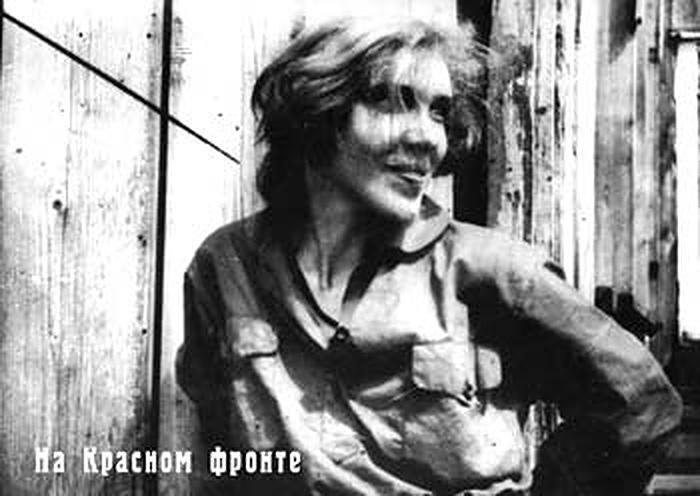
In the frigid, resource-starved winter of 1920, a young Lev Kuleshov set out to the front lines of the Polish-Soviet War, not merely to document the conflict, but to reinvent the very fabric of visual communication. Na krasnom fronte (On the Red Front) stands as a monumental artifact of the Soviet avant-garde, an 'agit-film' that discarded the theatrical lethargy of the pre-revolutionary era in favor of a propulsive, American-influenced dynamism. While contemporary Western films like The City of Tears were exploring the nuances of individual pathos and domestic melodrama, Kuleshov was dissecting the mechanics of the frame itself.
This film was birthed in the 'Kuleshov Workshop,' a collective of radical thinkers who viewed the camera as a tool for engineering perception. With a chronic shortage of raw film stock, every inch of celluloid had to justify its existence. This scarcity bred an aesthetic of extreme brevity—a staccato rhythm that felt alien to audiences accustomed to the long, painterly takes of the Tsarist era. In Na krasnom fronte, we see the embryonic stages of what would eventually become the world-altering theory of montage. It is a film that breathes through the cut, where the meaning of a shot is derived not from its internal content, but from its juxtaposition with its neighbors.
The plot is deceptively utilitarian. A courier (Leonid Obolensky) must deliver a secret report to the headquarters of the Red Army. Along the way, he encounters a Polish spy (played by Kuleshov himself) and a series of obstacles that would define the action genre for decades to come. Unlike the slower, more deliberate pacing found in The Green Swamp, Kuleshov’s work is obsessed with velocity. The chase sequence involving a train and an automobile is not just a narrative beat; it is a masterclass in spatial reconstruction. Kuleshov famously used 'creative geography' here, splicing together disparate locations to create a seamless, imaginary battlefield.
Leonid Obolensky brings a frantic, almost acrobatic energy to the lead role. His performance is stripped of the grandiloquent gestures common in silent cinema, such as those seen in Lulu. Instead, his movements are functional, sharp, and integrated into the film’s overall rhythmic structure. When he leaps across moving vehicles, it isn't for the sake of spectacle alone; it is a manifestation of revolutionary urgency. The inclusion of Aleksandra Khokhlova adds a layer of 'eccentric' acting—a style the workshop championed to move away from psychological realism and toward a more graphic, expressive form of performance.
To categorize Na krasnom fronte merely as propaganda is to ignore its formal audacity. While it served a didactic purpose—rallying the masses during the Civil War—it also functioned as a laboratory. Kuleshov was deeply enamored with American detective films and westerns, particularly the works of Griffith and the rugged adventure seen in The Bulldogs of the Trail. He sought to marry this 'American' pace with a distinctly Soviet ideological framework. The result is a film that feels remarkably modern, even a century later.
The film’s structure is episodic, yet tightly coiled. Each sequence is designed to elicit a visceral reaction, a 'shock' to the viewer’s system. This stands in stark contrast to the sentimentalism of films like My Little Sister or the moralistic weight of The Family Honor. Kuleshov doesn't want the audience to weep; he wants them to move. The camera is often placed in precarious positions, capturing the dust of the road and the smoke of the locomotive with a gritty realism that predates the polished artifice of later Soviet epics.
One cannot discuss this film without touching upon the theoretical breakthrough it represents. During the filming and subsequent editing, Kuleshov realized that the sequence of shots was more powerful than the shots themselves. This is the 'Kuleshov Effect' in its primitive, raw state. By cutting from the courier’s determined face to the churning wheels of a train, or to the encroaching threat of the Polish spy, Kuleshov creates a psychological tension that exists entirely in the mind of the spectator. This was a radical departure from the 'tableau' style of filmmaking, where the camera acted as a static observer of a stage play.
Compare this to the narrative linearity of Matching Billy or the whimsical diversions of In Slumberland. Kuleshov’s editing is aggressive, almost violent. He uses the cut as a weapon, carving out a new reality from the chaos of the war. The film’s climax, a frantic pursuit that culminates in the delivery of the dispatch, is a rhythmic crescendo that leaves the viewer breathless. It is cinema as a machine—efficient, powerful, and relentless.
While Na krasnom fronte may lack the epic scale of Battleship Potemkin, it is the foundational text upon which Eisenstein and Pudovkin built their masterpieces. It is the 'missing link' between the early pioneers and the golden age of Soviet montage. The film’s focus on physicality and the 'objectness' of the human body influenced a generation of filmmakers who sought to deconstruct the bourgeois obsession with the individual soul. In Kuleshov’s world, the courier is a gear in the revolutionary machine, and his success is a victory for the collective.
Even when compared to the technical innovations of sports films like The Corbett-Fitzsimmons Fight, Kuleshov’s work feels more intellectually grounded. He wasn't just capturing movement; he was organizing it into a philosophical statement. The film’s use of natural light and location shooting gives it a documentary-like texture that contrasts sharply with the studio-bound aesthetics of The Love Net or Little Miss Happiness.
Watching Na krasnom fronte today is like looking at the blueprints for the modern action thriller. The DNA of the 'chase movie' is visible in every frame. The way Kuleshov handles the geography of the train—the interior cabins, the roof, the passing landscape—prefigures the sophisticated spatial logic of Hitchcock or Miller. It is a film of 'firsts,' a daring experiment conducted in the heat of battle. While some might find its ideological messaging heavy-handed, one cannot deny the sheer formal brilliance of its execution.
In the broader context of silent cinema, where films like Law of the Land or The Bar Sinister were refining the grammar of social drama, Kuleshov was looking toward a future of pure visual energy. He understood that the screen was not a window, but a canvas. Na krasnom fronte is the moment that canvas was slashed and reassembled into a new, terrifyingly beautiful shape. It remains a vital, electrifying piece of cinema that demands to be seen by anyone interested in the origins of the moving image. Its legacy is not just in the history books, but in every cut that makes us lean forward in our seats, every sequence that prioritizes the rhythm of the heart over the logic of the mind.
Reviewer’s Note: This film is a rare example of a work where the constraints of its production—the lack of film, the wartime conditions—actually enhanced its artistic value. It forced Kuleshov to be smarter, faster, and more innovative than his peers in the West, resulting in a piece of art that feels as urgent today as it did in 1920. It is a stark reminder that great cinema is born not from excess, but from necessity.
IMDb 4.8
1926
Community
Log in to comment.