DbcultAccessing Vault...
Cult Review
Senior Film Conservator
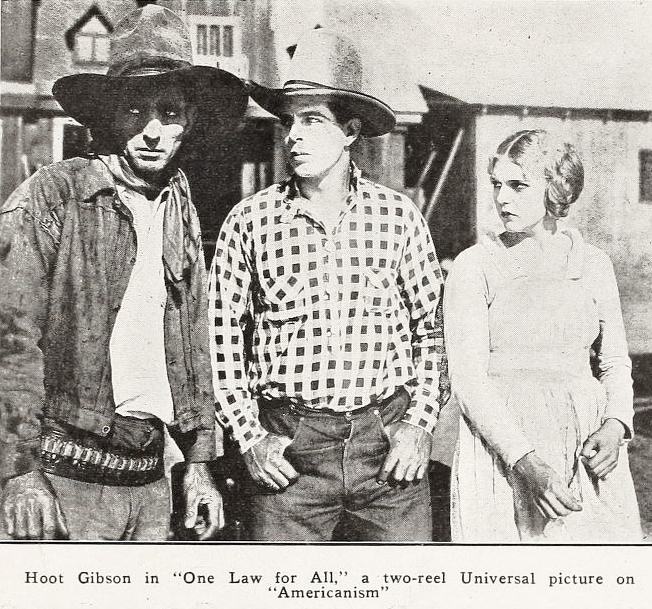
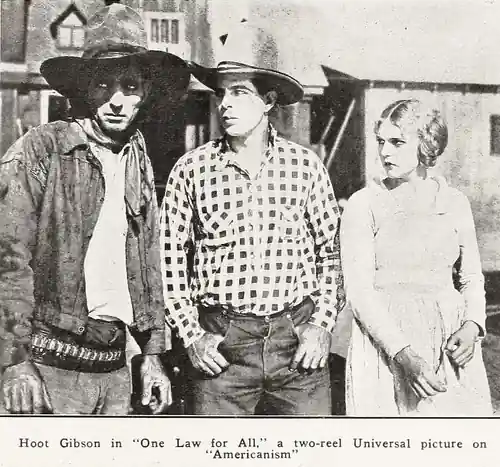
Ford Beebe’s 1927 bullet of celluloid, One Law for All, arrives like a wanted poster nailed to the inside of your eyelids: crude, sun-bleached, yet inked with a lyricism that refuses to flake off.
The film pretends to be a B-western, but its marrow is pure existential opera. Hoot Gibson—usually a laconic rodeo clown—here sports the hollow gaze of a man who has already died in another language. Every time he shrugs on that too-tight leather vest, it looks like he’s zipping himself into a new nationality. Watch how he practices tipping his hat in the barbershop mirror: the gesture repeats until it becomes an incantation, a negotiation with his own reflection over who gets to claim the face.
Dorothy Wood, ostensibly the love interest, is less a paramour than a customs agent of the heart. She sizes up El Águila with the cold appraisal of a woman pricing contraband, her lacquered smile a checkpoint. Their courtship scenes—shot in over-exposed daylight that bleaches the desert into a white canvas—feel like interrogations. When she finally kisses him, the intertitle reads: “Welcome to the States, stranger.” The kiss itself is off-camera; we see only the shadow of their silhouettes merging into an eagle-shape on the adobe wall, a visual pun that would feel ham-fisted if it weren’t so eerily erotic.
Jim Corey and Leo D. Maloney provide the film’s Greek-chorus of nativism. Corey’s sheriff—part P.T. Barnum, part border-patrol algorithm—keeps rewriting town ordinances faster than the typist can scroll: yesterday a foreign accent is merely comic; tomorrow it’s probable cause. Maloney’s preacher, meanwhile, weaponizes scripture into a deed of sale: salvation, cheap, payable in English only. Together they embody the film’s thesis: citizenship is less a birthright than a protection racket.
Technically, the picture is a hodgepodge that should collapse under its own patchwork. The opening reel is tinted amber like preserved grasshoppers; midway, the tint shifts to sickly green—maybe the lab ran out of dye, maybe Beebe wants us to feel the nausea of rebranding. Yet the inconsistency becomes philosophy: identity here is a misprint you must learn to love. The editing is elliptical, almost Soviet. One moment El Águila is plowing a field; the next he’s wearing a deputy star. The missing steps aren’t continuity errors—they’re the ellipses of immigrant experience, the months lost to paperwork, bribes, and the slow erasure of accent.
The score, long vanished, survives only in cue sheets: “Play something galloping but broken,” reads one marginal note. Contemporary festivals often substitute nuevo-tango or dusty trip-hop, but silence works best. Silence lets you hear the squeak of Gibson’s too-new boots, the papery rasp of the naturalization certificate as it’s unfolded for the thousandth time, the faint crack of identity splitting like dry cedar.
Comparisons? Try Nobody’s Wife where marriage also functions as passport, or The Hoosier Schoolmaster whose rural classroom becomes crucible of belonging. Yet neither dares the savage brevity of Beebe’s finale: a single iris-in on the protagonist’s new surname, freshly stenciled on a mailbox, blowing away in the sandstorm. Roll credits. No encore, no redemption aria.
Modern viewers may flinch at the stereotypes—greaser bandoleers, cantina floozies—but the film knowingly weaponizes them. The camera lingers on these clichés until they curdle, revealing the gaze that invented them. When El Águila finally dons a ten-gallon hat, the mirror shows not triumph but burlesque: the hat is too large, swallowing his head until he becomes a cartoon, a living minstrel act for whiteness. Beebe’s indictment is not of the immigrant but of the host country that can only read the alien through the funhouse glass of stereotype.
Restoration-wise, the surviving 35 mm print is Swiss-cheesed: emulsion pits look like bullet-holes, scratches like spurs dragged across flesh. Yet the wounds feel intentional, as if the film itself has crossed a desert to reach us. The eye adjusts; soon the gaps become negative space where your own immigrant anxieties pool. You half expect the missing frames to contain the moment you yourself were naturalized, or rebuffed, or learned to mispronounce your own last name.
So, is it a great film? Hardly. Its pacing lurches like a wagon with square wheels; its politics veer between empathy and opportunism; its gender dynamics deserve a whole thesis on the fetishization of passport brides. But greatness is the wrong yardstick. One Law for All is a campfire tale told by a country to itself, equal parts brag and shiver. It survives as a palimpsest: every new scratch, every warped sprocket, is another immigrant’s fingerprint. To watch it is to be drafted into that chain of restless ghosts, shuffling toward a frontier that keeps receding the closer you get.
Verdict: 8/10—flawed, feral, and essential. Required viewing for anyone who has ever had to translate their own laughter into another tongue.
IMDb 5.9
1937
Community
Log in to comment.