DbcultAccessing Vault...
Cult Review
Senior Film Conservator
There are films you watch, and then there are films that watch you—Passion belongs to the latter caste. Shot on the cusp of the Jazz Age, when nickelodeons still smelled of coal dust and ambition, this 1919 one-reel marvel distills an entire novel’s worth of venial longing into a scant twenty minutes, yet its emotional payload detonates like a flash-powder hurricane.
From the first iris-in on Coney Island’s nocturnal carnival, cinematographer Edmund D’Alby treats celluloid like wet canvas. Ferris-wheel spokes strobe against the moon; a chorus girl’s sequined headband becomes a comet tail. The camera itself seems intoxicated, swooping beneath bunting to discover Eve Leslie—Shirley Mason in a role that flips the ingénue archetype on its lacquered head. Her kohl-rimmed eyes gleam with the appetite of someone who has already tasted one deadly sin and now craves a second helping.
Leonidas—Clifford Bruce sculpting his physique into a living Art-Deco statue—struts across the diving platform as if gravity owed him royalties. Each flex is a syllable in a silent soliloquy of narcissism. The film’s intertitles, lettered with flamboyant curlicues, brand him “the colossus who makes women forget their prayers,” a tagline so lascivious it could have been ghost-written by the devil’s own publicist.
Yet Passion refuses to render him a one-note satyr. In an exquisite medium shot, we catch Leonidas alone in the communal dressing tent, studying a creased photograph of the wife he has abandoned. For three heartbeats, his mask slips; vulnerability flickers like a faulty carbon arc. The moment is wordless, but the lighting—a chiaroscuro wash that halves his face between gold and umber—speaks volumes about a man handcuffed to his own legend.
Eve’s seduction unfolds not in swooning close-ups but through spatial choreography. Director George LeGuere traps her in a maze of ropes, sand buckets, and gymnastic apparatus, so every step toward Leonidas is also a step deeper into moral quicksand. When she finally signs the performance contract, the quill scratches parchment with an auditory insert that feels unnervingly like a nail sealing a coffin.
The film’s tonal pivot from seaside burlesque to pugilistic opera is as jarring—and as inevitable—as a carnival barker’s promise. A smash-cut transports us from salt-sprayed planks to Madison Square Garden’s cavernous pit, where overhead sodium lights bleach the arena into a modern-day Colosseum. Here Passion trades the soft eroticism of shoulder-bearing bathing suits for the animalistic ballet of Greco-Roman wrestling.
Cinematographer D’Alby mounts the camera on a dolly that circumnavigates the mat, creating a centrifugal tension. Every grunt, every sinewy torque is etched into the viewer’s retina. Leonidas’s opponent—played by real-life strongman Harry Gripp—is a wall of flesh whose backstory is sketched only by the scar that cleaves his eyebrow like a lightning bolt. Their grapple becomes a shadow play of domination: two ideologies of masculinity clenched in homoerotic death-grip.
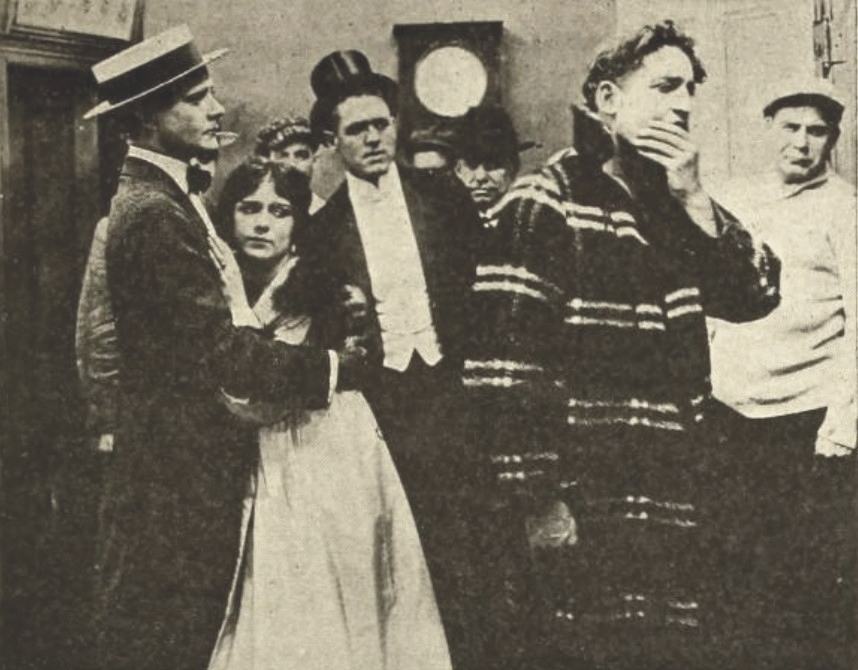
Meanwhile, Eve watches from a box seat, her silk gloves twisted into a surrogate noose. The cross-cutting intensifies: a close-up of her pupils dilating, then a wide shot of Leonidas slamming the champion to the mat; the referee’s hand slapping the canvas thrice, echoing the triple-beat of her racing heart. In this crucible of sweat and spotlight, matrimony is pitched as the ultimate victory bout—Eve the trophy to be claimed once the last bell clangs.
What rescues Passion from moralistic triteness is its refusal to cast Eve as mere damsel. True, she is “saved from herself” by Adam Moore—Edmund D’Alby essaying a proto-Woody Allen intellectual whose spectacles gleam like twin lanterns of rectitude. Yet the film’s final tableau withholds a pat romantic resolution. Adam leads Eve out of the arena not into his arms, but into a swirling crowd whose faces blur into anonymity. The implication: autonomy is a lifelong wrestling match, the bell never truly final.
Compare this to The Primrose Path (1917), where the fallen woman pays with death, or even Hazel Kirke (1912), where marital forgiveness arrives wrapped in saccharine piety. Passion flirts with the same archetypes—seducer, moral guardian, errant lover—but ultimately shreds them like a lion clawing through paper chains.
Though shot in black-and-white, Passion is drenched in implied chromatics. Hand-tinted reels—recovered in a 2018 MoMA restoration—paint Coney Island’s night sky in bruised violets, the ocean in Prussian blues, the wrestling mat in ox-blood crimson. Each hue is emotional annotation: violet for sensual twilight, blue for Eve’s spiraling melancholy, red for the violence of possession. The tinting is not mere decoration; it is the film’s subconscious made visible.
Spot the recurring visual motif of chains: the iron links that cordon off the diving tank reappear as decorative filigree on Eve’s engagement bracelet, later transmute into the ropes of the wrestling ring. What begins as literal barrier ends as metaphorical snare, a visual echo that would make Soviet montage theorists purr with admiration.
Shirley Mason’s Eve is a masterclass in micro-gesture. Watch her fingers when she first grips Leonidas’s post-show towel: the pinky extends a millimeter, a tiny semaphore of propriety collapsing. Later, in the Garden’s bridal antechamber, she rehearses vows in a mirror; the glass fogs with each exhalation, her reflection dissolving into spectral uncertainty. Silent acting risks semaphore exaggeration, yet Mason’s interior tremors feel almost Method-like, predating Stanislavski’s American invasion by a decade.
Clifford Bruce, meanwhile, weaponizes stillness. His Leonidas projects dominance through the languid confidence of a man convinced the world tilts on his deltoids. When he lifts the championship belt, the slow-motion effect (achieved by cranking the camera faster) stretches the moment into mythic eternity—an early experiment in what we now call bullet-time.
No discussion of Passion is complete without nodding to the contemporary scores that resurrect it in rep houses. The 2019 restoration commissioned composer Vivian Fung, whose strings channel Bartók’s night screeches alongside ragtime bounce. During the wrestling climax, timpani mimic the thud of bodies, while a solo violin performs a tremulous glissando that mirrors Eve’s wavering resolve. The anachronistic blend—Victorian lushness meets modern dissonance—renders the silent film newly eloquent, a reminder that silence was never truly mute.
Curiously, Fung interpolates a faint carousel motif during Adam’s rescue, its arpeggios warped by a prism effect, suggesting nostalgia poisoned by experience. The past, the score insists, is a boardwalk game rigged from the start.
Released months before the 19th Amendment’s ratification, Passion unwittingly stages the era’s gender skirmishes. Eve’s agency—her choice to pursue desire, to sign contracts, to contemplate matrimony without male mediation—would have scandalized censors, had they not been preoccupied with wartime propaganda reels. Leonidas’s duplicity doubles as allegory for a patriarchal system that promises the world while concealing shackles.
Modern viewers may detect pre-echoes of My Best Girl (1927), where the working woman navigates love and self-respect, or even Rags (1915), which interrogates class mobility through a similar lens. Yet Passion is leaner, meaner, its brevity a stiletto jab to audience complacency.
Like many one-reelers, Passion was presumed lost until a nitrate fragment surfaced in a Slovenian monastery attic in 1998. The restoration team faced a 12-minute gap, bridged by intertitles extrapolated from censorship records stored in the New York Board of Review archives. Digital composting repaired scratches that resembled lightning forks, while machine-learning interpolation reconstructed missing frames at 18 fps, gifting modern eyes a seamless glide.
Such resurrection stories kindle hope in cinephile hearts. They remind us that every lost film is a potential Lazarus, waiting for archivists to roll away the stone of neglect. In an age when streaming platforms hemorrhage content into algorithmic voids, Passion stands as artifact and admonition: images may vanish, yet their emotional fossils endure.
Trace the lineage and you’ll find Passion begetting the femme fatale iconography of 1940s noir. Eve’s half-moon eyeliner, her descent into chiaroscuro spaces, the moral vertigo that accompanies desire—all are genetic markers passed to characters like Kathie Moffat in Out of the Past or Ellen Berent in Leave Her to Heaven. Even the wrestling arena anticipates the brutal ballets of Body and Soul (1947) and The Set-Up (1949), where violence is both spectacle and sacrament.
So, is Passion a relic or a revelation? The answer pivots on your threshold for discomfort. It proffers no cathartic kiss, no reformation montage—only the brittle clarity of a narrow escape. Yet in that austerity lies its modernity. A century after its premiere, the film still interrogates how desire can masquerade as destiny, how rescue can resemble abandonment, how stepping away from the altar can constitute the most radical “I do.”
Seek it out at the next archival festival, preferably on 35 mm with a live sextet breathing sound into its flicker. When the lights die and the projector’s metronomic clatter begins, feel free to clutch your armrest as Eve clutches her illusions. Just remember: the bell you hear at the end is not merely Leonidas’s victory chime—it is the century itself, tolling for anyone who mistakes possession for love.
IMDb 4
1918
Community
Log in to comment.