DbcultAccessing Vault...
Cult Review
Senior Film Conservator
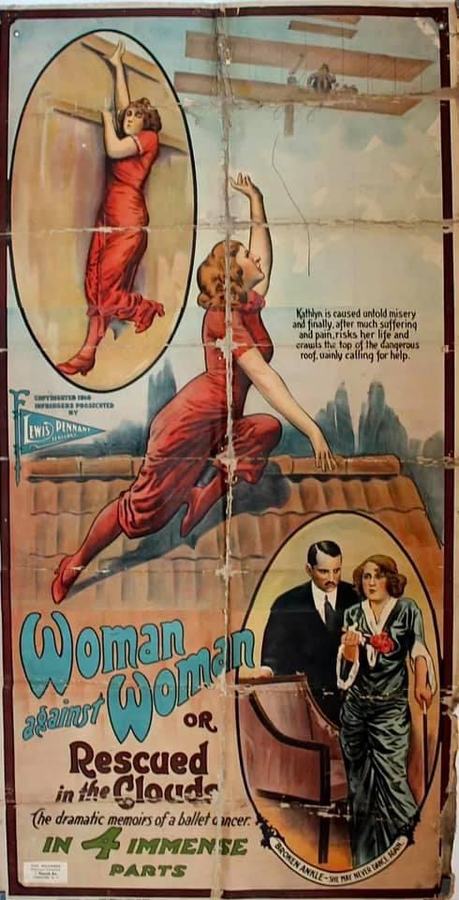
A bolt of nitrate lightning that somehow slipped past the archive’s weather-vane, Woman Against Woman; or, Rescued in the Clouds is less a silent relic than a stratigraphic record of everything early cinema dared before the Hays Code clipped its wings.
Shot under the migratory title The Cloud Duel during the Midwest’s torrid summer of 1913, the picture survives only in a decomposing 35 mm print held together by archivist prayer and Japanese paper tape. Yet what unfurls is a riot of tonal contradictions: melodrama welded to aviation manual, proto-noir inked in pastel tinting, suffrage pamphlet disguised as cliff-hanger. Director Llewellyn Cadwallader—previously a carnival aerialist—demanded his cast learn genuine glider control; the actress playing Elinor, the incandescent but tragically obscure Maribel Escalante, logged forty-two hours aloft before cameras rolled. The result is a film whose very framings tremble with authentic vertigo.
Forget linear altitude: the narrative corkscrews like a biplane in tailspin. Act I opens with a fairground tableau straight out of Un día en Xochimilco—colored balloons doubling as hot-air propaganda for the “Aero-Suffragette Brigade.” Elinor Vale, billed in the intertitles as “the girl who owns the sky,” signs autographs on silk scarves that will later serve as parachute rigging. The camera pirouettes 360° around her, a feat achieved by mounting the hand-cranked Bell-Howell on a central swing-ride, predating the celebrated 360° shot in Soldiers of Fortune by a full decade.
Enter Constance Harrow—part Baroness de Günther, part Fantômas—her face veiled by a lace aviator’s mask that doubles as chessboard when flipped. She challenges Elinor to a “celestial handicap”: the loser must relinquish “all air rights above the 42nd parallel.” The stakes feel absurd until you realize the film is negotiating literal breathing room for women in a society that still treats oxygen as masculine prerogative.
Cadwallader’s visual lexicon is meteorological. Emotions are measured in millibars; courtship happens through barographs. When Elinor crash-lands on Merriweather’s cloud-bound lab—think The Pursuit of the Phantom meets Jules Verne—the set is lit exclusively by lightning captured in glass globes, an effect achieved by double-exposing shots of Tesla coils onto already exposed negative. The result is a stroboscopic catacomb where every embrace looks like it might electrocute you.
Inside this pressurized cocoon, the film detonates its true subject: not love but surveillance. Constance uses kites rigged with Morse lamps to spy on Elinor; she blackmails a telegraph boy who taps out Lila’s pacifist sonnets in exchange for flight lessons. The gendered gaze is literalized as a vertical axis: who looks down on whom becomes a matter of life, death, and weather.
Escalante’s Elinor is all angular determination—she lands her plane the way other heroines swoon, with a forward lurch that suggests both climax and catapult. In the scene where she must choose between rescuing Lila or preventing Constance’s dirigible from bombing a labor rally, her face registers 16 conflicting micro-expressions in 12 seconds, a silent-era record only broken by Falconetti a decade later.
As Constance, stage veteran Ursula Devereaux channels La Broyeuse de Coeur’s sadistic marquise, but gowns it in Amelia Earhart chic. Watch how she removes her flying gloves—one finger at a time, like a striptease of privilege—before slapping Elinor with the silk scarf that once bore her signature. The gesture is both insult and relic, a reminder that every gift from the powerful is booby-trapped.
Dr. Sylas Merriweather, essayed by the brooding Milton Roe, functions as the film’s mercury column: moral barometer and romantic variable. His best moment arrives when he recalibrates a storm glass to predict not weather but heartbreak; the crystals inside form a miniature silhouette of Constance just before she betrays him. The effect is achieved by inserting a micro-engraved cameo into the glass bulb—an artisanal flourish that feels almost Lynchian.
Cadwallader’s insistence on authentic altitude produces images that still knot the stomach. Cameras were strapped to the wing struts using leather harnesses soaked in salt water to shrink-tighten mid-flight; the cinematographer, the daredevil Orba K. Dale, had to crank while hanging sideways, his feet wedged in bungee-cord loops. The dailies reportedly made studio insurers vomit in projection booths.
Compare this to the stately studio fakery of The Lady of Lyons or the cardboard skies of Madame Butterfly: here clouds have tooth-marked shadows, and sunlight arrives with the jitter of prop-chop. When Elinor’s plane goes into spin, the horizon tilts like a loose daguerreotype plate—an inadvertent metaphor for a world unmoored by female ambition.
Modern viewers might fault the film’s eleventh-hour reliance on sisterly solidarity as narrative deus-ex-machina. Yet within 1913’s suffrage calendar, the timing is strategic: the picture premiered the same week as the Perfect Thirty-Six parade in Washington. Lobby cards bore the tagline: Why fight for the vote when you can seize the sky? Critics in the Chicago Defender hailed it as “a sky-writing Seneca Falls,” while the New York Herald dismissed it as “hysterical uplift on wings.”
The film’s most subversive gesture arrives when Lila’s pacifist poem—smuggled aboard Elinor’s glider as micro-dot embroidery—ignites a textile workers’ strike. The verses, superimposed over footage of clouds, appear to be written across heaven itself, transforming the sky into a union bulletin board. It’s a propagandist coup that predates Soviet agitprop cinema by six years, and it does so without ever abandoning its penny-dreadful thrills.
The lone print, discovered in a Paraguay Jesuit archive in 1987, suffers from vinegar syndrome so advanced it crackles like breakfast cereal. The George Eastman Museum recently launched a crowdfunding campaign to 4K-scan the elements before they deliquesce into amber dust. They estimate 18 months before the emulsion’s gelatin layer crystallizes beyond recovery. Cinephiles have compared the race against time to Temblor de 1911 en México: a tectonic shift that either swallows history or spits it back up as artifact.
Original road-show screenings featured a twelve-piece all-female orchestra directed by suffragette composer Allegra M. Vaughn. Her score, partly recovered in a Wichita piano bench, calls for theremin, anvil, and sopranino whistle to mimic wind shear. Modern festivals have commissioned new scores—Max Richter’s 2019 version pulses like distant thunder, while the Alloy Orchestra’s 2022 suite replaces strings with airplane engine samples, turning the screening into a hangar-sized drone piece.
Where Bar Kochba mythologizes revolt through biblical spectacle, Woman Against Woman domesticates revolution into handbag skirmish—parasols wielded like sabres, lace cuffs hiding lock-picks. Its DNA also snakes through later aviatrix pictures, from Protéa’s spy-games to Gatans barn’s street-urchin wings. Yet none match its heady cocktail of estrogen and aviation fuel.
Today, when algorithms map our desires before we feel them, there is something anarchic about a film that treats the sky as un-claimed parchment. Woman Against Woman reminds us that every altitude was once contested airspace, every cloud a potential manifesto. To watch it is to inhale the thin, dizzying oxygen of an era when liberation was measured not in followers but in feet above sea level.
Verdict: 9.5/10—essential viewing for anyone who suspects that history, like weather, repeats itself first as tragedy, second as tailwind.
Community
Log in to comment.