DbcultAccessing Vault...
Cult Review
Senior Film Conservator
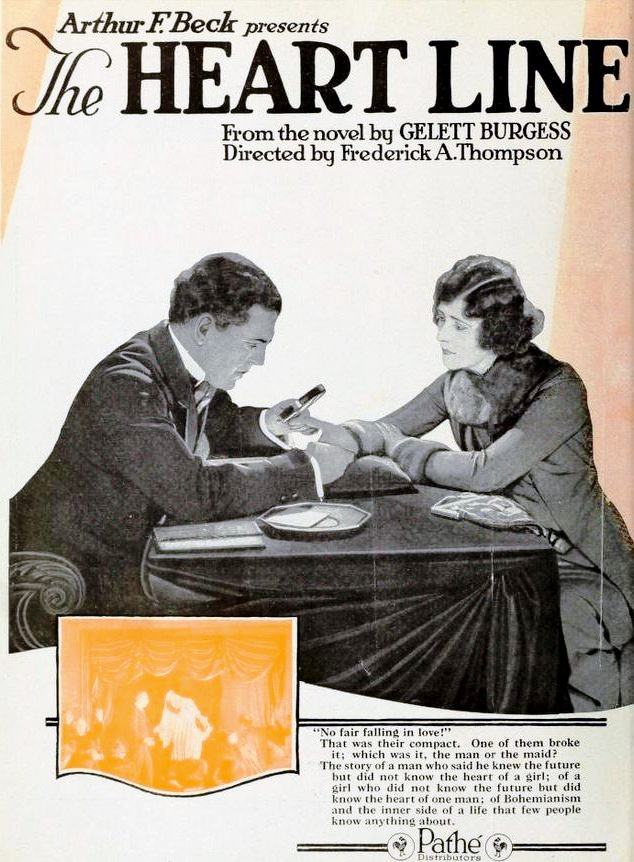
Cinema in 1921 was a medium grappling with its own adolescence, yet The Heart Line emerges as a remarkably sophisticated meditation on the fragility of the human psyche. Directed with a keen eye for the atmospheric tensions of post-war spiritualism, the film serves as a cautionary tale regarding the intersection of wealth and desperation. The narrative begins not with a flourish, but with the visceral weight of tragedy—a locomotive disaster that functions as a structural pivot for the entire story. Oliver Payson, portrayed with a stoic vulnerability by Frederick Vroom, is a man whose financial empire is built upon the shifting sands of a haunted conscience. Unlike the whimsical escapades found in The Fortunes of Fifi, here the stakes are rooted in the permanent scars of loss.
The screenplay, adapted from Gelett Burgess's novel by George Elwood Jenks, avoids the saccharine pitfalls of many contemporary melodramas. Instead, it leans into the shadows of the San Francisco occult scene, a milieu where the line between the ethereal and the fraudulent is perpetually blurred. The introduction of Madame Spoll, played with a delicious, calculating nuance by Mrs. Charles Craig, provides a fascinating look at the economics of the séance room. In an era where the public was reeling from the collective trauma of the Great War, the figure of the 'fake medium' was not merely a villainous trope but a reflection of a burgeoning cultural crisis. Spoll is a predator of hope, a character whose secret—her total lack of supernatural faculties—mirrors the broader deceptions inherent in the film's social strata.
Central to the film's emotional resonance is the burgeoning romance between Clytie Payson (Ruth Cummings) and the enigmatic Francis Granthorpe (Jerome Patrick). Granthorpe is a masterstroke of character writing; he is a man who inhabits the skin of a mystic while harboring a terrestrial secret that threatens to dismantle the Payson household. The chemistry between Patrick and Cummings is palpable, even through the flickering grain of a century-old negative. Their interactions are framed with an intimacy that contrasts sharply with the cold, cavernous halls of the Payson estate. While Restless Souls explored the spiritual malaise of the wealthy, The Heart Line focuses more acutely on the specific mechanics of the 'long con' and the redemptive power of genuine affection.
The subversion of the 'clairvoyant' archetype through Granthorpe allows the film to interrogate the nature of truth. Is a lie told to bring comfort more virtuous than a harsh reality? This philosophical inquiry elevates the film beyond the standard fare of 1921. Granthorpe’s secret—which I shall refrain from spoiling for the modern viewer—serves as a mirror to Madame Spoll’s own charlatanry. However, where Spoll seeks to exploit, Granthorpe seems trapped by his own persona, a victim of the very illusions he facilitates. This duality creates a narrative tension that is far more compelling than the slapstick pacing of Number, Please?, offering instead a slow-burn psychological thriller that rewards the patient observer.
Gelett Burgess, perhaps best known for his 'Goops' and his contribution to the lexicon of 'blurbs,' brings a unique literary sensibility to the proceedings. The film’s title, The Heart Line, refers to the palmistry term, suggesting that our fates are etched into our very flesh. This deterministic theme is reflected in the cinematography, which utilizes tight close-ups to capture the minute flickers of doubt and recognition on the actors' faces. The lighting design, particularly in the séance sequences, employs a chiaroscuro effect that prefigures the film noir aesthetic of the coming decades. The shadows are deep, almost ink-like, swallowing the characters as they reach out for ghosts that do not exist.
The casting of Leah Baird as a pivotal figure adds a layer of gravitas to the production. Baird, a powerhouse of the silent era, understood the economy of movement required to convey complex internal states. Her presence on screen provides a counterpoint to the more theatrical performances of the supporting cast, such as Martin Best and Philip Sleeman. In comparison to the lighthearted themes of Baby Mine or the rugged exteriority of Bare-Fisted Gallagher, The Heart Line feels remarkably modern in its focus on the interiority of its protagonists. It is a film about the stories we tell ourselves to survive the vacuum of the unknown.
At its core, the film is a study of the 'lost child' motif, a perennial favorite of early 20th-century literature that finds new life here. Oliver Payson’s twenty-year search for his partner's son is not merely a plot device; it is a manifestation of his desire to rectify a past that has been calcified by neglect. The search leads him through the underbelly of San Francisco, showcasing a city that is as much a character as the people inhabiting it. The contrast between the high-society ballrooms and the cluttered, incense-heavy dens of the mediums provides a sharp critique of the era's social stratification. While Strictly Confidential dealt with the secrets of the elite through a more comedic lens, The Heart Line treats these social divisions with a somber intensity.
The film also touches upon the burgeoning 'New Woman' of the 1920s through the character of Clytie. While she is initially presented within the confines of a romantic interest, her agency in navigating the deceptions of Granthorpe and Spoll suggests a shift in the cinematic portrayal of women. She is not merely a prize to be won but a discerning participant in the unraveling of the mystery. This nuance is often missing in films of the period, such as Rags or Miss Crusoe, which tended to rely on more static archetypes.
When viewed alongside international contemporaries like the Russian Venchal ikh satana or the German Das Glück der Frau Beate, The Heart Line holds its own as a quintessentially American exploration of the 'self-made' man’s existential crisis. It lacks the expressionistic distortion of the German school but replaces it with a gritty, melodramatic realism that feels uniquely grounded. The film’s preoccupation with the 'secret'—whether it be Madame Spoll’s phoniness or Granthorpe’s hidden identity—resonates with the thematic concerns of Words and Music by - and The Honey Bee, where the disparity between public persona and private truth creates the primary narrative friction.
Furthermore, the film’s pacing is a testament to the editing skills of the early 1920s. The transition from the industrial chaos of the railroad accident to the stagnant, tension-filled rooms of the Payson mansion is handled with a rhythmic precision that maintains a sense of impending revelation. Even in moments that could have felt like filler—typical of the 'healthy and happy' fluff seen in Healthy and Happy—the director ensures that every frame contributes to the overarching atmosphere of dread and discovery. It is a far cry from the disjointed energy of Smash-Up in China, opting instead for a cohesive, novelistic flow.
Ultimately, The Heart Line is a film about the search for connection in a world defined by its absences. Whether it is the lost son, the lost truth, or the lost innocence of a daughter, the characters are all reaching for something that remains just out of grasp. The 'heart line' of the title is not just a palmist's mark; it is the fragile thread of humanity that binds these disparate souls together across decades of deceit. The resolution of the film, while satisfying the requirements of the era’s morality, leaves the viewer with lingering questions about the nature of forgiveness and the possibility of truly knowing another person.
As we look back from a century's distance, the film stands as a remarkable artifact of a time when cinema was discovering its power to explore the unseen. It bridges the gap between the terrestrial and the celestial, the honest and the fraudulent, with a grace that few of its peers could match. It sits comfortably alongside 'Tween Heaven and Earth as a seminal work of early metaphysical drama. For the modern cinephile, The Heart Line is not just a historical curiosity; it is a vibrant, breathing piece of art that continues to pulse with the anxieties and hopes of its time. The performances of Ben Alexander and Ivor McFadden, though smaller in scope, round out a cast that brings Burgess’s world to life with a conviction that transcends the silent medium. This is a film that demands to be seen, not just for its place in history, but for its profound understanding of the human heart's capacity for both deception and devotion.
IMDb 5.7
1930
Community
Log in to comment.